
Committee hears industry-backed bill to raise pawnbroker fees and shorten loan terms
Get AI-powered insights, summaries, and transcripts
Subscribe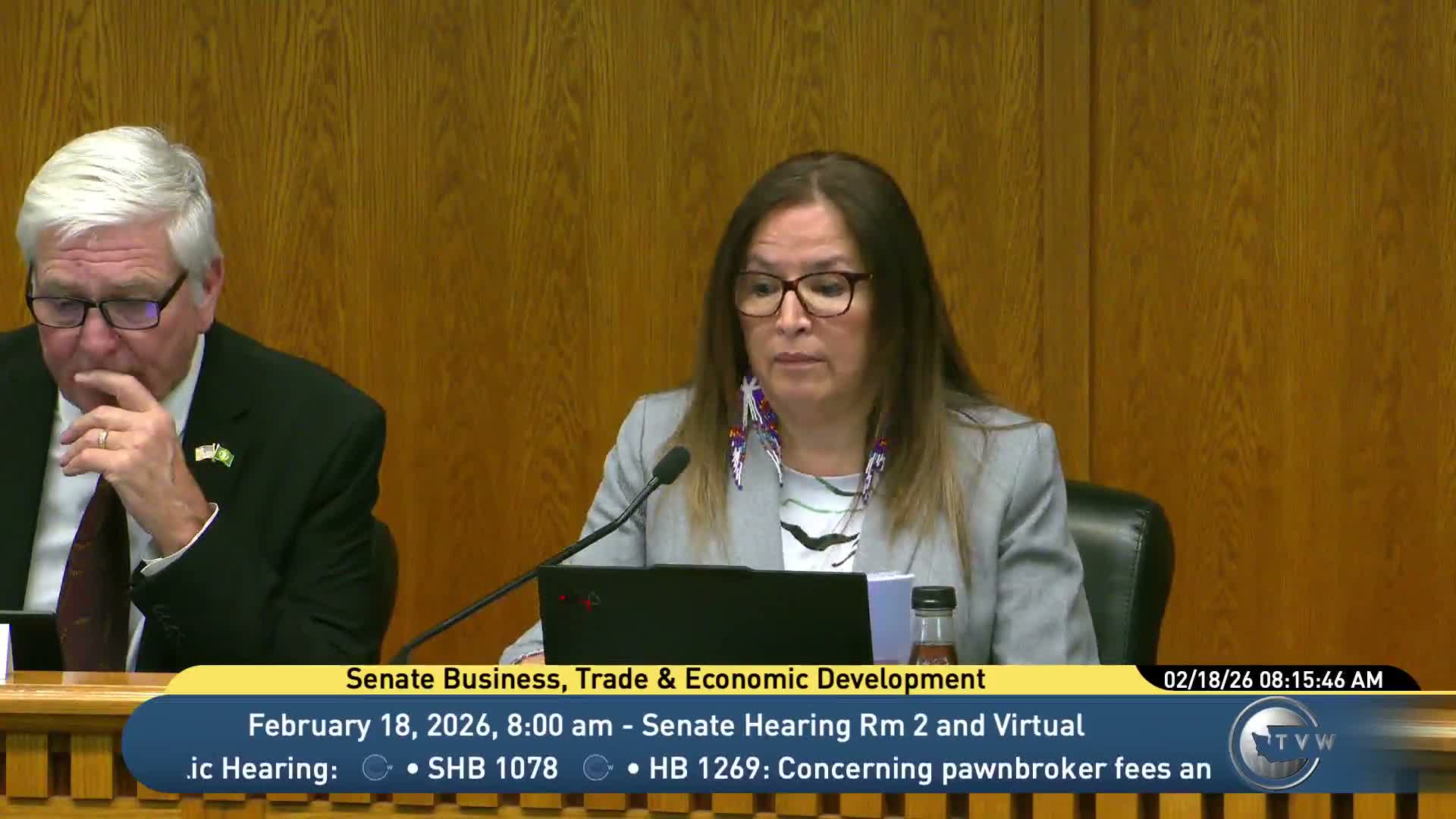
Summary
House Bill 1269 would shorten statutory pawnbroker loan terms from 90 to 60 days, raise the top interest tier from 4% to 5% for loans over $100, standardize document-prep fees and increase optional storage fees; industry witnesses called the changes modest and necessary for business viability, while some senators questioned overall consumer cost impacts.
The committee heard Substitute House Bill 1269 on Feb. 18, a measure proposing multiple changes to the pawnbroker statute: shorten the statutory loan term from 90 days to 60 days, increase the maximum interest rate for loans over $100 from 4% per 30‑day period to 5%, replace a sliding document‑preparation fee with a flat 15% fee for loans of $50 or more, raise optional storage fees (including higher daily storage for firearms) and allow an online payment option for mutually agreed loan extensions.
Industry witnesses, including Tamara Rancourt (Washington State Pawnbrokers), Karen Strickland (PondOne) and representatives from Cash America Pawn and Kittitas County Trading Company, said pawnshops provide a short‑term, nonrecourse lending option for unbanked customers and many shops have not been able to raise fees in 10–11 years. "Pawnshops are community establishments...We're the bank for the unbanked and underserved communities in Washington," said Karen Strickland. Industry witnesses gave redemption statistics, saying roughly 75–77% of loans are redeemed within 60 days and the average loan size is about $150–$200.
Representative David Hackney, the bill’s prime sponsor, said the changes are modest and needed to keep small shops competitive and operational. Industry witnesses and sponsors framed the increases as responses to inflation and higher operating costs.
Several senators expressed concern about cumulative cost effects. Senator Stanford noted that while storage‑fee increases (a dollar amount) can be seen as adjusting for inflation, raising percentage‑based fees (interest and document fees) is not inherently an inflation adjustment and could make many loans significantly more expensive. "When you put all of these changes together...many of these loans are more than double the cost under current law," Stanford said, questioning the characterization of changes as "modest." Industry witnesses replied they were open to collaborate on specific numbers.
What happens next: the committee took public testimony from industry and consumer voices and did not record a committee vote. Sponsors said they are willing to work with legislators on fee levels.