
Senate committee hears 'penny' bill to allow permissive rounding of cash sales
Get AI-powered insights, summaries, and transcripts
Subscribe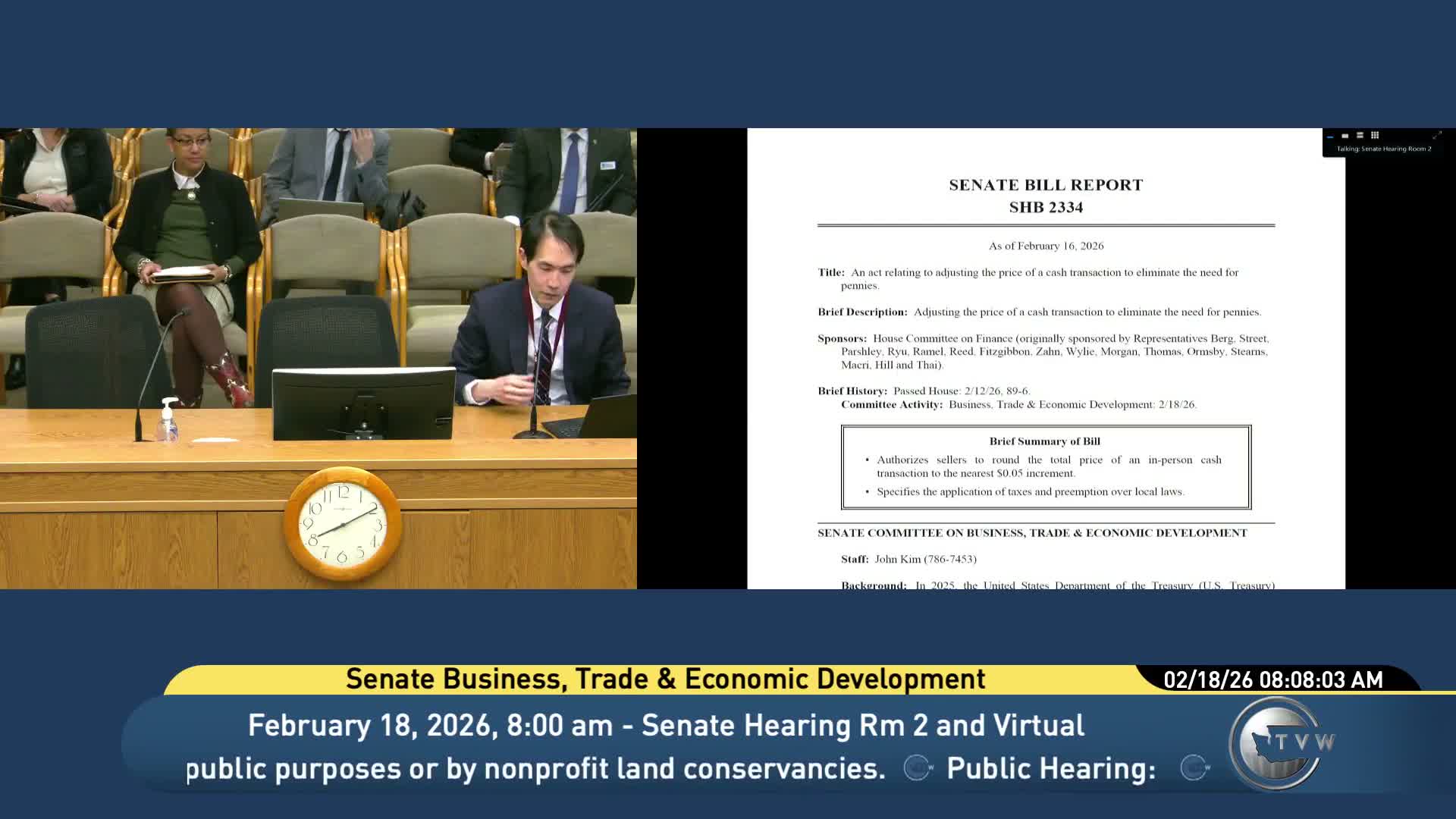
Summary
Substitute House Bill 2334 would allow permissive asymmetrical rounding for in‑person cash transactions after the U.S. Treasury stopped minting pennies; supporters say retailers lack pennies and need legal guardrails, while members asked about signage and mixed‑tender rules; staff and sponsors said rounding would not affect tax calculations and would be permissive.
The Senate Business, Trade and Economic Development Committee heard Substitute House Bill 2334 on Feb. 18, a bill that would permit sellers to round in‑person cash transactions to eliminate reliance on pennies. Committee staff explained the rounding method: totals ending in 1¢, 2¢, 6¢ and 7¢ would be rounded down; totals ending in 3¢, 4¢, 8¢ and 9¢ would be rounded up. Rounding would be applied after sales and use tax so the tax owed is not changed.
John Kim, committee staff, said the bill is permissive for sellers and state and local agencies, applies only to in‑person cash transactions (including rules to handle mixed cash/noncash payments), preempts local laws that prohibit or restrict rounding, and provides immunity for sellers from actions under the Consumer Protection Act for rounding done as the bill authorizes. The Department of Licensing estimated one‑time operating expenditures of $186,000 related to motor vehicle accounts.
Representative April Berg, sponsor, said the federal decision to stop minting pennies left states to provide guidance. Berg said the House worked with the treasurer, local businesses and the Department of Revenue to ensure retailers and agencies are held harmless for rounding and that exact change remains acceptable. "We did not put a signage requirement in this because I felt like it'd be an unfunded mandate to our businesses," Berg said when asked about posting notices at the counter.
Retail trade witnesses testified in support. Molly Poffin of the Washington Food Industry Association and Brandon Huskeeper of the Northwest Grocery Retail Association said many stores can’t get pennies from banks, have been rounding to the nearest nickel, and need state guidance to update point‑of‑sale systems. A citizen who worked in Australia described a smooth transition when pennies were eliminated there.
Committee members asked about mixed‑tender transactions, whether signage should be required and whether rounding is effectively opt‑in for merchants. Sponsors and trade witnesses said the bill’s permissive approach and an explicit safe harbor will provide needed certainty but that some technical drafting tweaks (particularly for mixed tender) may be appropriate.
What happens next: the committee took testimony and discussed possible technical amendments; no committee vote was recorded.