Get Full Government Meeting Transcripts, Videos, & Alerts Forever!
Get email alerts on the Special Education Timeline topic
No spam. Unsubscribe anytime.
Committee considers changes to special‑education evaluation timelines to give parents time to review reports
Summary
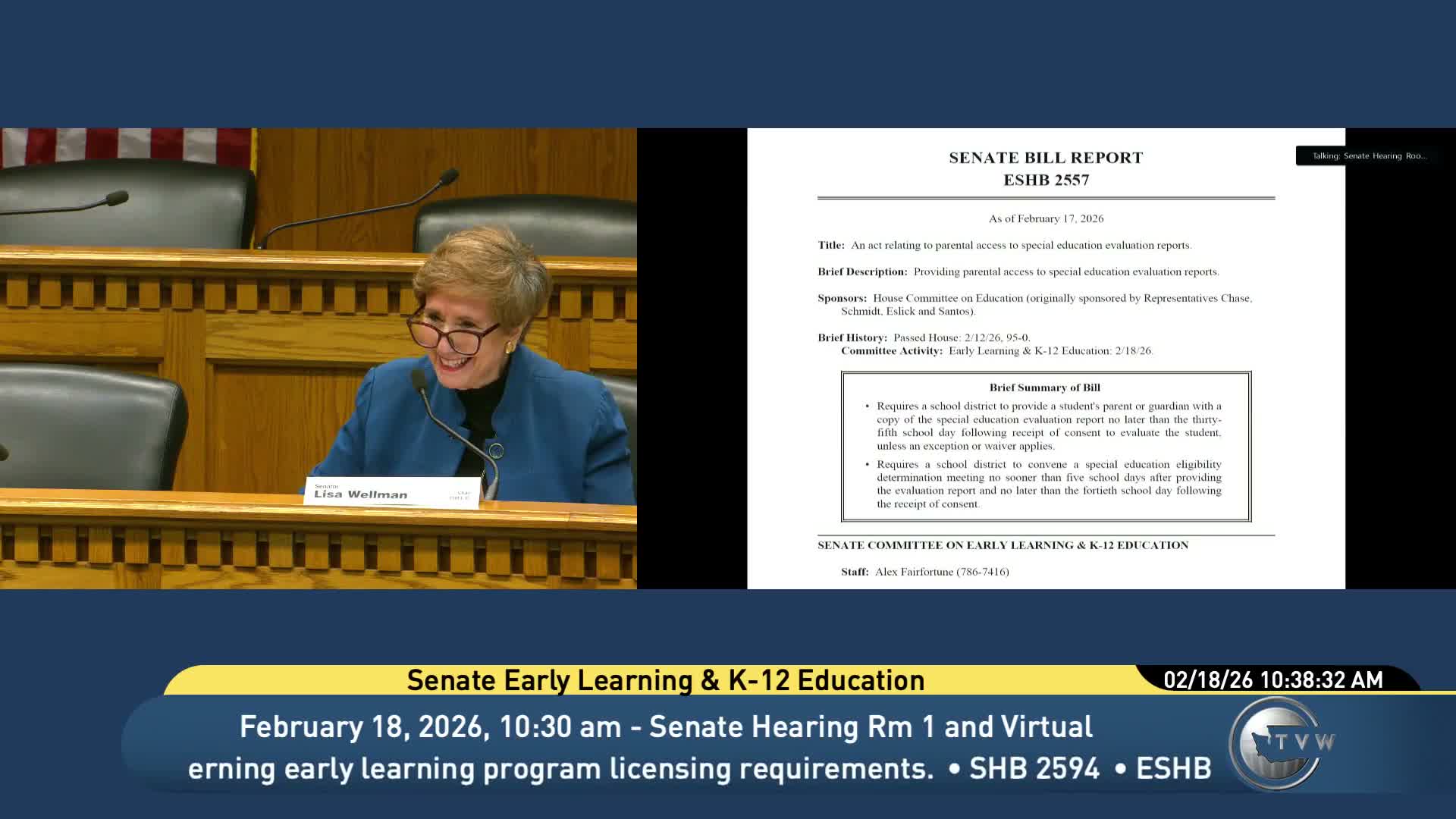
Substitute House Bill 2,557 would require school districts to give parents a copy of special education evaluation reports no later than the 35th school day and hold eligibility determination meetings no sooner than five school days after the report is given, producing an up-to‑40‑school‑day timeline; advocates and OSPI supported the approach with technical amendments to protect both parent participation and district implementation.
Committee staff described substitute House Bill 2,557 as a timeline‑clarifying bill to require school districts to provide parents or guardians a completed special education evaluation report by the 35th school day after consent and to convene an eligibility determination meeting no sooner than five school days after the report is provided, allowing a maximum of 40 school days absent an agreed waiver.
Representatives of the Washington Education Association and the Arc of King County said the five‑school‑day review period protects parents’ ability to meaningfully participate in IEP team decisions. Jared Mason (WEA) described concerns raised by school psychologists about potential lost interaction time and said House amendments addressed the issues; he asked that those amendments remain in the Senate version. Ramona Hattendorf (Arc of King County) described how some parents currently receive reports only during rushed meetings and said the bill provides important review time.
OSPI’s Tanya May told the committee OSPI supports the substitute, noting the approach balances family participation with practicable implementation and that OSPI is pursuing rulemaking to align timelines and shorten referral timelines so the total evaluation process remains consistent with federal oversight. Parent advocates asked for a shorter decision window and clearer waiver language to avoid unintended extension of federal 60‑calendar‑day timelines.
Committee members asked clarifying questions about school days versus calendar days and the practical interactions of weekends and school breaks on timelines; witnesses acknowledged the distinction matters and suggested further discussion. No vote was taken during the public hearing.