Committee hears staff, sponsor say bill clarifies mortgage‑modification priority
Loading...
Summary
Committee staff and sponsor told the Consumer Protection and Business Committee that SB 5,831 would adopt the Uniform Mortgage Modification Act to clarify how many mortgage modifications affect security and priority, creating safe harbors so certain modifications do not change a mortgage’s priority.
Committee staff and the prime sponsor summarized Senate Bill 5,831 on Feb. 18, saying the bill would adopt the Uniform Mortgage Modification Act to reduce uncertainty about how mortgage modifications affect a loan’s security and priority.
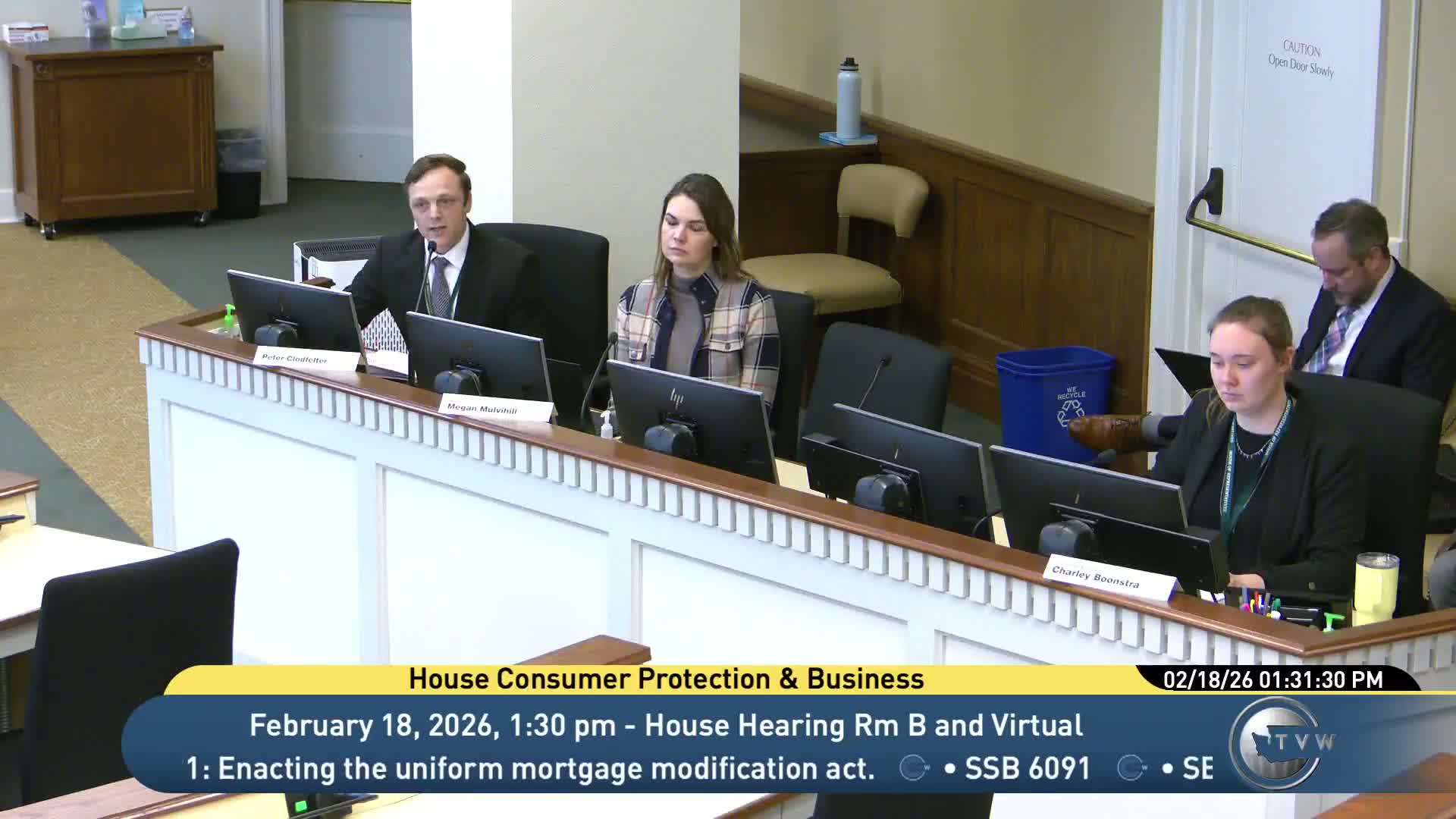
Peter Klotfelter, committee staff, told lawmakers the Uniform Law Commission in 2024 promulgated the Uniform Mortgage Modification Act and that SB 5,831 would "establish provisions controlling the effect of certain mortgage modifications," including a set of safe harbors. He said the bill would treat specified modifications — examples given include an extension of a maturity date (no later than six years beyond the original or most recently recorded modification), reductions in interest rate, principal forgiveness, changes to escrow or insurance requirements, and rate‑type conversions that do not increase interest — as not affecting a mortgage’s priority.
The bill would make clear that these listed modifications do not constitute a novation and that the mortgage "continues to secure the obligation as modified," Klotfelter said. He added that modifications not identified in the bill would be governed by other law and that the bill excludes transactions such as releases or additions to encumbered property, changes in obligor, assignments or transfers of a mortgage.
Sen. Perry Dozier (16th District), the bill’s sponsor, told the committee the legislation "removes some of the uncertainty in law on the priority of modifications," and said the safe harbors could save borrowers the cost and delay of seeking legal advice about whether a modification must be re‑recorded.
No members asked questions during the hearing, and no public witnesses signed in to testify on SB 5,831. The committee closed the public hearing and moved on to other bills on the agenda.