
Senate committee hears compromise to narrow Washington's commercial email law, cutting statutory damages
Get AI-powered insights, summaries, and transcripts
Subscribe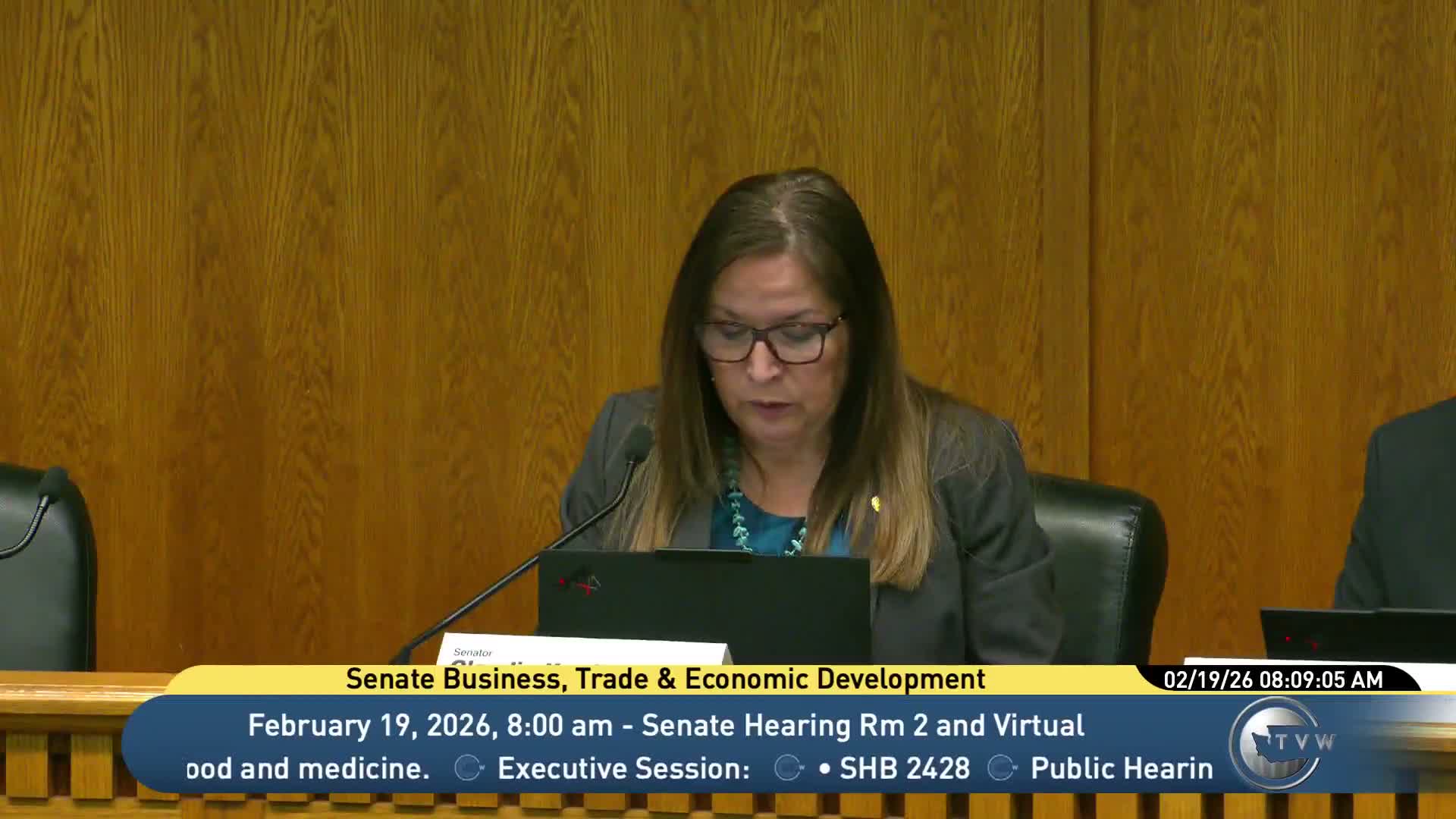
Summary
The Senate Business Committee heard public testimony on SHB 2274, an engrossed substitute that narrows liability under the Washington Commercial Electronic Mail Act (CEMA) by requiring subject lines be knowingly false and reducing statutory damages from $500 to $100, while consumer advocates urged further work on text‑message provisions.
Olympia, Feb. 19 — The Washington State Senate Committee on Business, Trade and Economic Development heard public testimony Thursday on engrossed substitute House Bill 2,274, a compromise measure that amends the Washington Commercial Electronic Mail Act (CEMA).
Representative Larry Springer, sponsor of the companion bill in the House, told the committee the engrossed substitute narrows liability so that a commercial email subject line is actionable only if it is false based on the sender's actual knowledge or knowledge fairly implied by objective circumstances. Springer said the bill lowers the automatic statutory damages in CEMA from $500 to $100 or actual damages if greater, a change intended to protect small retailers while leaving significant exposure for high‑volume senders.
The change follows a recent Washington Supreme Court decision that participants said has led to a surge of litigation focused on email subject lines. "Since June, when our Supreme Court made another ruling, there have been over a 100 lawsuits filed against retailers," Springer said, urging an interim stakeholder process to produce a more permanent solution.
Retail and industry witnesses supported the substitute. Crystal Leatherman of the Washington Retail Association said the proposal "does not dismantle the Commercial Electronic Mail Act" and argued it modernizes penalties to restore proportionality: "When penalties become untethered from actual harm, we worry about the system rewarding volume over genuine consumer protection." Leatherman said the substitute ties liability to what a sender knew or reasonably should have known.
Consumer advocates and trial attorneys described the measure as a compromise they would accept temporarily while pushing for more comprehensive reforms in the interim. Beth Terrell of the Northwest Consumer Law Center and the Washington State Association for Justice said the organizations were not initially included in drafting but later negotiated language they support as an interim step. "First, SHB 2274 clarifies that to violate CEMA, the subject lines must be knowingly false," Terrell said. "Second, it reduces statutory damages from $500 to $100." She urged continued stakeholder work before next session.
Not all testifiers were supportive. Joe Wright, an attorney representing consumers, asked the committee to retain stronger protections for recipients of commercial text messages and cautioned that reducing damages could encourage more commercial text traffic. "Brown has nothing to do with text messages," Wright said, arguing the bill's text‑message provisions are "untethered" from the email litigation driving the debate and urging the committee to remove changes to text‑message damages.
The committee held a public hearing and did not adopt final action on SHB 2274. Sponsors and both industry and consumer groups said they expected further negotiation during the interim.
The committee moved on to other agenda items and later held an executive session on a different bill.