Get Full Government Meeting Transcripts, Videos, & Alerts Forever!
Get email alerts on the Subdivision topic
No spam. Unsubscribe anytime.
Rhinebeck planners hear conservation‑subdivision yield plan for Route 308 parcel; water and trail protections top concerns
Summary
Consultants presented a conservation‑subdivision yield plan that shows up to 11 buildable lots under conventional rules but proposes 10 lots under conservation rules; the Planning Board asked CPL for technical review and continued the public hearing to March 16 after sustained public comment about wells, horse‑trail easements and slopes.
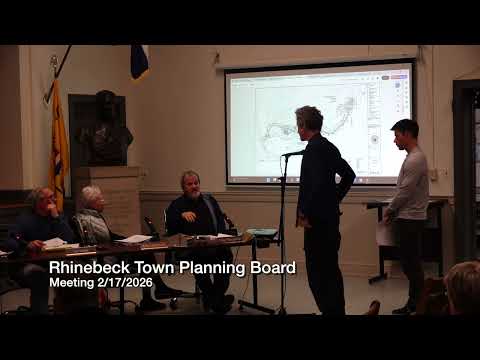
The Town of Rhinebeck Planning Board received a detailed presentation on Feb. 17 for a conservation‑subdivision yield plan on a large parcel north of Route 308. The consultant explained the mapping process used to determine constraints and buildable areas and said that, under conventional subdivision math, the yield plan would allow up to 11 lots but the applicant is proposing 10.
The presenter summarized the process: slope maps, wetlands and buffer mapping, a tree and specimen survey, soil classifications tied to the town’s Jason report, and a secondary conservation map that informed where houses, driveways and retained open space would be located. He said the conservation code requires at least 65% of the parcel to remain as contiguous open space and that shared driveways permitted by the conservation rules would reduce site impact.
Board members pressed technical questions about driveway grades, the feasibility of buildable rectangles on steep slopes and whether the yield plan understates engineering difficulty. Members recommended CPL — the board’s consulting engineer — conduct a targeted review of steep slopes, driveway geometry and groundwater/well impacts before the board makes a determination about feasibility.
Neighbors and community groups spoke during public comment. A neighbor’s letter noted a local 500‑foot well that goes dry twice a year and asked how additional wells would affect existing water supplies; the consultant replied that the proposed plan would rely on separate wells spread across lots, that drawdown tests and monitoring would be performed and that the site’s rock‑fracture aquifer behaves differently from sandy aquifers. Local equestrian stakeholders asked that horse trails shown on the plans be preserved; residents also raised lighting and driveway‑headlight concerns.
After discussion the board voted to continue the public hearing to March 16 to allow CPL and county/state agency reviews to proceed. Board members said they wanted the CPL review and answers about well testing and easement protection before taking any formal yield‑plan action.