Get Full Government Meeting Transcripts, Videos, & Alerts Forever!
Get email alerts on the Council Bill 121158 topic
No spam. Unsubscribe anytime.
Seattle Council passes ordinance to limit city sharing of nonpublic data for immigration enforcement, 8-0
Summary
The Seattle City Council voted 8-0 Feb. 17 to update city code to align with the state's Keep Washington Working law and prohibit city employees from sharing nonpublic personal information for civil immigration enforcement absent a warrant; public commenters urged stronger protections and removal of surveillance cameras.
The Seattle City Council voted 8-0 on Feb. 17 to pass council bill 121158, updating the Seattle Municipal Code to codify provisions of the state’s Keep Washington Working law and to expand prohibitions on sharing nonpublic personal information for civil immigration enforcement across all city departments.
Councilmember Rivera, the bill’s sponsor, told colleagues the ordinance clarifies that "all city employees" are prohibited from sharing nonpublic information for immigration enforcement "absent a warrant or legal obligation to do so," and that the update aligns Seattle law with the state statute. Rivera said the change was a practical step the city can take to protect immigrant residents while noting it “does not preclude further actions.”
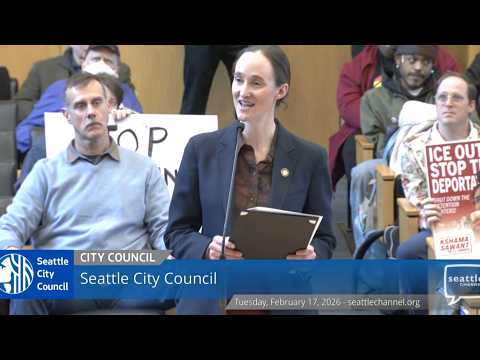
The vote followed an extensive public comment period during which scores of speakers urged the council to go further. Matthew Malloy, a renter and organizer, called for a rollback of the city’s surveillance network, a ban on local agencies sharing any data with ICE and a citywide eviction moratorium for families targeted by immigration enforcement. Gabriel Diaz, who said he witnessed the Cal Anderson protests, urged firings and an independent investigation into police conduct. Dozens of other speakers asked the council to shut down real-time crime centers, remove CCTV cameras, and redirect surveillance funds to community supports.
Councilmember Lynn — who abstained in committee — told the council she supported passage but reiterated concerns about a specific subsection of the ordinance (transcribed in the meeting as section 4.18.015b) that public commenters had flagged. Lynn said she plans to introduce follow-up legislation to align that subsection more closely with the Keep Washington Working Act and the council’s practices.
Councilmember Juarez thanked Rivera and noted the city’s long history of pursuing protections for immigrants; Rivera said she had worked with legal counsel and other offices while drafting the bill to remain within legal bounds.
The ordinance passed unanimously at the dais (8 in favor, none opposed). Council President Joy Hollingsworth announced the chair would sign the legislation and asked the clerk to affix her signature on the council’s behalf.
The passage is the most recent step in a broader local debate about surveillance, police accountability and how municipal governments respond to federal immigration enforcement. Several speakers asked the mayor and council to take additional steps — including an executive order to remove recently expanded CCTV cameras and creation of elected civilian oversight — which the council did not adopt as part of this ordinance.
At the conclusion of the meeting the council moved into an executive session on pending or potential litigation; the public meeting adjourned afterward.