Get Full Government Meeting Transcripts, Videos, & Alerts Forever!
Get email alerts on the Insurance Code Update topic
No spam. Unsubscribe anytime.
Sen. Lang outlines six updates in S.B. 306 to modernize Ohio insurance code
Summary
Sponsor Senator Lang told the Financial Institutions, Insurance and Technology Committee S.B. 306 would add electronic signature authority, consumer protections for repair shops, towing statute fixes, codify special purpose financial captives, license unaffiliated agents, and strengthen assigned‑risk anti‑fraud provisions.
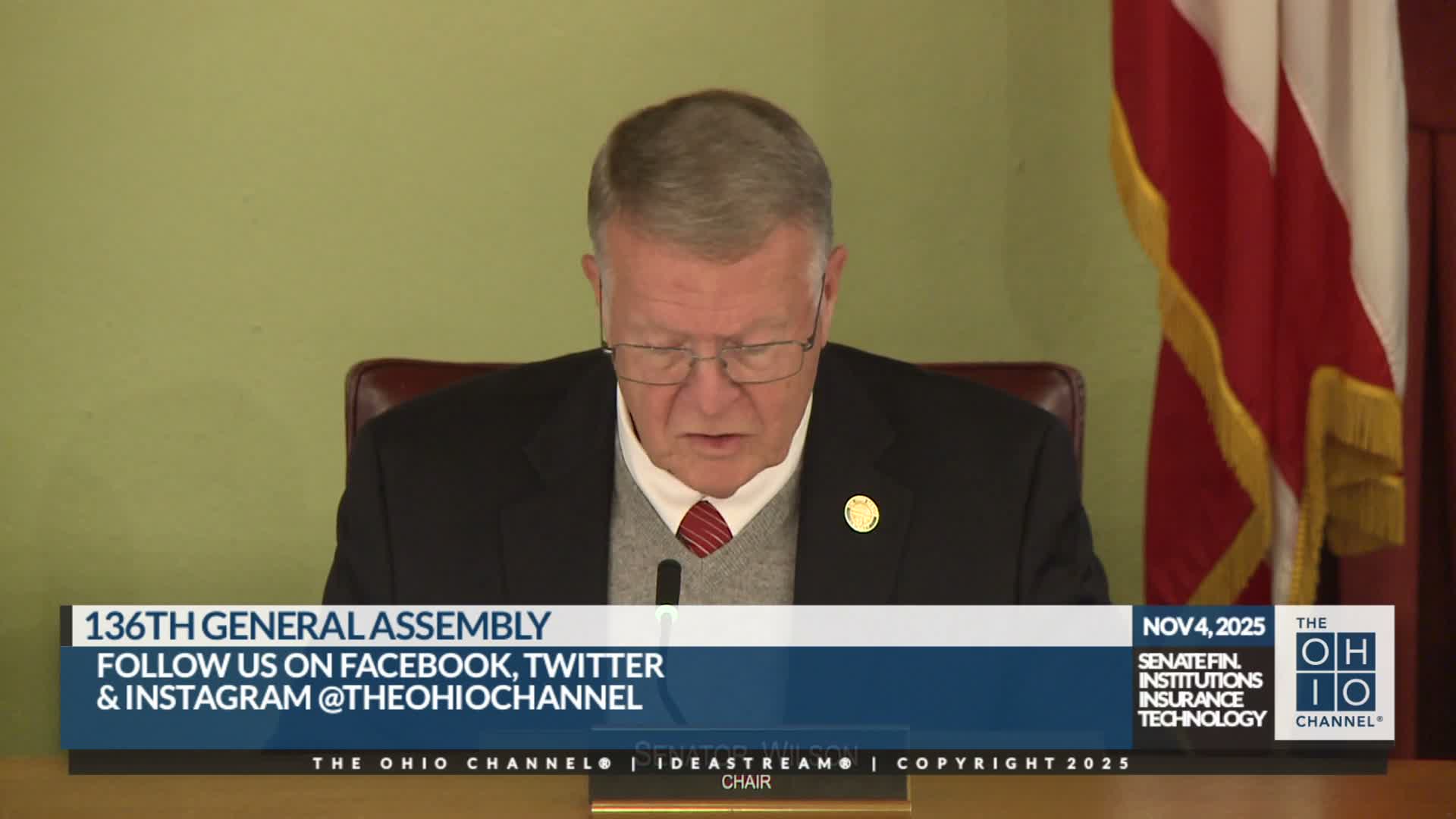
Senator Vernon Lang, sponsor of Senate Bill 306, told the Senate Financial Institutions, Insurance and Technology Committee that the measure makes a series of technical and policy updates to Ohio’s insurance code intended to keep the state competitive and protect consumers and insurers.
"I call this and I'm excited to bring forward to you the most boring bill that you will see in this GA," Lang said in sponsor testimony, before outlining six principal changes. He said the substitute bill adopted at the start of the hearing restores language omitted in the introduced version and explicitly addresses licensure for certain financial‑industry representatives and the status of unaffiliated agents.
The bill’s updates described by Lang include: clarifying that required signatures may be captured electronically; new consumer protections to prevent repair shops from holding vehicles or imposing contract terms that limit customers’ statutory remedies; technical changes to towing statutes developed with the towing industry; codification and transparency measures for special purpose financial captives; a provision treating unaffiliated agents who solicit an application for insurance on another person as agents of the insured; and strengthened anti‑fraud measures and codified provisions for the assigned‑risk plan.
Lang also provided context on the insurance sector’s scale in Ohio, saying the industry employs roughly 114,000 workers, supports about 271 insurance companies in the state, generated roughly $794,000,000 in premium tax revenues to state government in 2024, and accounted for approximately $11,300,000,000 in wages in 2024.
There was no committee debate recorded on the bill’s merits during the hearing; the chair closed the first hearing after sponsor testimony. Next steps for S.B. 306 were not specified in the hearing record presented here.