Get Full Government Meeting Transcripts, Videos, & Alerts Forever!
Get email alerts on the Math Policy topic
No spam. Unsubscribe anytime.
Senate Education Committee Advances Senate Bill 19, Backed by Educators and Safety Experts
Summary
Senate Bill 19, which expands math graduation pathways and authorizes classroom‑integrated high‑dosage tutoring, received broad proponent testimony from education leaders and was favorably reported by the committee; proponents framed the bill as workforce‑aligned and focused on implementation fidelity.
The Senate Education Committee favorably reported Senate Bill 19 after hearing extensive proponent testimony on math pathways, tutoring and implementation supports.
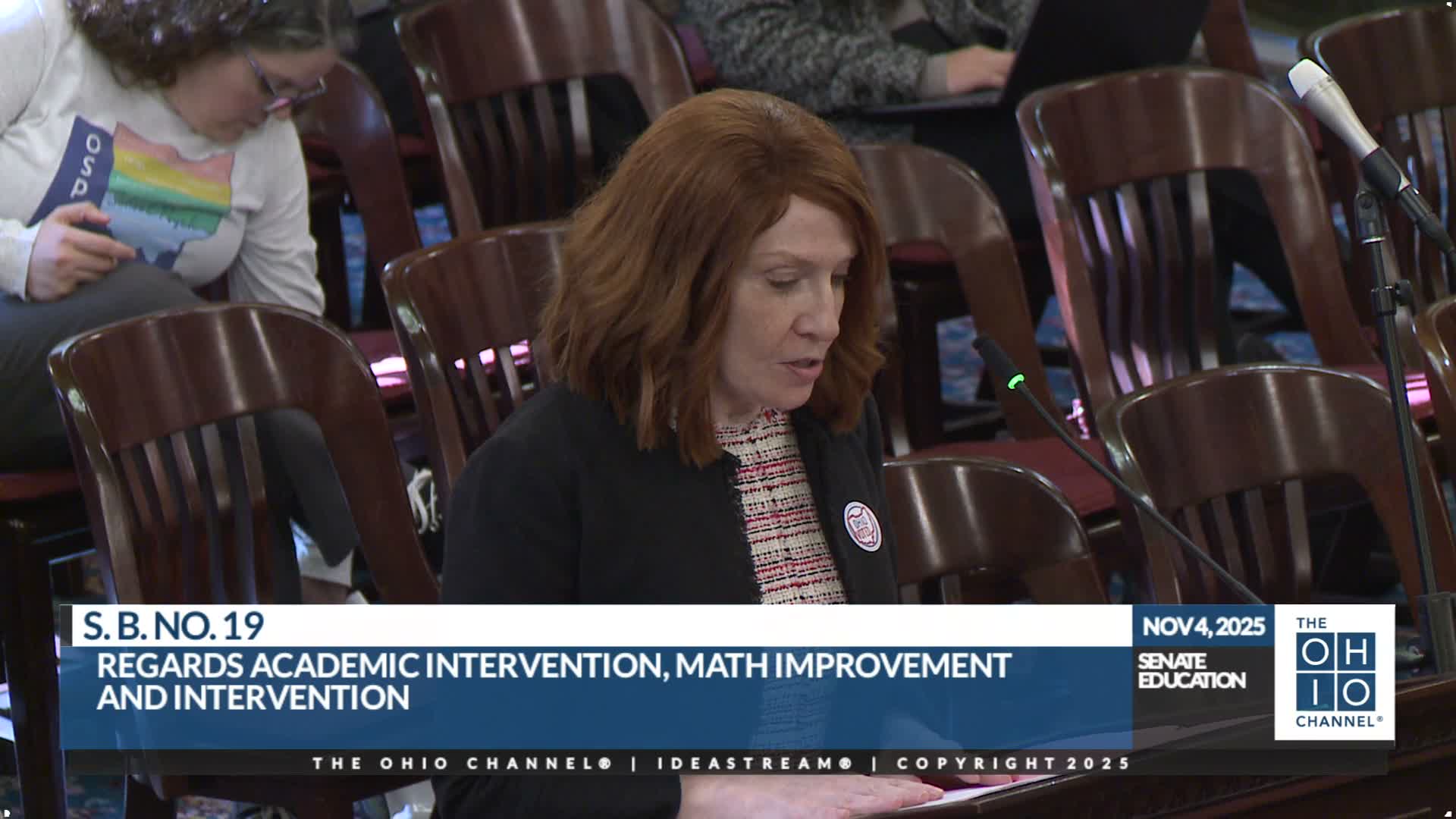
Proponents, including a strategy officer from the PAST Foundation and Doctor Corbin (introduced to the committee as a CEO and educator), described SB 19 as a shift away from a single algebra‑centric sequence toward multiple pathways — such as data science, statistics and quantitative reasoning — that can count toward graduation. A strategy officer for the PAST Foundation said the bill "invites us to rethink the purpose of mathematics education" and argued the change would reduce barriers disproportionately affecting students of color and first‑generation learners.
The Department of Education explained amendments intended to harmonize SB 19 with recent budget language: AM12601‑1 reconciles potential conflicts between a budget provision requiring advanced learning opportunities for top scorers and a provision in SB 19 that would automatically enroll high scorers in Algebra I in eighth grade; the amendment also applies the budget language to community and STEM schools and clarifies that high‑dosage tutoring may be incorporated into regular classroom instruction rather than requiring additional outside‑of‑day time.
Doctor Corbin emphasized the need for implementation fidelity, job‑embedded coaching and ongoing measurement, and cited statewide literacy and achievement gaps as context: "fewer than 38% of third graders statewide scored at or above proficient in reading," Corbin told the committee. Committee members asked about costs and whether expanded tutoring would require vendors or additional funding; proponents said the approach is intended as an efficiency within existing structures though it may require training and supports.
After discussion and a motion by Vice Chair Blessing, the committee voted to favorably report SB 19 to the committee on rules and reference; the clerk left the roll open for one senator’s vote and recorded the bill as favorably reported.
Next steps will move the bill to rules and reference for scheduling.