
House taxation panel advances amended Senate tax package, restores 1% pay increase and extends select credits
Get AI-powered insights, summaries, and transcripts
Subscribe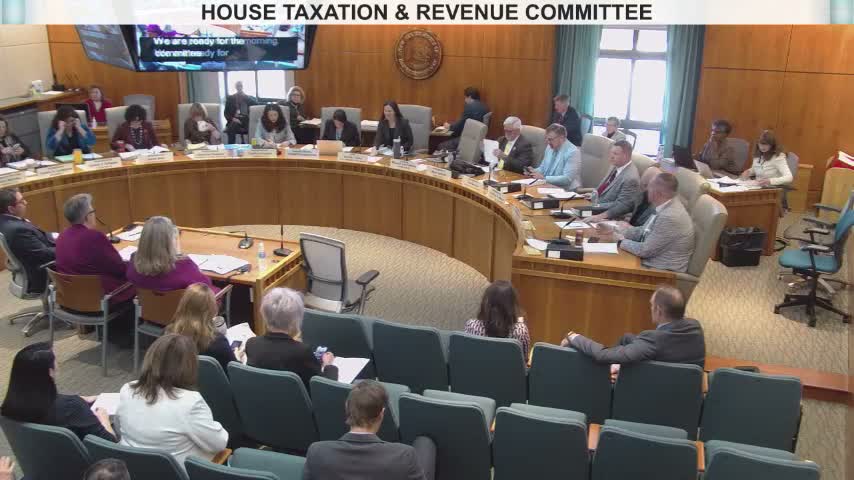
Summary
The House Taxation and Revenue Committee approved a House amendment to the Senate substitute for Senate Bill 151, restoring a 1% pay increase for state employees, extending a high-wage jobs tax credit and adding capped, sunsetted tax breaks for physicians, affordable housing and local news; committee recommended the amended substitute 7–5.
The House Taxation and Revenue Committee voted to advance an amended Senate substitute for Senate Bill 151 on a 7–5 committee vote after a daylong hearing of testimony and debate.
The amended substitute, as presented by the committee sponsors, uses the House’s share of revenue capacity to restore a 1% salary increase for state employees (scheduled to take effect in fiscal 2027), extends the high-wage jobs tax credit and includes targeted tax provisions intended to support physicians, affordable multifamily housing and local news organizations. The amendment also removes a gross receipts tax (GRT) deduction for certain medical equipment that had been in the Senate package and adds sunsets and compliance requirements to several sections.
Why it matters: committee sponsors said the changes are designed to create revenue capacity by decoupling from recent federal corporate tax changes and to direct those funds to a mix of workforce compensation, housing, economic development and local journalism supports. "We have approximately $55,000,000 in capacity in the senate side and, another 55,000,000 for you all here on the house side," the sponsor told the committee while outlining the package. Supporters argued the physician credit and housing deduction will improve recruitment and project feasibility; opponents warned the decoupling and other provisions risk disadvantaging investment and shifting burdens to other taxpayers.
What the amendment does: among other provisions, the House amendment as adopted (the 0.4/0.5 series discussed in committee) was described by the mover as doing five things: fully funding the 1% salary increase for state employees and higher education staff; renewing the high-wage jobs tax credit for another decade; removing the Senate GRT deduction for medical equipment and supplies; arranging effective dates so compensation and some credits apply in the near fiscal year; and inserting sunsets where prudent to evaluate fiscal impacts.
Public testimony: the committee heard supporters who said the package would help affordability and essential services. Rebecca Velarde, director of development for Palindra, said the affordable-housing GRT deduction would help projects that otherwise cannot move forward because of high construction costs and weak equity markets. Belinda Mills of the New Mexico Press Association urged support for the journalism and printer credits, noting local newspapers' fragile economics. By contrast, Karla Sonntag of the New Mexico Business Coalition opposed SB 151, arguing the bill "expands preferential corporate income tax treatment" without clear fiscal offsets. Ashley Wagner of the New Mexico Oil and Gas Association warned the bill "raises over $100,000,000 a year by delaying cost recovery, expanding the tax base, and increasing complexity for employers."
Agency perspective: Stephanie Chardonn Clark, secretary of the Taxation and Revenue Department, said the decoupling provisions restore New Mexico’s tax baseline relative to recent federal changes. "They are restoring the baseline level of corporate taxation that would have been New Mexico's tax level before HR 1 was signed," she said, adding that the extension of the high-wage jobs credit is important for economic development.
Committee debate and fiscal considerations: members questioned local-government impacts, citing fiscal-impact report numbers for potential local GRT reductions (one representative referenced a $9,400,000 local impact figure for particular sections). Some members argued decoupling is a necessary response to federal changes that reduced state tax capacity; others said removing federal incentives risks discouraging long-term private investment and shifts costs to local governments.
Votes and procedure: the committee unanimously approved the committee’s House amendment in a recorded roll-call on the amendment itself (reported 13–0), then continued broader bill debate and ultimately voted to give the amended substitute a due-pass recommendation to the House floor on a 7–5 vote. Representative (recorded in the transcript as) Padawan moved the due-pass motion; the motion was seconded and carried by the committee.
What’s next: with a committee due‑pass recommendation, the amended Senate Finance substitute for SB 151 will move to the House floor for further consideration and possible amendment. Committee members said they expect additional action later in the day on capital outlay and related matters.
"We trust New Mexicans to make their own decisions about their futures," the chair concluded in closing remarks, urging the House to send the amended package forward for further debate.
Votes at a glance: committee recorded passage of the House amendment (reported 13–0) and a committee due-pass recommendation on the amended substitute (7–5).