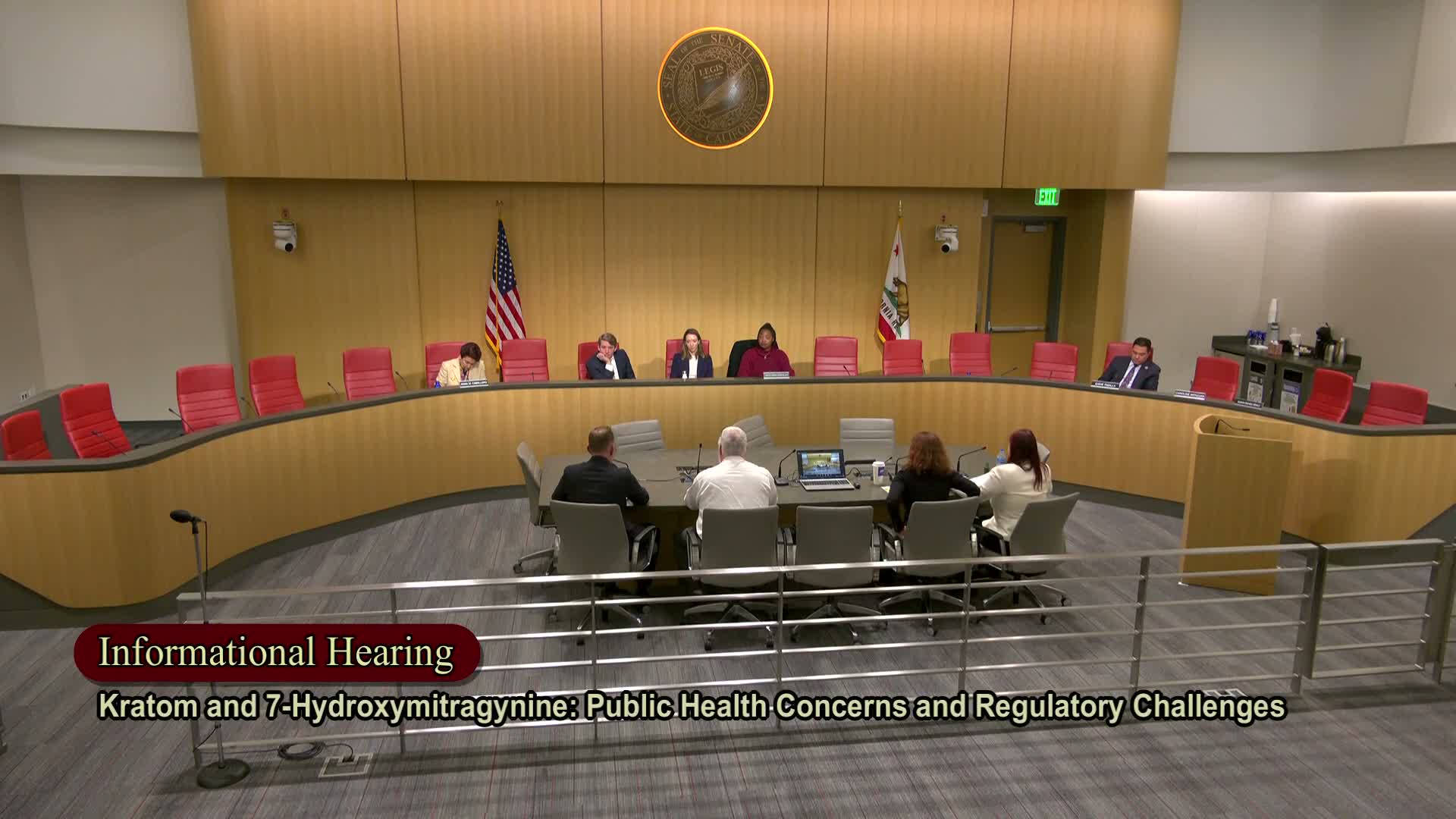
Industry and advocates urge regulation, not bans; scientists and public‑health officials dispute evidence
Loading...
Summary
Industry and consumer groups pushed the Senate committee to limit policy to concentrated synthetic 7OH while preserving access to natural kratom; public‑health witnesses and some scientists warned that flawed studies complicate interpretation and enforcement challenges remain.
The Senate Health informational hearing also foregrounded a sharp policy debate: industry and consumer advocates urged a regulatory framework that preserves access to natural whole‑leaf kratom while banning or restricting concentrated synthetic 7‑hydroxymitragynine (7OH); public‑health experts and some scientists said the evidence and enforcement realities complicate a straightforward distinction.
Matthew Lowe, executive director of the Global Kratom Coalition, told the committee that natural kratom leaf has decades of use and that concentrated or synthetically produced 7OH products are a distinct exposure class that should be prohibited. "These are not the same products," he said, urging rules like age gating, labeling, and analytic caps on 7OH in leaf products similar to regulations other states have adopted.
Sheldon Bradshaw, an FDA regulatory counsel, supported banning chemically manipulated 7OH and implementing Kratom Consumer Protection Act‑style rules — including testing and transparent labeling — to align state law with FDA science and to stop products that "masquerade" as botanicals.
Consumer advocates and industry participants argued prohibition would harm people who rely on kratom for chronic pain, mental‑health support, or recovery. Jackie Sue Beck of the 7 Hope Alliance warned lawmakers that abrupt criminalization could push people to illicit markets and have predictable harms; several public commenters described personal health benefits and urged careful regulation rather than bans.
Other scientists at the hearing criticized some of the published literature that is being used to justify immediate bans. Dr. Michelle Ross said parts of the research record have required corrections and cautioned legislators to rely on a robust, validated evidence base. She urged policymakers to focus enforcement attention on adulterated multi‑ingredient products and concentrated extracts that present the clearest immediate risk.
Committee members asked for documentation of corrected studies, clearer protocols to verify product 7OH content, and for modeling of enforcement capacity if the legislature implements a differential regime. The hearing underscored ideological and factual disagreement among stakeholders and left open how the state will square consumer protection with feasibility of testing and enforcement.
The committee ended the panel with requests for written materials and data from both scientific and industry witnesses for staff use in drafting or amending legislation.