Get Full Government Meeting Transcripts, Videos, & Alerts Forever!
Get email alerts on the Public Health topic
No spam. Unsubscribe anytime.
Senate hearing spotlights rising harms tied to concentrated 7‑hydroxymitragynine and enforcement limits
Summary
Health officials and county medical examiners told the Senate Health Committee that concentrated 7‑hydroxymitragynine (7OH) products are linked to a recent rise in unexplained deaths and that gaps in testing and enforcement hinder efforts to remove dangerous products from retail shelves.
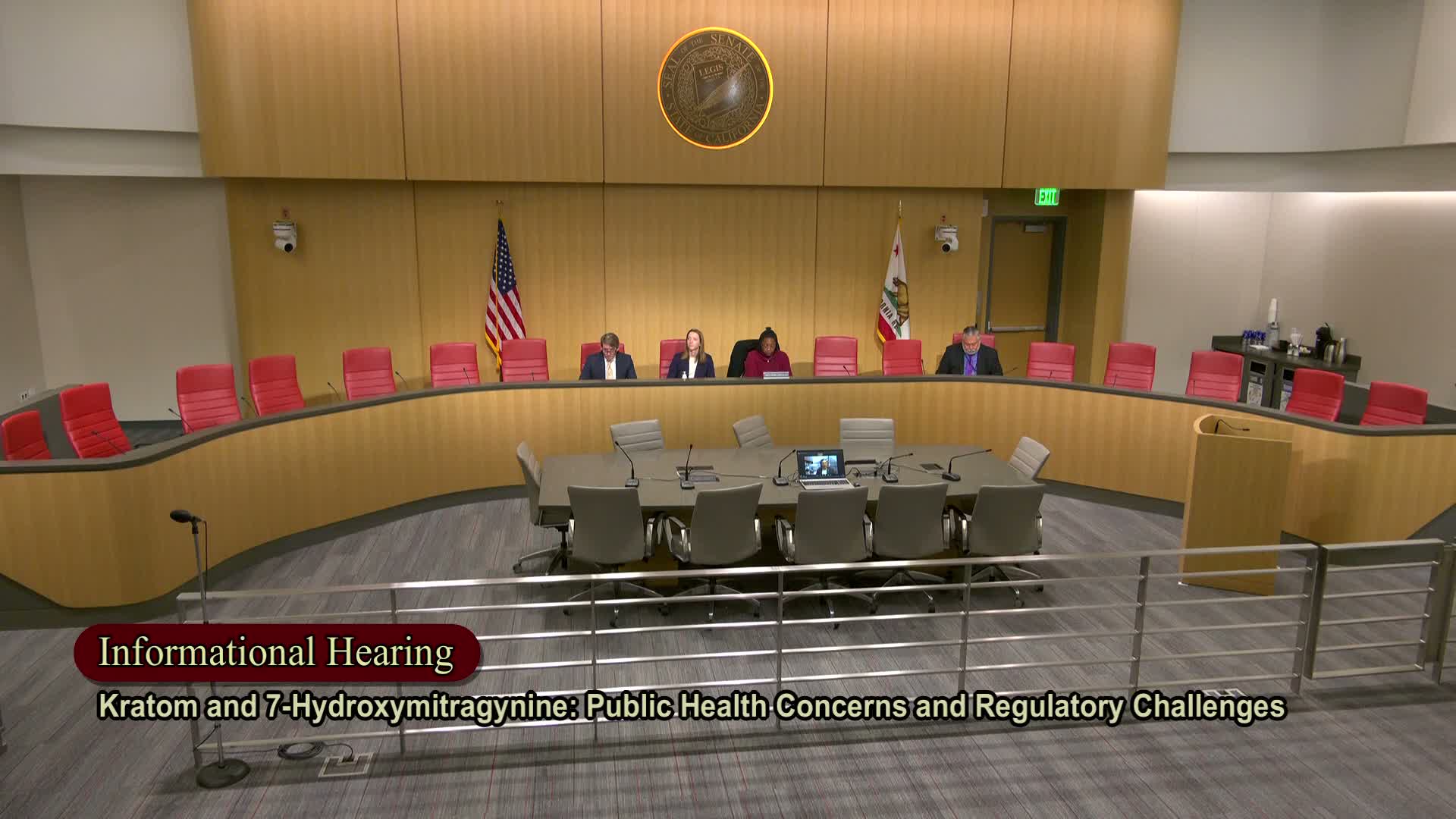
A California Senate Health Committee informational hearing on kratom and 7‑hydroxymitragynine (7OH) on July 30, 2025 brought clinicians, state and county health officials, and a medical examiner together to outline a pattern of severe harms tied to concentrated 7OH products and to describe limits in testing and enforcement.
Officials from the California Department of Public Health said the department’s review of death records identified 362 kratom‑related overdose deaths statewide from 2019 through 2023 and 15 death certificates that specifically listed 7OH as a contributing substance. Maral Farsi, speaking for the department, said those figures are likely undercounts because they were identified through text searches of death certificates and that differentiation between unmodified kratom and adulterated or concentrated products remains difficult without broader lab standards.
The Los Angeles County chief medical examiner described a local spike in unexplained deaths among people aged roughly 19 to 40 in June and July 2025 that prompted expanded toxicology testing. "When we discovered this agent, it was the only reasonable conclusion that we could make was that the toxin caused the death," the medical examiner said, explaining that the office shifted toward testing for kratom alkaloids even in cases where other drugs were present.
Emergency and addiction physicians told legislators they are seeing patients with opioid‑style dependence and withdrawal associated with concentrated 7OH. Dr. Amy Mullen, an emergency‑medicine and addiction specialist at UC Davis, said some patients require established opioid‑use treatments such as buprenorphine or methadone and that naloxone has been used in overdoses, sometimes requiring multiple doses.
Local public‑health officials described enforcement activity but warned it is resource‑intensive. Los Angeles County investigators visited 2,882 sites and identified 357 locations with kratom or 7OH products that were removed; CDPH detailed enforcement actions at manufacturers, wholesalers and roughly 50 retailers. County and local leaders said many jurisdictions lack laboratory capacity to verify product labeling or to routinely quantify 7OH levels, and that environmental‑health inspectors are not generally set up to police non‑food substances.
Panelists repeatedly urged a multiagency approach. County public‑health leaders said a statewide enforcement framework, paired with lab standards and resources for local jurisdictions, would help distinguish unmodified kratom leaf from concentrated or adulterated products and enable consistent action across counties.
The committee did not take votes. Members asked panelists for citations and lab protocols and for the state to identify how to scale testing and enforcement if lawmakers adopt legislation that would distinguish natural kratom from concentrated 7OH formulations. The chair closed the hearing by urging careful work to balance consumer protection, enforcement feasibility, and the need for more research.
The committee said staff will continue briefing members and review evidence ahead of any legislative action, including the bill discussed at the hearing, AB 1088.