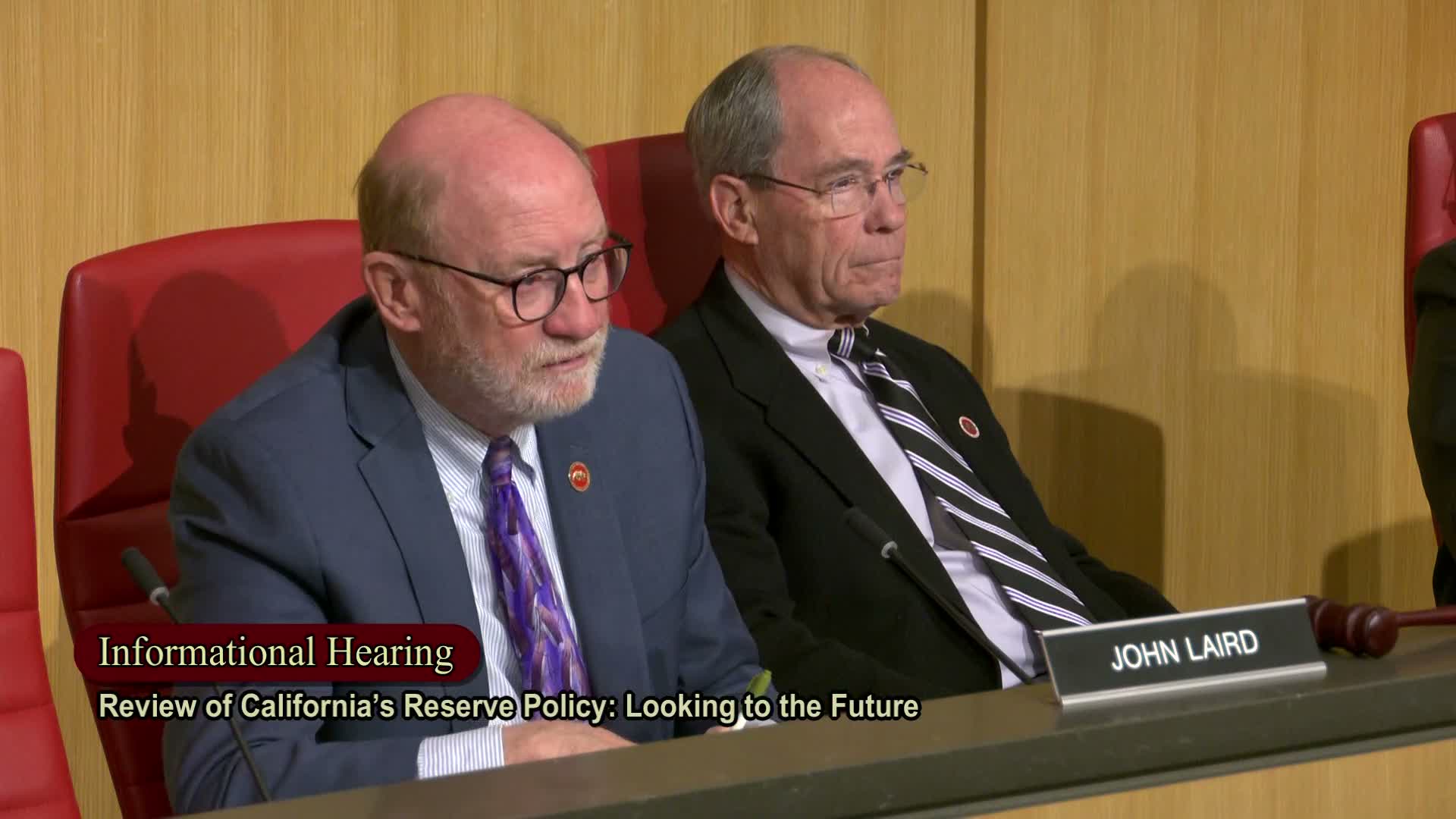
Administration, advocates and senators spar over how to reform California's rainy day fund and who should pay
Loading...
Summary
At a Senate Budget and Fiscal Review hearing, the Department of Finance defended a more modest 20% cap and SAL exclusion, while advocates urged larger caps and structural fixes (unemployment insurance, targeted reserves). Senators debated business exits, EDD debt and whether to create separate emergency reserves.
The Department of Finance and outside experts presented competing approaches for strengthening California's Budget Stabilization Account and the committee's members spent much of the hearing testing trade‑offs among higher reserves, tax policy and program priorities.
Lisa Murzynski of the Department of Finance summarized the administration's proposals: "The administration proposed two changes to the BSA: increasing the cap from 10% to 20% and excluding deposits into and out of the reserve from counting against the State Appropriations Limit," she told the committee. The DOF framed this as maintaining the BSA's intent while giving lawmakers more flexibility to save during revenue surges.
Independent analysts and advocates pushed for more ambitious reforms. "The reserve policy can truly, truly assist our budget writing woes in very positive ways," Irene Asmundson of Practical Idealism Economics told the committee and urged updating California's unemployment insurance system and other structural spending changes alongside any reserve reforms. Asmundson added that, facing greater inequality and more gig work, "my first instinct is almost always to put it in reserves" when uncertain about future forecasts.
Scott Graves of the California Budget & Policy Center urged a balanced approach that includes revenue diversification and said the governor's proposal would materially improve the BSA's coverage: "Under the governor's plan, the BSA would cover around half of future funding gaps," he said, citing the LAO's analysis showing improvements from a higher cap.
Several senators focused on practical constraints and distributional impacts. Members raised that California previously hit the state appropriations limit and that, in those years, discretionary deposits were constrained by SAL mechanics. The LAO and DOF described how those legal rules and prior policy choices limited deposits during recent revenue surges and how changing the SAL treatment would require legislative and possibly voter action. Anne Hollingshead told members that raising the cap would require a constitutional amendment sent to voters.
The hearing also included heated exchanges about broader fiscal pressures. One senator cited examples of employers leaving the state and sizable EDD debts and fraud cases as reasons to avoid raising employer costs; others stressed closing corporate tax loopholes or borrowing from special funds as alternatives. Panelists recommended a mix of tools—including a projected surplus holding account that can temporarily hold uncertain revenues—rather than a single silver‑bullet solution.
On emergency planning, LAO recommended separate accounts for revenue stabilization and true emergency spending (for earthquakes, major bridge failures or large wildfire costs), because the timing and magnitude of those risks differ. Several senators asked for additional LAO and DOF analyses on Medi‑Cal cost drivers and local government fiscal stress.
What happens next: The committee did not take formal action. The presentations and Q&A laid out concrete options staff will need to translate into legislative language if lawmakers pursue either statutory changes or a ballot measure to change the BSA cap.