LAO recommends sweeping expansion of California's rainy day fund cap, offers two deposit options
Loading...
Summary
The Legislative Analyst's Office told the Senate Budget and Fiscal Review Committee that California's current reserve rules would cover about 30% of downside funding shortfalls under a conservative benchmark and recommended raising the constitutional BSA cap from 10% to 50% by 2055, with options to broaden deposit rules or deposit full excess capital gains.
The Legislative Analyst's Office recommended a major expansion of California's Budget Stabilization Account on the grounds that current rules leave the state exposed during deep revenue downturns.
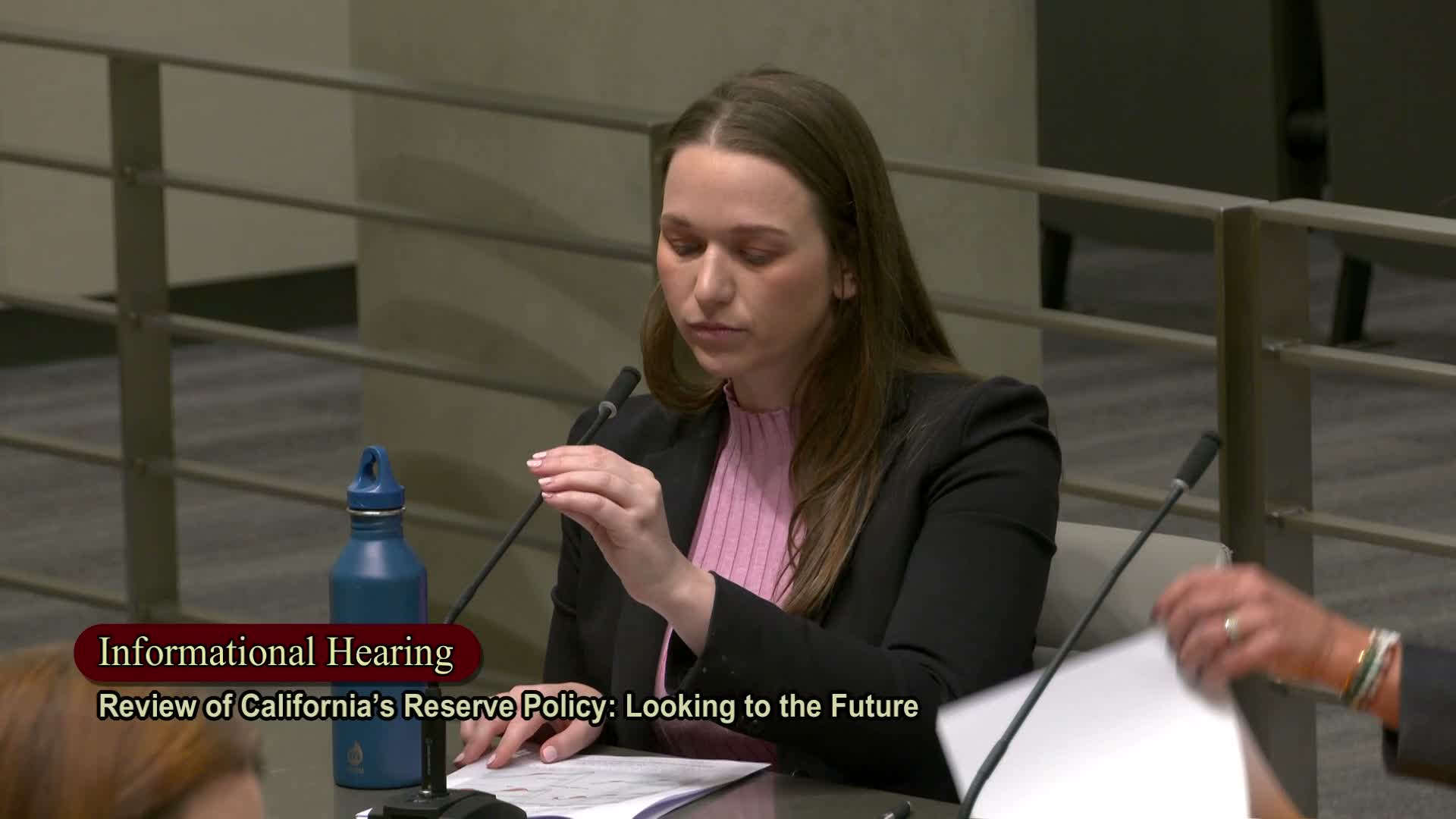
"Our analysis found that for the current policy under Proposition 2 the state would be able to cover about a third or 30% of funding shortfalls over the next 50 years in that benchmark scenario," Anne Hollingshead of the LAO told the Senate Budget and Fiscal Review Committee. She said the office evaluated policies against a 90th‑percentile, 50‑year scenario to test resilience across multiple economic cycles.
Hollingshead said the most important LAO recommendation is to raise the constitutional cap on BSA deposits. "We suggest that the legislature raise the cap from the current level of 10% of general fund taxes to 50% by 2055," she said, proposing an initial 20% cap followed by 5% increases every five years so voters could approve a staged increase rather than an immediate jump.
The LAO also offered two deposit‑rule options. One would create "more flexible, robust" rules to capture volatility across more revenue sources, not just capital gains. The alternative would simplify current formulas by setting aside the full share of excess capital gains that now trigger complicated offsets.
Hollingshead warned that the constitutional 10% cap constrains how much reforms to deposit rules can improve the state's ability to absorb multi‑decade funding shortfalls: "Even if you significantly change the deposit rules but kept the cap at 10%, that wouldn't cause a significant increase in the state's ability to cover more funding shortfalls."
The LAO framed reserves as a tool to preserve core services through downturns rather than a single‑year tradeoff between saving and spending. The office said a stronger BSA would let the state avoid making deep, permanent cuts to programs when revenues fall.
Where the money would come from and whether voters would approve a constitutional amendment remain political questions. The LAO said any cap increase would require a ballot measure and suggested the legislature draft an automatic schedule into statute as part of a constitutional amendment request to voters.
What happens next: The LAO's recommendations set a clear legislative pathway (and a needed voter question) for an expanded BSA; the committee's airing highlighted the trade‑offs but did not produce votes or formal actions during the hearing.