House panel backs bill to clarify Arizona in‑state TPT sourcing after heated debate
Loading...
Summary
The House Ways and Means Committee voted to advance HB 22-90, a bill sponsors say codifies historic origin-based sourcing for in‑state sellers; cities’ group and other witnesses warned it could shift revenue to distribution centers and complicate compliance.
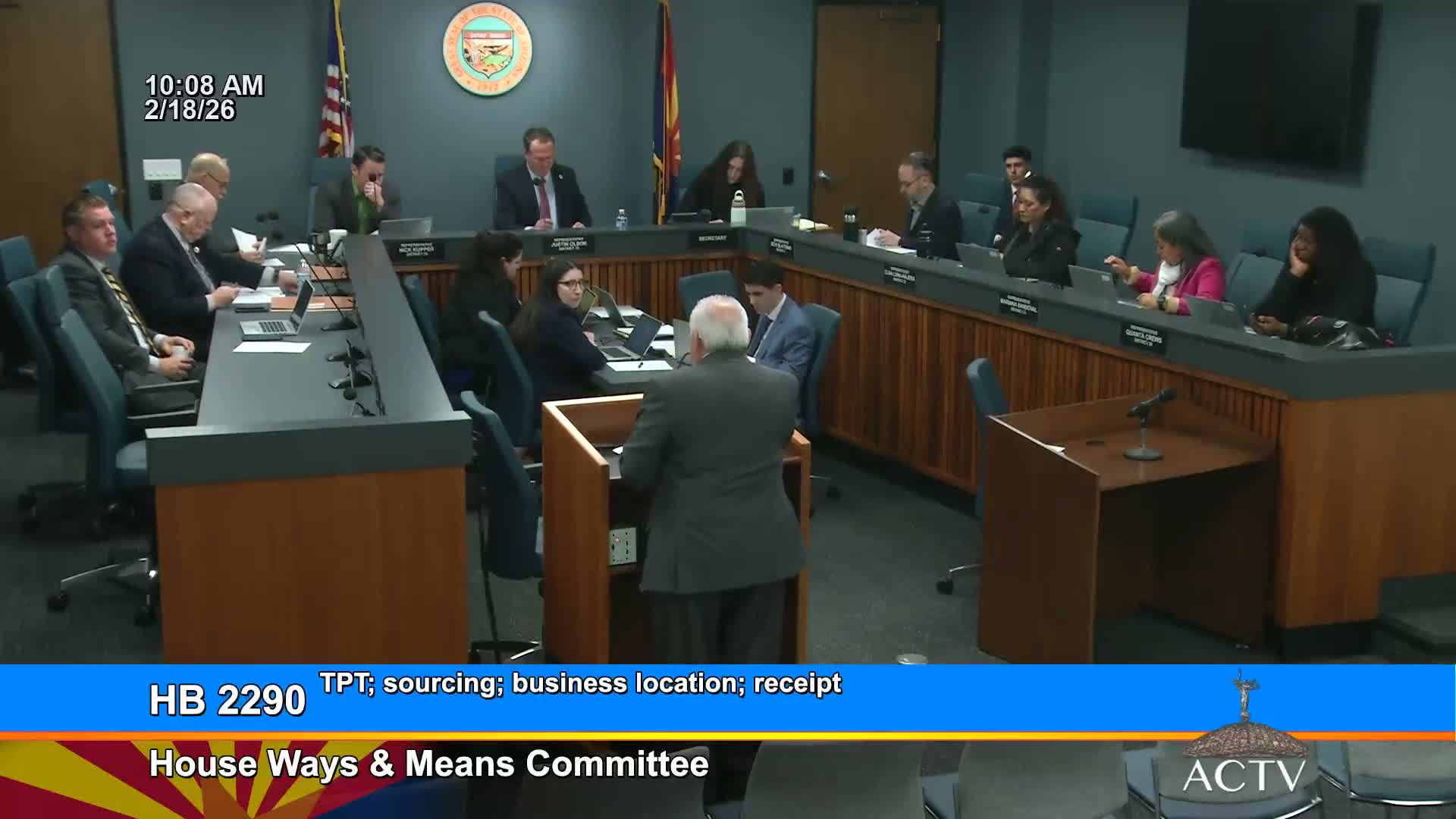
The House Ways and Means Committee voted to return House Bill 22-90 with a due‑pass recommendation after more than an hour of testimony and questions about how Arizona taxes in‑state online sales.
Chairman Olsen, the bill sponsor, said the measure simply codifies the state’s long‑standing approach to transaction privilege tax (TPT) sourcing: when a seller has a business location in Arizona, the transaction is received at that location and should be sourced there. He said the change would make clear that the physical location of servers used to transmit an order does not determine where the order is received.
Nick Ponder of the League of Arizona Cities and Towns testified in respectful opposition, arguing the draft language could shift tax revenue from destination jurisdictions — often rural cities and towns — to business locations such as distribution facilities in larger municipalities. “By focusing on the business location as opposed to the destination…you could be charged three potential tax rates,” Ponder said, warning of compliance complexity for multi‑location retailers.
Business witnesses offered mixed views. Brad Scott, director of finance for Halsted Bead in Prescott, described the operational costs of complying with Wayfair‑era obligations for remote sales and urged preserving origin‑based treatment for in‑state sellers. Kevin McCarthy of the Arizona Tax Research Association told the committee the dispute stems from a fragmented municipal tax system and said DOR’s draft guidance had gone far toward solving confusion.
The Department of Revenue said it was neutral on the bill and offered to provide technical assistance. Molly Murphy said the agency’s 2023 draft ruling was never finalized and that correct sourcing of online sales often requires a fact‑intensive review of business models.
Committee members questioned whether the bill changes existing law or only clarifies it. Proponents characterized the change as confirmation of the statute’s plain meaning; opponents said the drafting and references to “business location” could alter current destination‑based outcomes for many online transactions.
The motion to advance HB 22-90 passed on a voice/roll‑call vote; the transcript records the committee returning the bill with a due‑pass recommendation (tally shown in the transcript as 5 ayes, 3 no’s, 1 absent). The committee asked stakeholders to submit scenario analyses and thanked DOR for its technical input; the bill will proceed to the next floor stage.