Lifetime Citizen Portal Access — AI Briefings, Alerts & Unlimited Follows
Appropriations Committee advances package of public‑safety, education and health bills; key votes split along fiscal lines
Loading...
Summary
The Arizona House Appropriations Committee on Feb. 18 advanced a slate of budget and policy bills, including $1.5M for a corrections oversight office, $20M for local border support, a plan to let fire districts buy into a firefighter cancer reinsurance pool, and a proposal to use rainy‑day interest for public‑safety pay parity; each measure received a ‘due pass’ recommendation following debate and public testimony.
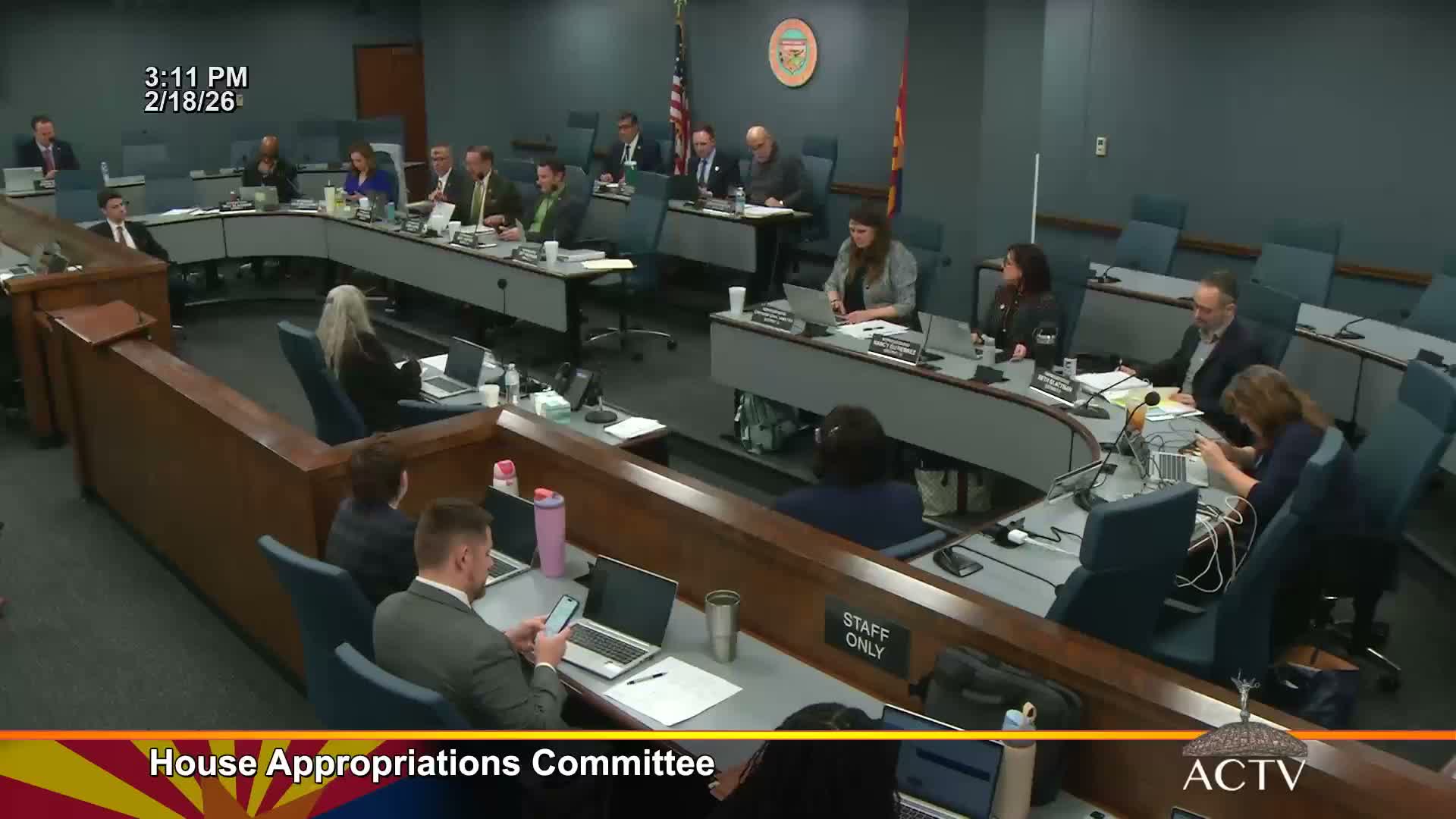
The Arizona House Appropriations Committee on Wednesday advanced multiple bills affecting corrections oversight, border enforcement, firefighter insurance, school policy and maternal mental‑health services, returning each measure with a due‑pass recommendation to the full House.
Committee members voted through a mix of budget appropriations and policy changes after lengthy discussion and public testimony. Several items generated substantive debate over funding sources and long‑term fiscal effects, most notably a proposal to direct interest from the state’s Budget Stabilization (rainy‑day) Fund to a new Public Safety Parity Fund for Department of Public Safety (DPS) and Department of Corrections (ADCRR) pay increases.
Representative David Livingston’s HB 2063 received a due‑pass recommendation after advocates and the sponsor said $1,500,000 in FY2027 is needed to stand up an Independent Correctional Oversight Office. Sponsor Representative Blackman (bill sponsor) and Edie Lafaire of Justice Action Network argued the appropriation is modest relative to ADCRR’s budget and is necessary to address lawsuits, staffing failures and inmate safety concerns. The committee voted 17–1 to give the bill a due pass.
Law‑enforcement funding and organization questions surfaced on two other bills. HB 2993, amended in committee to redirect $5,000,000 from a consumer fraud revolving fund into the Gang and Immigration Intelligence Team Enforcement Mission (GIITEM) Fund rather than a Peace Officers Training Fund, was shepherded by Speaker Steve Montenegro. Montenegro said the change would let the Department of Public Safety (DPS) secure independent legal counsel and shift funds toward multi‑agency enforcement operations; the amendment and the bill as amended were adopted and returned with a due pass.
In an extended discussion on HB 2271, stakeholders described efforts to let fire districts buy into an industrial commission cancer reimbursement (ICA) reinsurance pool that now covers municipal firefighters but leaves roughly 2,000 fire‑district firefighters exposed to high premiums. Mark Osborne, representing a workers’‑comp insurer that serves fire districts, called the bill a “shell” pending a larger consensus plan but said the mechanism would allow fire districts to access reimbursement and reduce premiums if stakeholders agree on buy‑in terms. The committee returned the bill with a due pass (vote reported 16 yes, 1 no, 1 present).
Border‑related spending surfaced on HB 2416, a $20,000,000 FY2027 request to DPS for local border support: funding officer positions, prosecution/detention costs and capital needs tied to border‑related cases. Several sheriffs and the Arizona Sheriffs Association supported the appropriation, citing interdictions and seizures; a faith leader testified in opposition on moral and priority grounds. The committee returned HB 2416 with a due pass.
Members also approved HB 2692 (procurement changes for construction projects and progressive design‑build options) and HB 2478 (creation of an Arizona Commission on Student Outcomes with $1,000,000 in start‑up funding and additional amendments to study early childhood and potential trade‑pathway diplomas). Both measures were adopted with amendments after stakeholder testimony and discussion about statutory scope and funding sources.
The most contested funding measure was HB 4044, which would create a Public Safety Parity Fund by directing a large share of interest earned on the Budget Stabilization Fund to pay DPS and ADCRR salaries. Supporters, including the Arizona State Troopers Association, said the mechanism would provide a predictable fund for recruitment and retention and would spare the general fund. Opponents argued the rainy‑day fund is a critical fiscal backstop and warned that diverting interest could erode the corpus or reduce deposits; the committee nevertheless returned the bill with a due pass (vote 10–8). Members asked the sponsor for additional fiscal detail and formulas to manage distribution volatility.
Law‑and‑order, child‑safety and health bills rounded out the agenda. HB 2992, a pilot program in ADE for child abuse and exploitation awareness (amended to cover K–12 and add grooming/exploitation modules), and HB 2593, a $1,500,000 appropriation to the University of Arizona to sustain the Arizona Perinatal Psychiatry Access Line, both received due‑pass recommendations after advocates and clinicians testified on prevention and clinical utility.
Votes at a glance (committee recorded tallies): HB 2063 — due pass (17–1); HB 2993 (as amended) — due pass (11–7); HB 2271 — due pass (16–1–1 present); HB 2416 — due pass (11–6–1 not voting/present); HB 2692 — due pass (10–7–1 present); HB 2478 (as amended) — due pass (11–7); HB 4044 — due pass (10–8); HB 2992 (as amended) — due pass (12–6); HB 2593 — due pass (16–1–1 present).
What happens next: All bills with due‑pass recommendations will go to the full House for further consideration and potential floor action. The committee chair reminded members that a bonus Monday session is planned and that the Monday agenda will be posted the preceding day.
Quotes that illustrate the debate: “This oversight is essential,” Edie Lafaire testified of the correctional oversight office; “this is money that’s going to be coming in and having a funding source,” sponsor Rep. Jeff Weninger said of the parity proposal; and “I was groomed … which led to seven years of trafficking,” survivor‑advocate Sherry Lopez said in support of the K–12 prevention pilot.
The committee adjourned after completing the listed items and noting the next bonus committee date.