
ADOT updates on I‑11, I‑10 Wild Horse Pass, SR 347 and I‑40; litigation stalls full I‑11 progress
Get AI-powered insights, summaries, and transcripts
Subscribe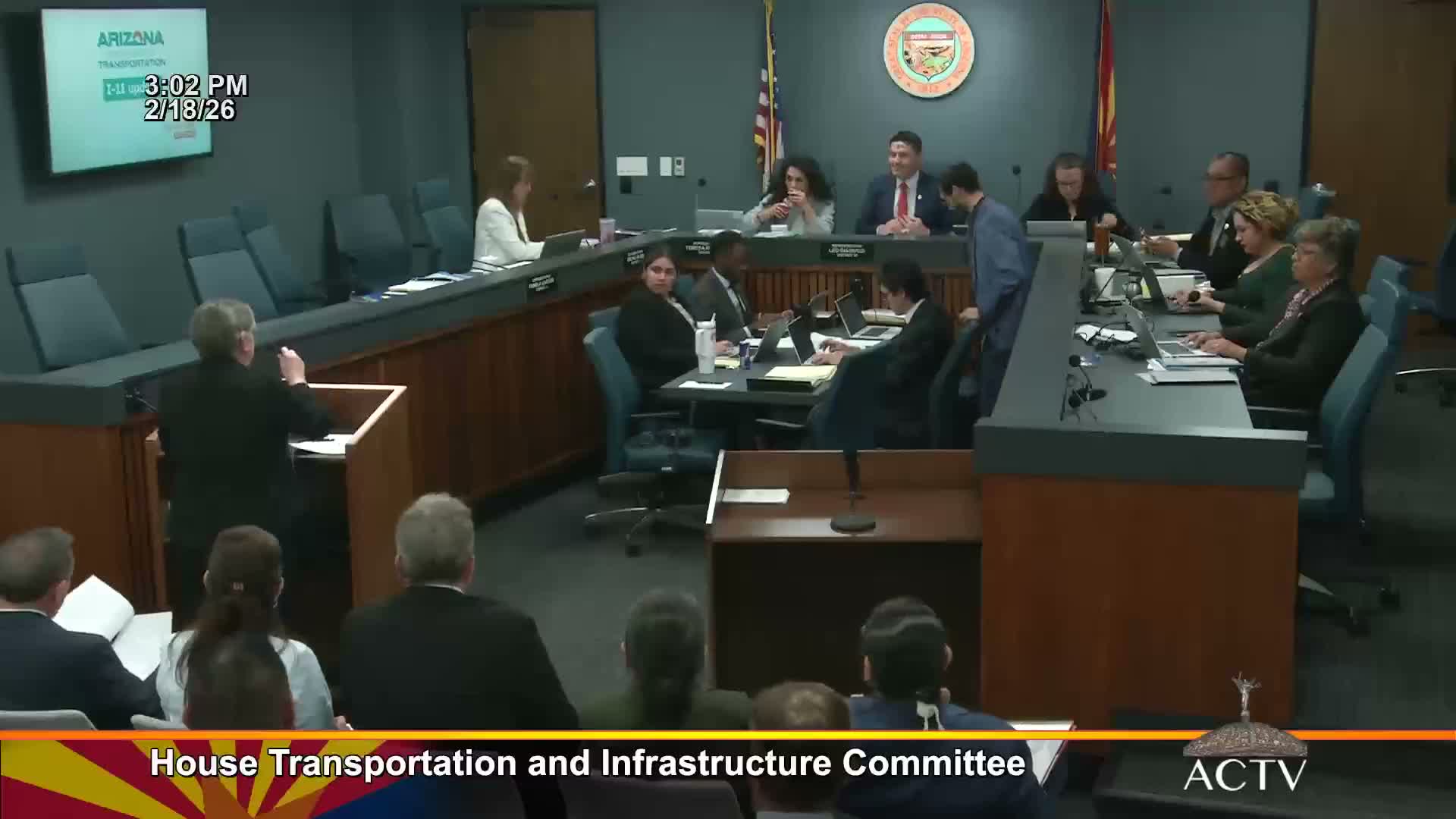
Summary
ADOT told the Transportation Infrastructure Committee that Interstate 11 remains without construction funding and a 2022 lawsuit has prompted a Tier‑1 EIS reevaluation; meanwhile ADOT presented progress and timelines for regional I‑10, SR 347 and I‑40 projects.
Arizona Department of Transportation officials briefed the House Transportation Infrastructure Committee on major corridor projects, saying long‑range planning remains but construction timelines vary.
ADOT Director Jennifer Toth summarized the Interstate 11 history and current status, saying the corridor study and a Federal Highway Administration record of decision cover a roughly 280‑mile route from Nogales to Wickenburg but “there is still no funding for right‑of‑way, for design, or construction for the proposed I‑11 in Arizona” (Director Jennifer Toth). She told the committee a lawsuit filed in 2022 challenges the corridor’s NEPA process, Section 4(f) and endangered‑species analyses and that the court order stayed post‑notice‑of‑intent Tier 2 activity until ADOT and FHWA complete a Tier‑1 reevaluation. Toth said ADOT and FHWA favor completing a Tier‑1 reevaluation rather than rescinding the record of decision or attempting piecemeal segmentation because rescission would likely add years and millions of dollars to the process and risk further litigation.
‘‘The FAST Act identified a general corridor and an ROD was issued in November 2021, but that did not come with construction funding,’’ Toth said, summarizing the federal and state posture.
ADOT said only the Buckeye–Wickenburg segment currently has state funding for a Tier‑2 study, approved by the Legislature in 2022. Toth said limited pre‑NOI Tier‑2 activities are being carried out under a joint stipulation (field surveys, agency contacts and 4(f) inventory renewals) and that public outreach on the Tier‑1 reevaluation is planned later this year with a target completion in early 2027.
Committee members pressed for clarity about whether the lawsuit affects northern segments; Toth and ADOT staff responded that the lawsuit challenges the entire corridor and recommended a reevaluation rather than rescission. Members asked ADOT to provide visual timelines and to meet with local stakeholder coalitions about segmentation and staging questions.
ADOT also presented on two I‑10 corridor projects and SR‑347: Amy Ritz, ADOT’s P3 group manager, described a 14.8‑mile SR‑347 widening from I‑10 to Maricopa with intersection reconstructions, a grade separation at Mammoth Way for heavy truck access, multiple bridge extensions and concrete median barriers for safety. Ritz said design completion is expected in June and that early construction work could begin this summer, contingent on environmental and right‑of‑way clearances; ADOT signed a preconstruction agreement with the selected contractor in February.
For the I‑10 Wild Horse Pass corridor, ADOT said the 22–26 mile program is broken into four projects, will add a third general‑purpose lane in each direction, extend an HOV lane, and rebuild several interchanges. The corridor work is staged; ADOT estimated overall completion around late 2029.
Deputy Director Audra Merrick described the West Kingman (I‑40/US‑93) project: a $106.5 million construction contract, about 60% complete with anticipated early‑2027 completion, and construction of a free‑flow ramp to reduce Beale Street intersection congestion.
What happens next: ADOT plans public outreach for the Tier‑1 reevaluation later this year, continued pre‑NOI Tier‑2 activities for Buckeye–Wickenburg, and continued coordination with local governments on mitigation and near‑term traffic measures. The committee requested additional visual timelines and local outreach briefings.