
Committee advances bill limiting state collaboration with certain international organizations and adds ABOR review for university deals
Get AI-powered insights, summaries, and transcripts
Subscribe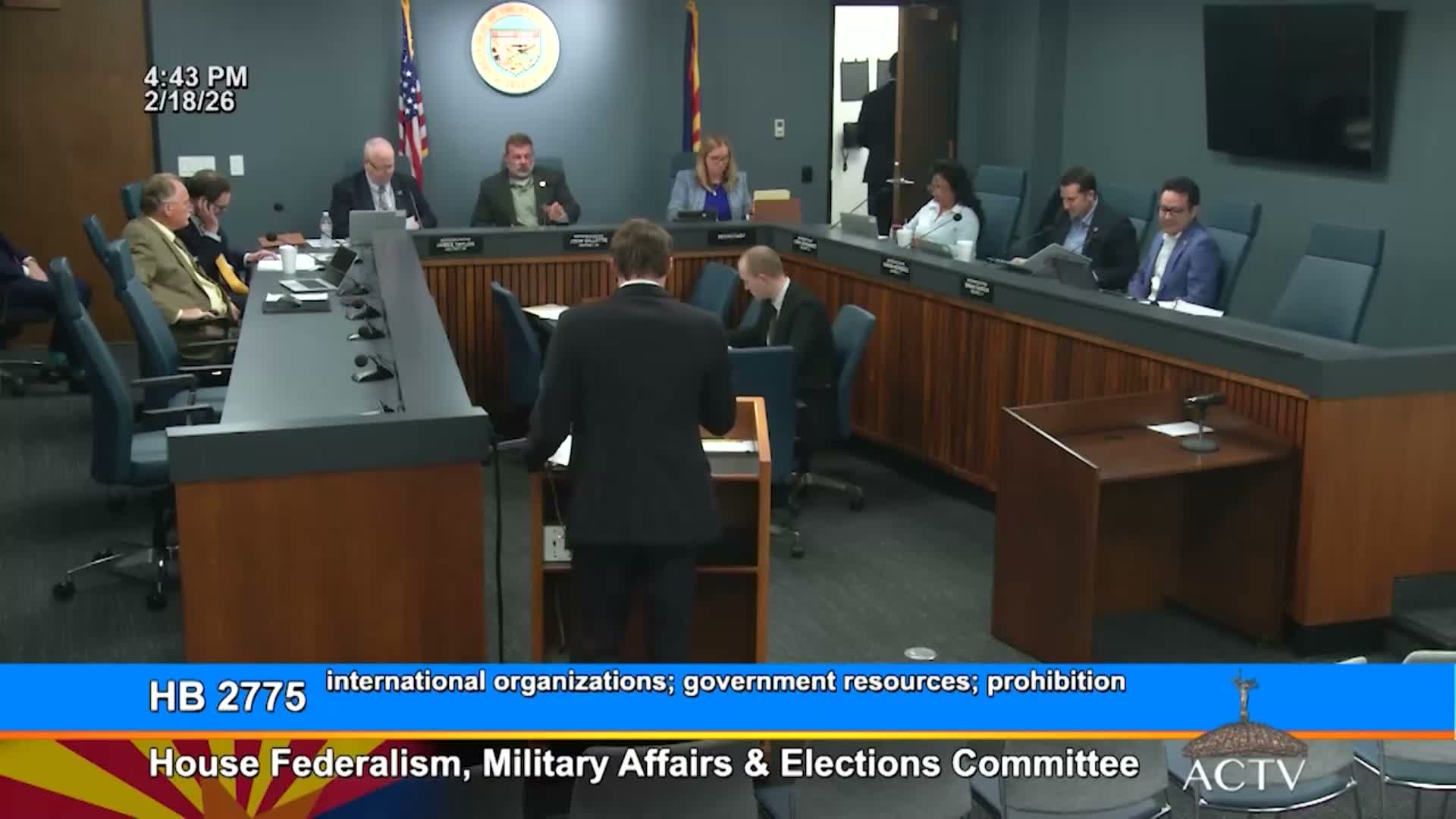
Summary
House Bill 2,775, as amended, would prohibit state agencies and public universities from knowingly using state assets to implement policies of enumerated international organizations; the committee adopted an amendment delegating review of covered university collaborations to the Arizona Board of Regents and advanced the bill 4–3.
A House committee on Thursday approved an amended bill restricting state entities’ use of assets for the implementation or enforcement of policies of specified international organizations and added a provision requiring Arizona public universities to submit proposed collaborations with such entities to the Arizona Board of Regents (ABOR) for approval.
The amendment adopted Feb. 17 removes earlier rulemaking authority language and instead requires ABOR review of any proposed loan, gift, contract, research partnership, memorandum of understanding or sponsored project that originates from or is funded by the listed organizations; the sponsor said ABOR may form a subcommittee to carry out the review.
Sponsor remarks framed the bill as a sovereignty measure. "Again, just trying to make an effort to give the state of Arizona absolute clarity when it chooses to exercise its sovereignty," the sponsor said, citing concerns about international influence on state policy. Supporters said the change clarifies state authority and prevents subnational policy deference to external bodies.
Representative Collin voiced concerns about rulemaking and constitutional separation of powers, praising the removal of a rulemaking provision. "Now that that rule making provision has been removed, I can vote for the underlying good, wonderful, and necessary bill," Collin said during debate.
The committee adopted the amendment and returned HB 2,775 with a due‑pass recommendation by a 4–3 vote. The sponsor said talks with universities and ABOR were ongoing as staff and members refined the bill’s scope and enforcement mechanics. The measure will proceed to additional legislative consideration.