Get Full Government Meeting Transcripts, Videos, & Alerts Forever!
Get email alerts on the Term Limits topic
No spam. Unsubscribe anytime.
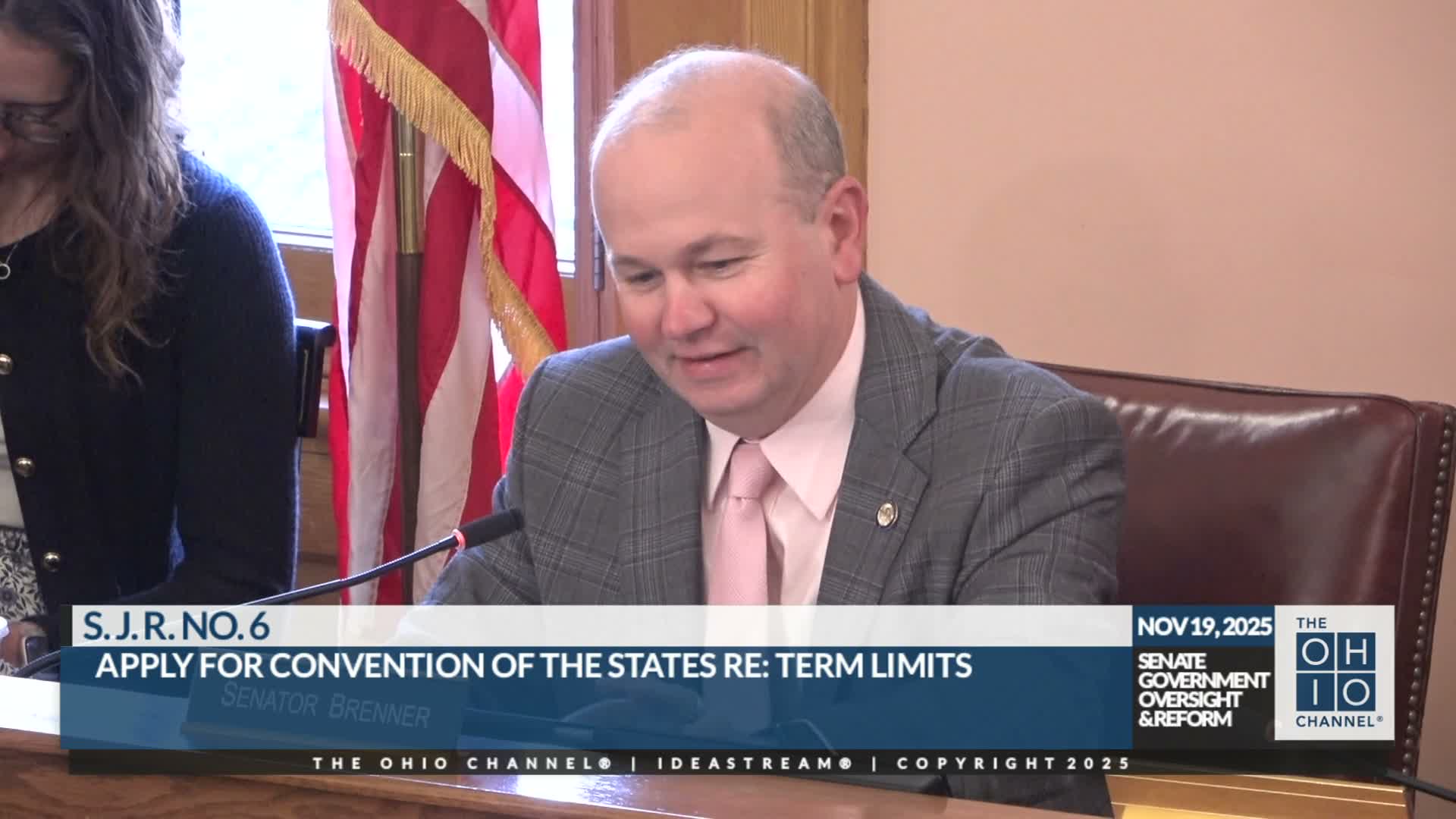
Committee Hears Proponents Urge Passage of SJR 6 to Press for Congressional Term Limits
Summary
Proponents told the Government Oversight and Reform Committee that SJR 6 would press Congress to act on term limits via the Article V process; witnesses cited high public support in Ohio and addressed concerns about runaway conventions, rescission, and grandfathering.
The Government Oversight and Reform Committee heard proponents of SJR 6 on the proposal to press for congressional term limits, with witnesses arguing the joint resolution would use the Article V process to compel Congress to act.
An unnamed proponent opened testimony by saying "the answer is term limits," arguing that support for limits spans party lines and citing a Scott Rasmussen poll they said showed roughly 80% of Republicans and 82% of Democrats in Ohio in favor. The witness urged the committee to "vote yes" on SJR 6 and said the measure would send pressure to Congress so lawmakers would act rather than waiting for a convention.
Les Chamblee, identified as regional director for US Term Limits, testified that his organization seeks a narrow, single-subject amendment imposing term limits on Congress. "We are not the conventional state's project," Chamblee said, distinguishing US Term Limits' approach from multi-subject Article V campaigns. He told the committee that some U.S. senators and representatives have indicated support for narrow, preemptive approaches to amendments.
Committee members questioned witnesses about perceived risks, including the possibility of a "runaway convention" and whether a state could withdraw its call. The unnamed proponent said a state "would have the opportunity to rescind the convention call the resolution at any time." Chamblee added that any amendment emerging from an Article V process would still require ratification by three-fourths of the states — 38 states — and stressed the high threshold for changing the Constitution.
Witnesses also discussed implementation details and political dynamics. Chamblee said practical proposals would likely center on multi-year limits and suggested realistic term ceilings might fall in an 18–20 year range rather than very short terms. He discussed "grandfathering," saying that when term limits are adopted federal lawmakers have historically been able to protect sitting members so that limits apply after current members leave the seat.
No formal committee vote or final action on SJR 6 was recorded in the transcript. The chair closed the hearing after questions and testimony and adjourned the committee.
The record shows proponents stressed public support in Ohio, described the Article V playbook as a tool to force congressional action, and answered committee questions about rescission, ratification thresholds and how term limits might be phased in.