Get Full Government Meeting Transcripts, Videos, & Alerts Forever!
Get email alerts on the Traffic Camera Regulation topic
No spam. Unsubscribe anytime.
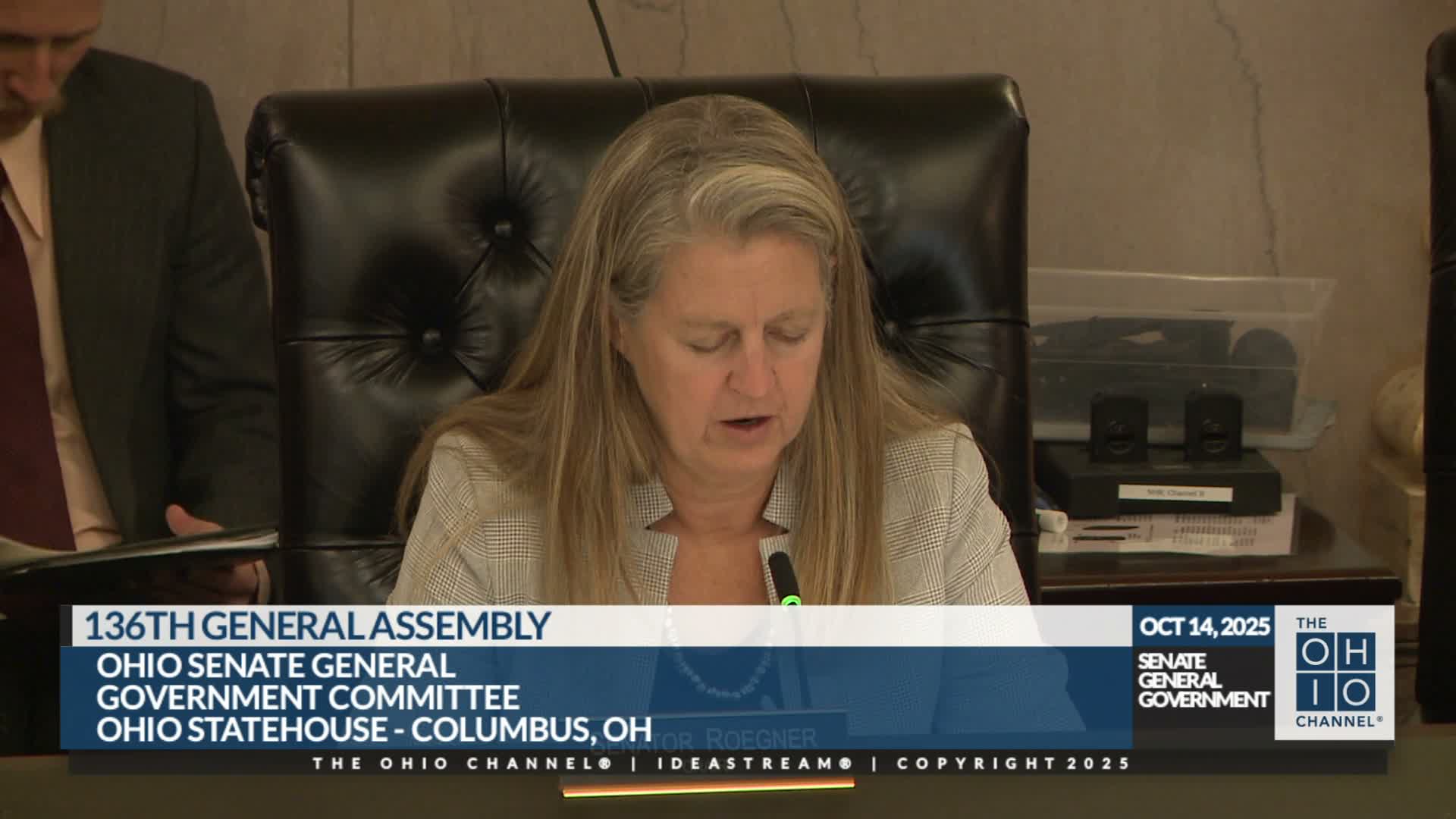
Senate hearing examines bill to license traffic‑camera companies, impose fees for first‑responder PTSD fund
Summary
Senator Patton told the Senate General Government Committee that SB213 would create a per‑camera license ($100,000), require monthly calibration by the Department of Public Safety (~$5,000/month per camera) and levy an 8% fee on revenues to fund a PTSD program for first responders; members pressed feasibility and data gaps, and no vote was taken.
Senator Patton urged the Senate General Government Committee to create a new licensure and fee structure for traffic‑camera companies, saying the state lacks a reliable count of devices and that an estimated $67,600,000 in camera revenue has flowed through the system.
Patton told the committee that "they believe that these traffic cameras have collected $67,600,000," and argued roughly 40% of gross receipts currently leave Ohio. He said SB213 would "create a licensure for traffic camera dealers with a per camera fee of $100,000 paid to the Department of Commerce," require monthly calibration by the Department of Public Safety (Patton cited a $5,000 monthly calibration cost per camera), and assess an 8% fee on revenues to support a PTSD fund for first responders.
The bill’s sponsor said the licensing and fees are meant to redirect revenue that now flows to out‑of‑state companies back to Ohio programs. "We are attempting to reroute some of this revenue back to Ohio," Patton said, and described the measure as a way to provide a funding mechanism for a PTSD fund established earlier in the General Assembly.
Members asked multiple operational and policy questions. Senator DeMauro asked, "You want the Department of Public Safety to calibrate these things every month. Is that even feasible?" Patton replied that if the department lacks capacity, the licensing revenue would cover hiring needed resources: "at $5,000 a month per camera, if we don't have enough people, we have enough resources to go out and hire the people to do that."
Committee members also pressed the sponsor on data gaps and the local financial impact. Senator Timken asked how many municipalities operate cameras; Patton said the committee has "no clue," describing the industry as decentralized and noting mayors and small villages sometimes act as local agents for companies. When asked whether municipalities would receive any of the proposed license fees, Patton replied that municipalities already receive about 60% of camera proceeds and that the bill targets revenue currently leaving the state.
Supporters framed the bill as a public‑safety and first‑responder funding measure; critics and some members warned of possible unintended consequences, including higher ticket costs for motorists if municipalities and operators raise fines. The committee took no vote on SB213 at this hearing; the measure was presented for sponsor testimony and questioning only.
What happens next: SB213 received a first hearing and sponsor testimony; no committee action or vote was recorded. Further hearings or fiscal analyses would be required before any motion to report the bill to Rules and Reference.