Get Full Government Meeting Transcripts, Videos, & Alerts Forever!
Get email alerts on the Election Administration topic
No spam. Unsubscribe anytime.
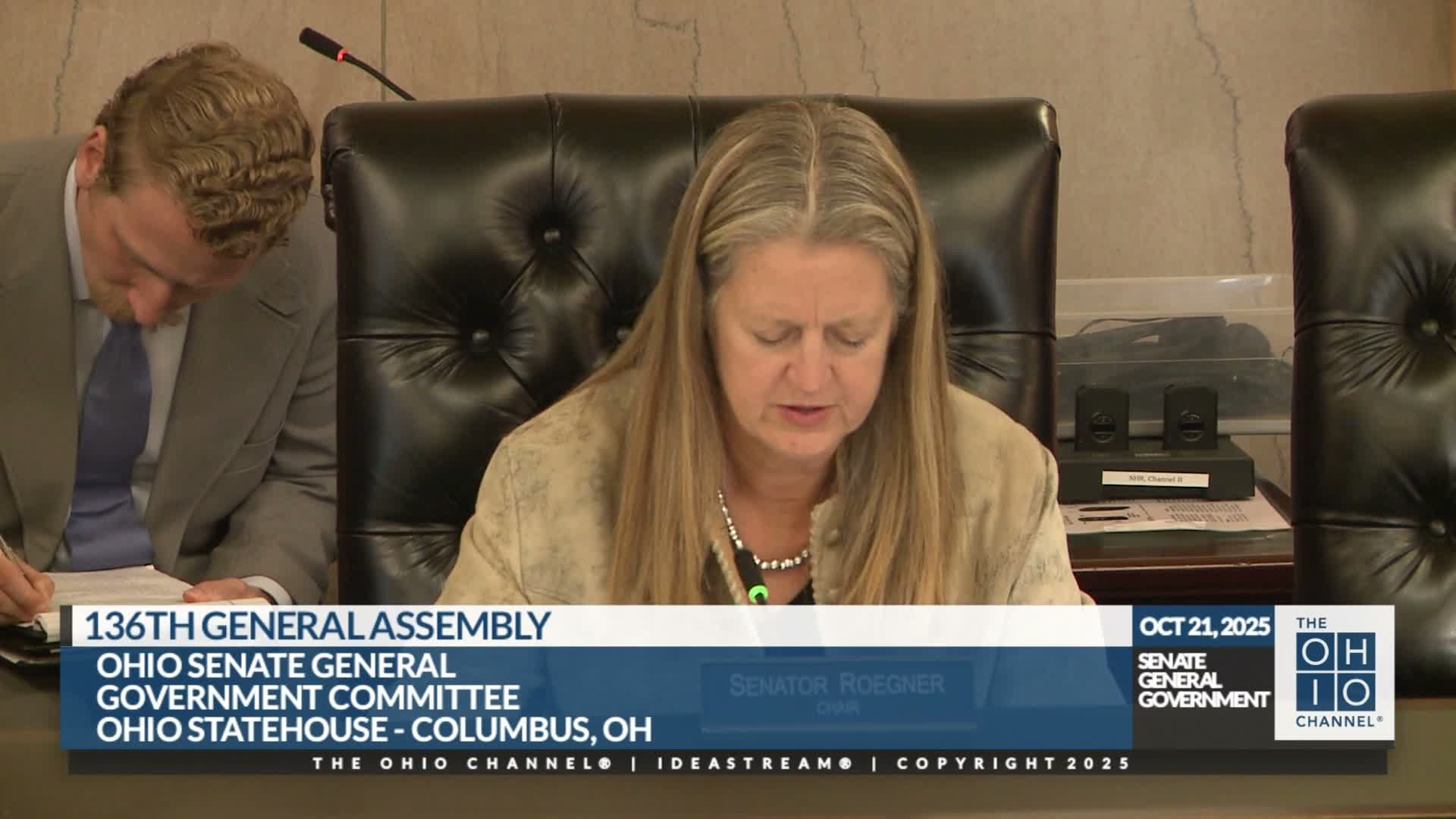
Ohio Senate committee hears bill to require absentee ballots be received by Election Day
Summary
At a Senate General Government Committee hearing, sponsors of Senate Bill 293 said the bill would eliminate Ohio's four-day post-election receipt extension for absentee ballots to align with federal election-day interpretations and to prevent fraud; committee members pressed sponsors on military voting and ballot counts.
At a hearing of the Senate General Government Committee, sponsors introduced Senate Bill 293, which would eliminate the four-day extension that currently allows some absentee ballots to be counted if received after Election Day.
Senator Gavaron, the bill's sponsor, told the committee the measure "will protect and improve the election process in Ohio" by removing ambiguity about when absentee ballots must be received and cited Republican National Committee v. Wetzel, a decision from the U.S. Court of Appeals for the Fifth Circuit, as interpretive guidance. "One case of voter fraud is too much," she said.
Senator Brenner, a joint sponsor, said the bill seeks to ensure timely and accurate results and to restore voter confidence by establishing a fixed receipt deadline on Election Day. Both sponsors said they would verify compliance with federal law and with UOCAVA requirements for military and overseas voters and would work with the Secretary of State's office on outreach and implementation.
Committee members raised practical concerns: Senator DeMora said "10,000 ballots from last year's election came in after [the] election day deadline," arguing the bill could disenfranchise voters; sponsors responded that they would provide counts and urged that boards of elections and the Secretary of State conduct education campaigns if the legislation advances.
Lawmakers also discussed postal-service delays and the absence of postmarks on some ballots. Sponsors pointed to alternatives such as 28 days of early in-person voting and ballot-drop options, saying the bill would remove ambiguity about postmark and receipt rules.
The committee concluded the first hearing; no vote on the bill was taken.