Get Full Government Meeting Transcripts, Videos, & Alerts Forever!
Get email alerts on the Insurance Reform topic
No spam. Unsubscribe anytime.
Broad insurance reform bill advances; targets uninsured motorist misuse, fraud and claims processing
Summary
House Bill 13 44, the Insurance Affordability and Claims Integrity Act, would add roughly 40 new fines, strengthen uninsured-motorist enforcement (including rules on 'excluded drivers'), expand Fortified Homes measures, and tighten storm-claims processing; the committee approved the bill by voice vote.
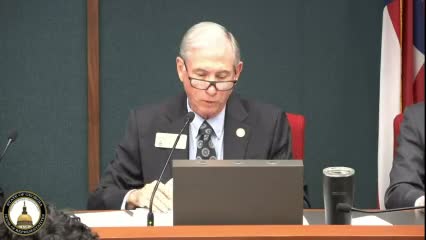
Representative Reeves presented House Bill 13 44, the Insurance Affordability and Claims Integrity Act, saying the package combines multiple measures from the Blue Ribbon Study Committee on insurance rates to make insurance more affordable and strengthen claims integrity.
Key provisions Reeves described include: adding nearly 40 additional enforcement fines, strengthening uninsured motorist law including clarifying 'excluded driver' mechanics, expanding the Fortified Homes program to help homeowners shore up roofs and reduce storm claims, tightening claims-processing requirements after disasters, cracking down on staged-accident fraud, and coordinating the Insurance Commissioner with the Department of Economic Development to attract insurer headquarters.
On "excluded drivers," Reeves said: "If you exclude a driver and get the benefit of a lower premium by excluding a driver you don't give them the keys and give them the car ... if somebody's an excluded driver they're gonna be classified as an uninsured motorist if they take the keys and drive." Committee members sought clarity about whether a third party injured by an excluded driver could sue the vehicle owner or insurer; Reeves said the bill focuses on uninsured-motorist compliance and ticketing and that it seeks to prevent shifting uninsured-motorist responsibility onto innocent third parties.
Members also discussed ZIP-code pricing and fraud prosecution; Bryce Rawson told members the department has agents working statewide on fraud cases and that ZIP-code level underwriting data is used by insurers under current law. After extended Q&A, the committee moved the bill by a voice vote.