Get Full Government Meeting Transcripts, Videos, & Alerts Forever!
Get email alerts on the Wildlife Management topic
No spam. Unsubscribe anytime.
Ohio witnesses split as Senate panel weighs constitutional right to hunt, fish
Summary
The committee heard extensive pro- and anti-amendment testimony on Senate Joint Resolution 8, a proposal to enshrine hunting and fishing as a constitutional right. Opponents warned vague language could limit Ohio Department of Natural Resources authority and invite litigation; proponents stressed heritage and preemptive protection. The committee took no vote.
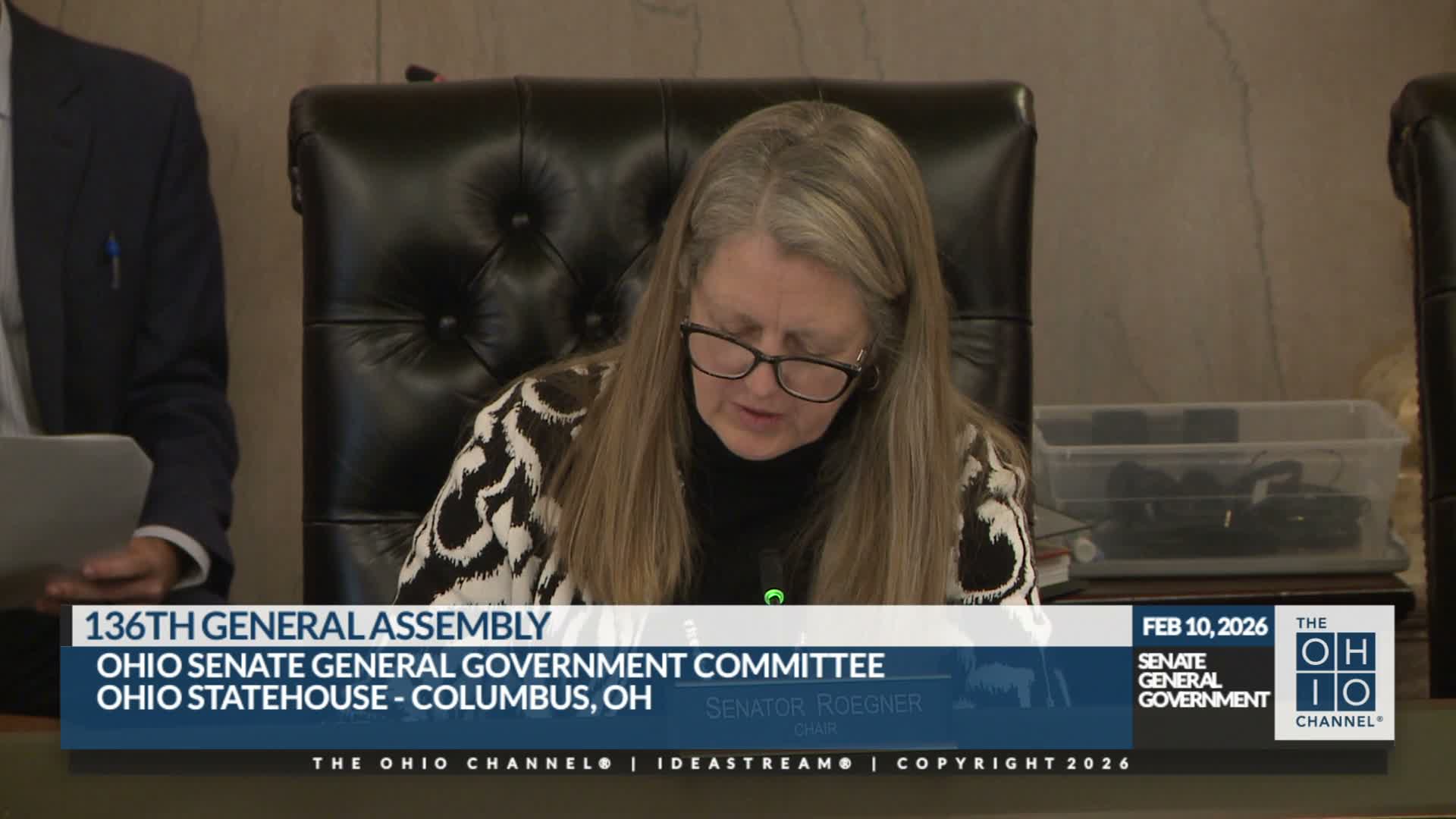
The Senate General Government Committee heard sharply divided testimony on Senate Joint Resolution 8, which would place a constitutional right to hunt and fish on the ballot.
Opponents — including Erica Davidson of Columbus Animal Advocates, Kaylee Leary of Ohio Animal Advocates, Mark Finner of Humane Society for Animals, and Vicki Diesner of the Animal Welfare Institute — urged the committee to reject the resolution or send it back for redrafting. They argued the measure is unnecessary in Ohio, uses vague language such as "traditional methods" that could protect controversial practices like trapping or off-highway pursuit, and could limit the Ohio Department of Natural Resources' (ODNR) ability to adopt science-based wildlife-management rules. "The resolution is ambiguous and would create significant regulatory uncertainty," testified Mark Finner, the organization's Ohio state director.
Proponents included Michael J. Budzik, a longtime sportsman and former ODNR official, Amanda Seficul speaking for the National Rifle Association, Travis Thompson of the International Order of Theodore Roosevelt, and Candy Petticord of Women for Gun Rights. Proponents said the amendment merely affirms longstanding traditions and safeguards outdoor heritage. "This amendment safeguards Ohio's outdoor heritage and preserves these freedoms for future generations," said Amanda Seficul representing the NRA.
Questions from senators focused on concrete legal effects — whether the amendment's "preferred" language could preempt local ordinances (for example, city limits on discharging firearms), restrict ODNR's nonlethal management options, or invite litigation over property rights and trespass. Witnesses for opponents cited Section 153.08 (testimony referenced Section 1531.08 of the Ohio Revised Code) as evidence that ODNR already has statutory authority to manage wildlife and warned that ambiguous constitutional language could undermine that statutory framework.
The hearing included many written submissions (committee staff noted dozens of written testimonies), and committee leadership adjourned after testimony; there was no floor or committee vote on the amendment at the conclusion of the session.