
Urbana commission reviews Section 106 timeline after SHPO finds Civic Center eligible
Get AI-powered insights, summaries, and transcripts
Subscribe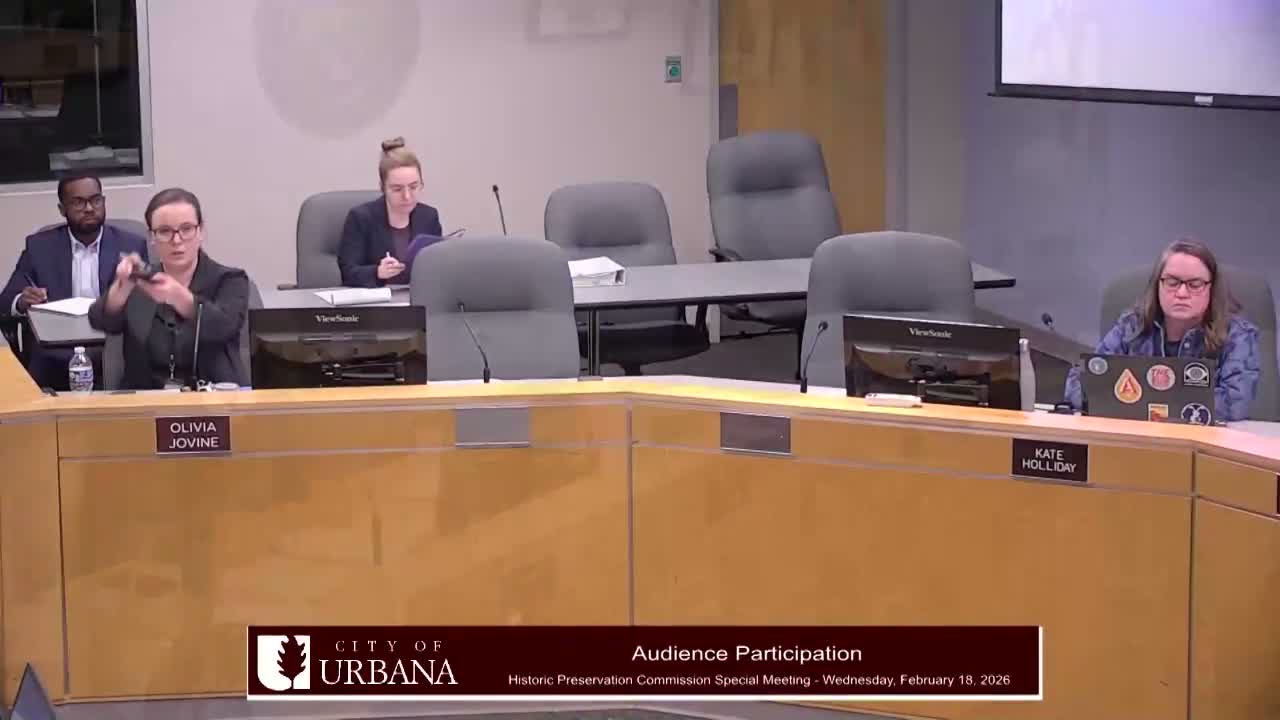
Summary
At a Feb. 18 special study session, Urbana staff outlined a multi‑year Section 106 and NEPA timeline tied to a proposed MTD downtown transfer center. SHPO has found the Urbana Civic Center eligible for the National Register while FTA and a consultant initially concluded no adverse effects; the MOA requires HIBS Level 3 documentation before any demolition.
The Urbana Historic Preservation Commission held a special study session to review the federal Section 106 consultation and NEPA timeline for a proposed Champaign‑Urbana Mass Transit District (MTD) downtown transfer center at the Urbana Civic Center, 108 East Water Street.
Staff told the commission that FTA’s January 2025 cultural‑resource report initially concluded the proposed project would have no adverse effects, but the Illinois State Historic Preservation Officer (SHPO) disagreed and determined the Civic Center eligible for the National Register under criterion A (community recreation and culture) and criterion C (modernist design). Staff said a memorandum of agreement (MOA) was later signed by FTA, SHPO and MTD; the MOA requires MTD to contract a qualified professional to record the Urbana Civic Center under Illinois Historic Building Survey Level 3 documentation prior to any potential demolition.
The room heard competing explanations for how the process unfolded. Joseph Altschuler, an assistant professor at the University of Illinois who led a student studio on the site, said the studio was intended to explore adaptive‑reuse options and ‘‘to make the existing civic center part of a richer civic and transit use,’’ while acknowledging adaptive reuse was not framed by MTD as the agency’s primary outcome. MTD’s representative, Ashley McLaughlin, said the agency ‘‘does not believe we can utilize it for transit purposes’’ in its current footprint and explained that safe circulation for 40‑ to 60‑foot vehicles would require at least partial removal or reconfiguration.
Public speakers and several commissioners urged exploring reuse or selective alteration. A preservation advocate, Phyllis, told the commission: ‘‘We deserve better than just tearing this down,’’ and asked the commission to press for alternatives. Commissioners highlighted options they can pursue under local code, including preparing testimony for city council, filing a local landmark nomination, and hosting follow‑up study sessions focused on ensuring future Section 106 processes include clear communication with the Historic Preservation Commission.
Staff and participants summarized key administrative milestones: the Civic Center was closed by city council action effective Dec. 31, 2018; the city’s facility master plan (July 2020) and CIP (June 2023) later listed the Civic Center as a capital backlog and a candidate for divestment; MTD and FTA initiated NEPA/Section 106 consultation in 2024; the consultant retained by MTD produced a November 2024 survey that staff said recommended the building was not eligible; SHPO later found the building eligible and identified adverse effects; in late 2025–early 2026 the MOA was signed and transmitted to the Advisory Council on Historic Preservation.
The commission asked staff to provide documentation, including the February city letter that initially agreed with FTA’s ‘‘no adverse effects’’ submission and the consultant report identifying the firm that prepared the architectural evaluation. Staff agreed to provide the requested letters and to place a continuation of the study session on the March 4 agenda so commissioners could formulate possible actions within their statutory authority.
No formal vote was taken at the special meeting. The chair granted a three‑minute time extension for public comment under the bylaws, and the session concluded with a motion to adjourn at 9:02 p.m.
Next procedural steps on the commission’s list included additional study sessions, possible testimony before city council, and consideration of a local landmark nomination; staff flagged Open Meetings Act limits for commissioners conducting out‑of‑meeting coordination.