Get Full Government Meeting Transcripts, Videos, & Alerts Forever!
Get email alerts on the Environmental Regulation topic
No spam. Unsubscribe anytime.
Council adopts critical‑areas update increasing some stream buffers and reinstating setbacks
Summary
The council passed Ordinance No. 2026‑683 updating critical‑areas code: it reinstates a building setback, allows limited rebuilding on fully covered sites, and uses a predictive model to increase some stream buffer minimums (e.g., from 100 to 150 feet for certain fish‑bearing streams).
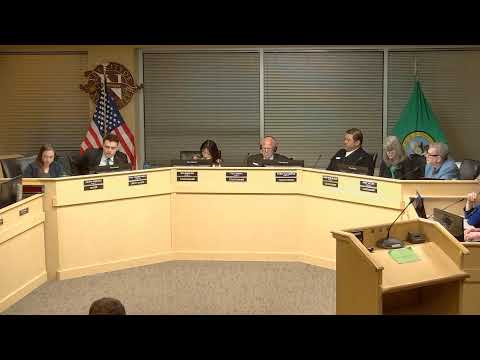
The Newcastle City Council voted unanimously on Feb. 17 to adopt an update to the city’s critical areas ordinance aimed at implementing state requirements and best‑available science for buffer widths and setbacks.
Planning Director Fitzgibbons summarized the work, which began in May 2025 and included outreach last summer. The ordinance contains multiple changes; staff identified three areas that drew the most comment: (1) an exception that would allow rebuilding on sites fully covered by critical‑area buffers, permitting up to a 500‑square‑foot expansion provided it does not move closer to the critical area; (2) reinstatement of a 10‑foot building setback to reduce future buffer encroachments; and (3) adoption of a recommended predictive model for stream buffers that increases the minimum distance for some streams — for example, Fitzgibbons said the current code for a fish‑bearing stream (Type F) is 100 feet and the proposed code would be 150 feet in some circumstances.
Fitzgibbons said the predictive model affects fewer parcels than an alternate tree‑height model the Department of Fish and Wildlife had referenced and that most changes align with state minimums. Council member Frost Blakely moved adoption of Ordinance No. 2026‑683; Council member Griffin seconded and the ordinance passed 7–0.
Fitzgibbons told the council that the amendments are largely responsive to state requirements and that a 10‑foot setback recommendation drew positive agency comments.