Get Full Government Meeting Transcripts, Videos, & Alerts Forever!
Get email alerts on the Holly Springs Utility Recovery topic
No spam. Unsubscribe anytime.
Holly Springs officials tell PSC progress made after Winter Storm Fern but disagree on scale, cost and rate fixes
Summary
Holly Springs officials told the Mississippi Public Service Commission they have reduced complaints, replaced meters and restored most residential customers after Winter Storm Fern, but disagreed with outside assessments about the total cost to stabilize the system — $110 million cited in one report versus the city's consultant's $10–15 million estimate — prompting commissioners to press for clearer analyses and rate-setting plans.
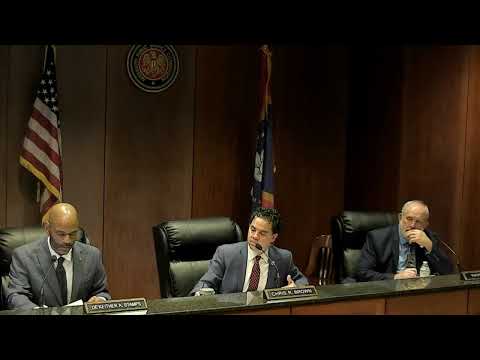
Holly Springs utility officials told the Mississippi Public Service Commission on the docket meeting in February that they have made measurable progress repairing systems damaged during Winter Storm Fern, but they and commissioners sharply disagreed over how much investment the utility needs and who should pay.
Michael Watson, the city's consultant and acting general manager for utility operations, said the utility has cut customer complaints from 2024 levels, contracted to replace roughly 2,000 meters (about 60% complete), and implemented an internal outage-management system that will soon be public-facing. "We're making steady progress," Watson said, adding that meter replacements and corrected billing cycles would allow the utility to reinstate late-payment fees and reduce billing errors.
The dispute centers on the scale of capital investment required. Watson said the data he reviewed across comparable utilities suggest Holly Springs needs roughly $10 million to $15 million in capital investments to reach median plant investment levels, plus a maintenance budget on the order of $4 million a year. That estimate contrasts with a figure presented in an earlier report that residents and some stakeholders have cited: $110 million to "stabilize" the system. Watson called that larger number "outrageous" relative to the size of Holly Springs and said it likely conflated total revitalization with other scenarios.
Commissioners pressed for clarity. "If the $110 million number was total revitalization and your $10–15 million was routine capital, that may explain part of the difference," the Chair said. Commissioner Stamps said the commission needed certainty about numbers and timelines: "Who's going to pay for it?" he asked, arguing that reliability cannot be pursued without setting appropriate rates.
Watson and Holly Springs representatives said rate authority for the electric side rests with TVA, not the PSC, and that the last rate change affecting Holly Springs dated to 2009. Watson said TVA and local rate consultants are working on a recommended rate adjustment and he estimated that improved metering and meter-testing practices could yield $0.5 million to $1.25 million annually in recovered revenue.
Budget lines and operational fixes were described in practical terms. Watson estimated defective poles and maintenance backlogs were a principal driver of long outages and described pole replacement "all-in" costs in the $2,000–$2,500 range per pole. He said the utility has identified substantial maintenance shortfalls and was working to implement an integrated vegetation-management and equipment-maintenance program.
On the customer side, commissioners and PSC staff recounted distressing household impacts during the storm and urged continued outreach. Watson said peak outages exceeded 11,000 meters but that, as of his latest update, residential accounts with intact weatherheads had been restored. The city has also sought mutual-aid crews and contracted outside crews; Watson said more than 100 outside employees supported restoration, including linemen and tree trimmers from neighboring municipalities.
Commissioners reiterated oversight and governance questions. Several noted that a large share of the utility's connections are outside Holly Springs' city limits, creating representation issues for county customers, and they discussed proposals for an independent or reconstituted local board to give outside customers a voice. Commissioner Stamps emphasized the regulatory obligation to set rates that sustain system operations and said the commission had imposed a $12,500-per-day fine to press urgency on remediation.
The commission asked Watson to provide his underlying analysis and comparisons to back the $10–15 million figure and to clarify which items would be covered by routine capital versus full revitalization. Commissioners said they would expect a timeline and clear data before any formal rate actions and that safety and transparency must remain priorities as repairs continue.
The commission thanked the Holly Springs delegation for appearing and asked for follow-up documents and analyses from Watson and city officials.
The commission adjourned after additional brief administrative items.