
Kansas committee hears mixed testimony on bill to allow triple trailers on non‑interstate highways
Get AI-powered insights, summaries, and transcripts
Subscribe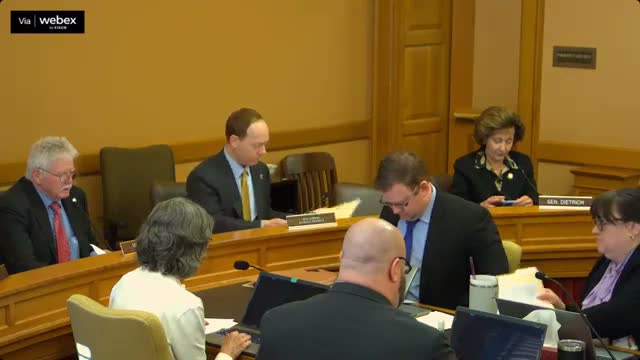
Summary
Lawmakers and witnesses debated Senate Bill 411, which would permit one‑truck/three‑trailer combinations on non‑interstate state highways, raise off‑interstate gross weight limits to 140,000 pounds and increase permitted combination length; supporters said design spreads axle loads and could cut truck counts, while KDOT and safety groups warned of federal funding risks, bridge and crossing impacts, and public‑safety concerns.
TOPEKA — The Kansas Senate Transportation Committee heard hours of testimony on Senate Bill 411, which would allow one‑truck/three‑trailer combinations on state highways outside the interstate system by raising combination length and off‑interstate weight limits.
Adam, the bill presenter, told the committee the measure would raise the current combination length limit (now cited at 65 feet in the hearing) to as much as 86 feet and would increase the maximum gross weight off the interstate system to 140,000 pounds, while the 80,000‑pound limit on the interstate would remain unchanged. The bill also would allow dealer license plates for short demonstrations, subject to statutory weight and length limits.
Proponents, including trailer builder Kenny Doonan of Great Bend, said the triple‑trailer design they described uses shorter (about 19‑foot) trailer bodies and axle spacing intended to spread loads and reduce pavement stress. "By going these trucks with the triple trailers, we'll reduce the trucks on the highway by 40%," Doonan said, arguing the configuration could help address driver shortages and lower overall roadway wear where the units are appropriate.
But Joel Skelly, director of policy at the Kansas Department of Transportation, warned of federal constraints and fiscal risk. Skelly cited a 1991 federal ‘‘freeze’’ that restricts triple‑trailer operation to only a few federally recognized routes and said federal law and related Code of Federal Regulations provisions limit length and weight on the National Highway System. "This would pull back approximately $187,000,000 a year," Skelly told the committee, describing the potential annual reduction in federal highway funds if Kansas were found to be out of compliance.
Skelly also said the department would need to re‑evaluate thousands of structures if the weight limits changed: "You basically have your engineers model with the weights distributed out … and that has to be modeled for what those bridges are designed for," he said, noting roughly 5,000 state bridges and an additional roughly 20,000 locally owned bridges would be implicated.
Other opponents raised safety concerns. Trooper Nick Wright of the Kansas Highway Patrol said heavier combinations would take longer to stop and could elevate crash severity. Railroad representatives and current and retired rail workers warned that long, heavy combinations can struggle at rail grade crossings, become high‑centered or fail to climb inclines at crossings, and that heavier loads could increase wear on railroad crossings that railroads must maintain.
Supporters and neutral stakeholders proposed mitigations: targeted route designations, permitting, temporary demonstration periods (Doonan suggested a three‑day dealer demo limit), weather‑based restrictions (removal of a trailer when conditions make operation unsafe) and speed limitations on designated routes. Several committee members asked KDOT and proponents for more data comparing other states' policies and for a technical plan to address bridge and crossing exposure and insurance implications.
The committee did not take a final vote on SB 411. Members said more work was needed — including possible route restrictions, permit structures, and federal‑compliance analysis — before the bill could proceed.
The hearing record includes detailed exchanges among committee members, KDOT staff, law enforcement and industry representatives on federal rules, bridge engineering, and the fiscal consequences of changing weight and length allowances.