
Senate committee advances S.255 to pilot regional policing in Windham County
Get AI-powered insights, summaries, and transcripts
Subscribe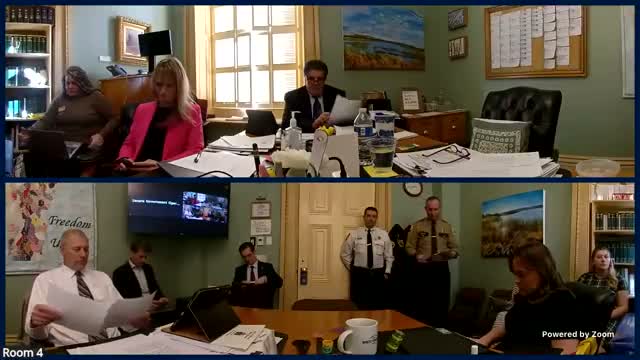
Summary
The Senate Committee on Government Operations voted to pass S.255, a five-year pilot to create a law enforcement governance council in Windham County. State police and local chiefs supported a regional model while urging clear accountability, replicability and funding clarity.
The Senate Committee on Government Operations voted to advance S.255, a bill to establish a five-year pilot law enforcement governance council in Windham County, after testimony from state and local law-enforcement leaders and residents.
The measure, as amended, passed out of committee following a roll call in which named senators on the record voted four in favor and one opposed. Senator Wade moved to advance the bill with amendments; the committee adopted the amendment and then reported the bill as amended.
The bill’s supporters and witnesses told the committee the pilot is intended to test whether a regionalized policing model can produce more equitable and stable coverage for rural communities. "The policing structure in Windham County, as you well know, is very fragmented, to say the least," Jeremy Evans, assistant police chief in Brattleboro, said in testimony supporting the pilot. Evans said Brattleboro officers responded to more than 100 incidents last year outside their jurisdiction and that a regional model could provide more consistent mutual aid.
State Police Director Matt Birmingham said the Department of Public Safety "supports regionalized models" in principle but urged careful design. Birmingham provided staffing figures to illustrate capacity constraints: the state police employ about 316 sworn officers with roughly 38 vacancies (about a 12% vacancy rate), he said, and the Westminster barracks that covers the Windham pilot area fields about 21 troopers and handles roughly 4,500 calls a year. Birmingham told senators any regional model must include these three elements: a law-enforcement executive answerable to an elected or appointed body; a framework that can be replicated statewide; and an organizational design that does not depend on a single elected official to succeed.
Pam McManus of the Department of State’s Attorneys and Sheriffs told the committee S.255 "has absolutely no impact on our department," because it is a county-based contracting model and does not change state transport-deputy responsibilities; her office said it would monitor implementation if the pilot moves forward.
Local officials and a Windham County citizen said the governance council is the place to answer questions about who hires a chief, how services are funded and how replication would work. Janette White, a Windham County resident, urged lawmakers to treat the measure as a true pilot: "That's what a pilot is for — to answer these questions," she said.
The bill includes a five-year sunset and language to make participation voluntary for municipalities; committee members said that timeline should allow time for recruitment, academy certification and evaluation of costs. Members also discussed funding mechanics, with the chair clarifying the measure uses county tax mechanisms and is not a new municipal property tax but a different route for collecting and dispersing existing payments for police contracts.
The committee’s action: Senator Wade moved to advance S.255 with amendments; the amendment was adopted and the committee reported the bill as amended, with a roll-call showing four yes and one no on the record. The committee indicated it will transmit the amended bill for further action and flagged the likelihood of additional amendments before second reading.
The committee adjourned and said the bill will be noticed for the next steps in the legislative calendar.