Get email alerts on the Dementia Training topic
No spam. Unsubscribe anytime.
Hoffman Estates trains public-facing workers on dementia-aware interactions
Summary
Lynn O'Malley led a community training under the Hoffman Estates Dementia Friendly Initiative teaching bank, retail, restaurant and transit staff simple, practical steps—approach from front, offer two choices, use visuals—to support people who may be living with dementia.
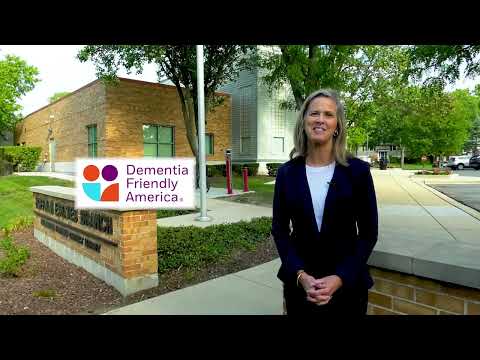
Lynn O'Malley, a certified dementia and community educator, led a training for public-facing workers as part of the Hoffman Estates Dementia Friendly Initiative, offering practical communication and environmental strategies to help people who may be living with dementia.
"With just a few simple techniques, you can help someone feel supported, safe, and respected," O'Malley said, framing the session around brief, actionable steps for bank tellers, retail staff, restaurant servers and transit employees.
O'Malley explained that the brain can change with age and that dementia is a cluster of symptoms affecting memory, problem solving, language and coordination. She used a visual analogy to describe how everyday spaces can appear overwhelming to someone with cognitive impairment: "The world may feel like a scuba mask to them," she said, illustrating reduced peripheral vision, difficulty judging depth and sensitivity to movement and clutter.
The training emphasized simple techniques staff can apply immediately: stay in the person’s visual range; approach slowly and from the front; pause slightly before speaking; greet in a pleasant tone; get to eye level if the person is seated; and use slow, open-hand gestures. O'Malley demonstrated short, permission-based openings such as, "Hi there. I'm here to help. Is that okay?" and recommended offering brief compliments to build connection.
To reduce decision-making stress, O'Malley advised avoiding open-ended questions and instead offering two clear options at a time (for example, "Would you like soup or a sandwich today?"). She also recommended using visuals—menus, photos or gestures—and being patient with repetition: calmly repeating answers rather than correcting or rushing the person.
The trainer urged staff to validate feelings before redirecting: a phrase like "that sounds confusing" acknowledges frustration and can help de-escalate a moment, she said. When possible, O'Malley suggested moving the person to a quieter or less stimulating area.
The session concluded with a brief review of the main points and a reminder that small, kind interactions can make Hoffman Estates more dementia friendly. For additional information about the initiative, O'Malley directed participants to www.hoffmanestates.org/dementiafriendly.
AI generated
The text on this page is AI generated. Summaries, highlights, analysis, and video transcripts are all produced from the original source material.
AI can make mistakes, so if you spot one, and we will fix it for everyone.
Note: the source content is unaltered by us. Any content source we link to, be it a video, an audio recording, or a document, is presented exactly as its publisher released it. That publisher is usually a government body, sometimes an individual official or another organisation.