
DeSantis urges Kentucky lawmakers to back balanced-budget amendment, defends Article V safeguards
Get AI-powered insights, summaries, and transcripts
Subscribe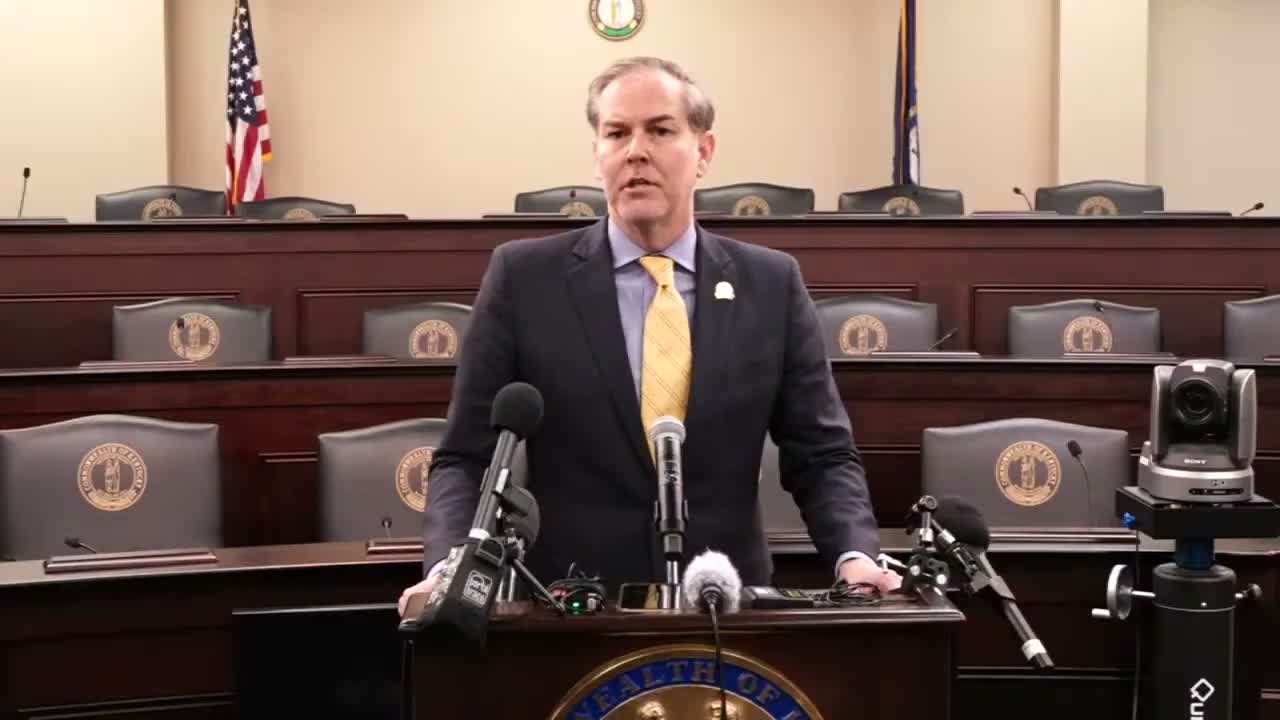
Summary
Gov. Ron DeSantis testified at a Kentucky hearing in favor of House Resolution 45, arguing a balanced‑budget amendment and state-led Article V action are needed to curb federal debt; witnesses and lawmakers pressed him on safeguards, delegate rules and related proposals including term limits.
At a session held at the annex, Gov. Ron DeSantis urged Kentucky legislators to support House Resolution 45, a proposed balanced‑budget amendment, saying states must act to place constitutional restraints on Congress to curb what he described as accelerating federal debt.
DeSantis told the committee he supports the measure and framed it as a practical response to long-term fiscal trends, arguing that state-level constraints can provide both structural limits and political cover for elected officials. "This balanced budget amendment is important," he said, calling state action a path to change the country’s fiscal trajectory.
The case for the amendment was framed in historical terms: DeSantis and Lauren Enns, who leads the National Campaign for a Balanced Budget Amendment, cited the near‑passage of an amendment in the 1990s and said states have used their authority to press for national change. Enns recounted the 2008–10 financial crisis and post‑crisis borrowing, saying the bailout and emergency spending altered the country’s fiscal path. "We borrowed, I think, $1,800,000,000,000 total that year to survive the housing bubble," Enns said while describing how cumulative borrowing has grown since 2010.
Lawmakers and audience members pressed DeSantis on legal and procedural safeguards. One question asked how supporters could ensure an Article V convention would not open the entire Constitution to revision. DeSantis responded that state legislatures can set rules for delegates, that several states have enacted "faithful‑delegate" laws and that delegates can be recalled. "An Article 5 convention cannot change the constitution. It's simply one mechanism of proposing," he said, noting that any amendment ultimately requires ratification by three‑quarters of the states.
DeSantis also tied the amendment to other reform efforts discussed at the session, including a mention on the House side of a separate measure on congressional term limits (introduced as a senate/house joint resolution during the session). He described term limits as complementary to fiscal reform and said he has worked on term‑limits proposals for about 15 years.
The governor addressed political questions from attendees, including an exchange about comments by Kentucky Gov. Andy Beshear. DeSantis criticized Beshear’s record on several issues and said he "wears that as a badge of honor" when criticized. Those remarks were made in answer to a question about why DeSantis was campaigning in Kentucky.
On specifics about fiscal management, DeSantis pointed to Florida’s use of line‑item vetoes, spending curbs and a growing rainy‑day fund as examples of state fiscal discipline. He contrasted those choices with federal debt growth and rising interest payments, arguing the amendment would impose enduring constraints on future Congresses.
No formal motion or vote on House Resolution 45 was taken during the session. DeSantis’s testimony was followed by questions from lawmakers and other attendees; advocates urged Kentucky to join the growing number of states supporting the amendment to reach a threshold that could prompt congressional or interstate action.
The hearing produced no immediate legislative action recorded in the transcript; the discussion ended after audience questions and DeSantis’s closing remarks.