Council directs staff to refine lead service line ordinance ahead of federal grant deadline
Loading...
Summary
The Wisconsin Rapids Common Council directed staff to revise a lead service line replacement ordinance and return it to Public Works, noting an estimated ~500 of the city’s 7,500 services may be lead-impacted and that an ordinance is needed to apply for Safe Drinking Water Act funds in June.
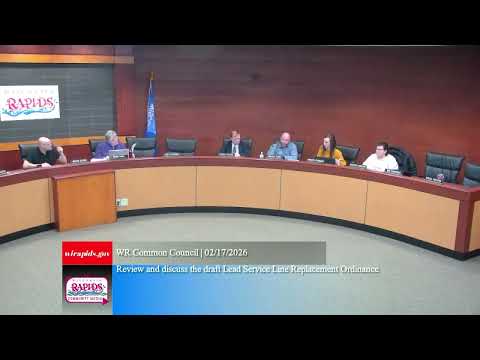
The Wisconsin Rapids Common Council on an evening meeting voted unanimously to direct staff to review and finalize a draft ordinance requiring replacement of lead or otherwise impacted galvanized water service lines and return the ordinance to the Public Works Committee for further review.
Councilmember Pompquist said committee members asked for more time to refine the draft so residents would have clearer timelines and more understandable language. An unidentified city staff member told the council the city currently estimates roughly 500 of about 7,500 service lines are either galvanized and impacted by lead or are lead services, and that an ordinance is the first step to pursue Safe Drinking Water Act funding. “This will be the first step…start with the ordinance, then start looking at your funds, and then look at how you’re going to administer it,” the staffer said.
City staff also told the council the state statute prevents the city from performing private-property replacements directly; city crews can perform ancillary work associated with public-side replacements but cannot replace customer-side service lines on private property. The staff explanation cited consultation with the municipal attorney on statutory limits.
Council members discussed notice windows and coordination with street reconstruction projects so residents are not unfairly required to replace lines at the same time as unrelated street work. The draft ordinance in the packet, the council was told, includes notice language (120 days and a minimum 45-day notice) and a placeholder referencing possible financial assistance programs; city staff said those program details would be added later once funding sources are known.
Members stressed the timing: staff said the ordinance needs to be in place so the city can apply for Safe Drinking Water Act funds in June; if the ordinance is passed in March, the city would still be eligible to apply in June, but missing that milestone would delay applications into 2027. Council voted to direct staff and the municipal attorney to review and refine the ordinance language and return it for public-works review; the motion passed 7-0.
The council did not adopt an ordinance at the meeting; it directed staff to prepare a final version for committee consideration. Questions about the eventual availability and amounts of grant funding remain unresolved and will shape whether and how the city can offset homeowner costs.