
Buxton residents press county on dune placement, easements and whether nourishment changes buildability
Get AI-powered insights, summaries, and transcripts
Sign Up Free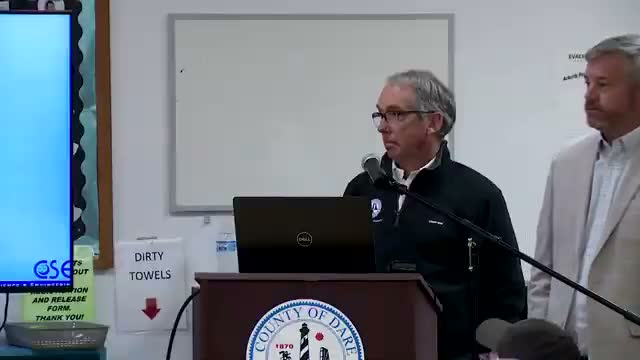
Summary
At a Dare County meeting residents pressed officials over where new dunes will sit, whether easements are required, and whether beach nourishment can make currently unpermittable lots buildable; county staff cited statute and said nourishment does not create new building rights.
Residents from Buxton pressed Dare County officials for details about the dune line, easement requests and whether nourishing the beach creates legal rights to build on previously unpermittable lots.
Manager Bobby Outen told the audience the county has asked oceanfront property owners to sign easements to allow dune construction and had received returns for all but four lots. He warned that “beach nourishment is not gonna make a property that's unbuildable today buildable,” citing a statute (quoted in the meeting as “UGS 146-6”) that, according to staff, prevents newly placed public sediments from being used to expand building footprints, septic coverage or other lot-area calculations.
Residents asked detailed technical questions about where the mean high-water line is measured and whether surveys use local tide data or a longer averaging period. Staff said engineers will refine the dune line using drone imagery and on-the-ground surveys before construction; they estimated roughly seven to eight houses today could fall into the projected dune line and that three were expected to be moved, with others already lost to overwash.
Officials committed to continued one-on-one outreach with affected property owners and to publishing drawings and a project FAQ online. Outen said the county will not place dunes over houses and will “go around” standing structures where feasible, but acknowledged there will be a small number of properties that require separate mitigation discussions depending on timing, house stability and changing shoreline conditions.
On taxation and lost lots, staff explained that tax assessments reflect the condition of property on January 1 each year; if a house existed on that date but washed away later in the year, owners remain liable for that tax year but subsequent assessments could treat a lot as a “washout” with no tax if it has no remaining value.
Next steps: county staff will meet directly with property owners in affected areas, share draft drawings from drone surveys, and publish answers on a dedicated project web page and FAQ.