Council advances Singer Island zoning change on first reading amid resident pushback
Loading...
Summary
The Riviera Beach City Council advanced a text amendment to RM-20 zoning on first reading that would ease high-rise setbacks in exchange for a fee-in-lieu parks trust; council members and residents debated shadowing, wind, process and possible special-exception safeguards before the 3–2 vote.
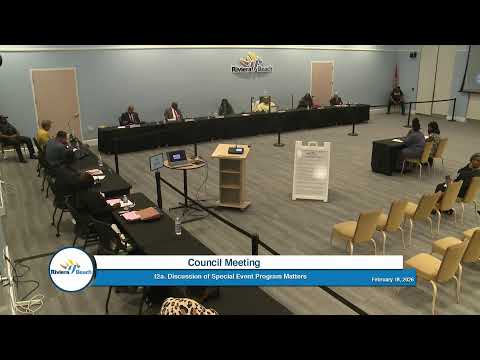
Council members on Feb. 18 voted in favor of advancing Ordinance No. 4279 — a text amendment to the RM-20 zoning code affecting Singer Island — on first reading, despite sharp public opposition and calls to return the proposal to Planning & Zoning for further review.
The amendment would alter the city’s “high-rise” setback requirement (currently a 20-foot minimum plus 2 feet of additional setback for each story above the second) by allowing developers to reduce the enhanced setback in exchange for payments into a newly created open-space/parks trust fund. Staff told the council it identified five narrow parcels in the RM-20 district that are constrained by the existing high-rise setback standard and that the proposed text includes a fee-in-lieu formula: $50,000 per quarter-acre of required on-site open space not provided, with a stated minimum contribution of $100,000 per project.
Why it matters: supporters say the amendment would allow redevelopment of narrow lots and generate new revenues for parks, impact fees and ad valorem taxes; opponents say it substitutes cash for required on-site open space and could set a precedent that changes the island’s development character and coastal risk profile.
Clarence Sermons, the city’s director of development services, told the council staff had measured lot widths and distances between existing towers and found examples of towers and narrow lots where the extra setback effectively precluded high-rise redevelopment. “We have identified five properties less than 200 feet where the high-rise setback makes high-rise structures functionally infeasible,” Sermons said during the presentation. He also noted the amendment could be structured to require a special-exception review if council wanted a site-specific path.
Developer representatives told the council that the applicant for the text amendment (Turnberry) would provide community benefits and follow-up studies at site-plan review. Attorney Hope Calhoun said the proposed language would not change ground-level setbacks and would preserve a 20-foot minimum at lower floors; Turnberry president A.K. Murale told the council the project team would pay permitting and impact fees and had committed to a minimum parks contribution. “We are looking to build an upper upscale boutique building that is not imposing ... and we’re contributing funds that are needed and that are gonna add value to our community,” Murale said.
Residents and association attorneys urged caution. Neil Schiller, representing OceansEd Condominium and other speakers, told the council the amendment “conflicts with” multiple comprehensive‑plan policies and argued a buyout-for-open-space approach may degrade on-site design quality in coastal high‑hazard areas. Nearby residents and condo board members described safety, traffic, shadow and wind concerns and urged the council to require additional studies before approving changes to the code.
Council discussion focused on procedural options and safeguards. Several members recommended adding language between first and second reading to require any use of the reduced setback be processed through a special-exception application (site-specific review with additional criteria). Others said first reading simply allows further public review and that second reading would be the time to finalize conditions.
The vote: the council advanced Ordinance 4279 on first reading with a 3–2 roll call (Councilmembers Guyton, Miller Anderson and Chair Lanier voting yes; Councilmembers Davis Penier and Dr. Espiritu voting no). The mayor and staff asked the developer to continue community outreach and said staff will prepare any ordinance language requested by council before second reading.
What’s next: the ordinance will return for a second and final reading, at which point council can add a special-exception requirement or other conditions, and the applicant would need to submit site-plan materials and required technical studies (shadow, wind, traffic) if the code change remains. Residents asked staff and council for additional community meetings in the interim.
Sources: staff presentation by Clarence Sermons; applicant remarks by Hope Calhoun and A.K. Murale; public testimony from neighborhood representatives; council roll-call recorded in the meeting transcript.