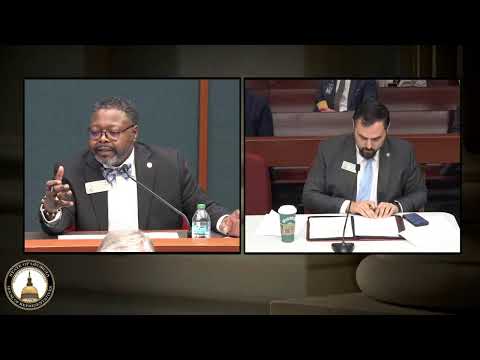
Committee advances HB 947 to tighten SNAP verifications and expand fraud powers
Loading...
Summary
The House Agriculture & Consumer Affairs Committee passed a substitute to HB 947 after testimony on fraud, verification timelines and technology; the bill phases in stricter verifications, gives broader subpoena authority to the inspector general and calls for legislative oversight and a requested appropriation to support implementation.
The House Agriculture & Consumer Affairs Committee on Thursday advanced a substitute to House Bill 947, a measure the sponsor said is intended to tighten verification of Supplemental Nutrition Assistance Program (SNAP) recipients and strengthen fraud-investigation authority.
Representative Montahan, the bill sponsor, told committee members the substitute (working draft LC461440S) strengthens the inspector general's role on SNAP-related subpoenas, clarifies that the measure does not create a private right of action against the state and phases in verification requirements for certain low- or zero-income cases. "It's not to cut benefits. It's to make sure that more families have more nutritious food," Montahan said.
The bill sets implementation dates to give the Department of Human Services (DHS) time to hire staff and adapt systems: expedited verification timeframes and categorical adjustments will not come into effect until Jan. 1, 2029, the sponsor said, while a primary-vehicle exclusion related to an asset test would take effect Jan. 1, 2027. Montahan told the committee the substitute also requires reporting back to the legislature during rollout to maintain oversight.
Testimony from stakeholders highlighted competing priorities. Kathy Kozova, president of the Georgia Food Industry Association, said retailers support technology upgrades to reduce fraud and noted the program's scale: "We have 1,400,000 Georgians. That's 1 in 8 Georgians that receive food stamps, SNAP benefits," she said, urging adoption of chip-and-pin technology and customer education on locking EBT cards.
Advocates and policy analysts urged caution over expanded documentation and asset reviews. Ife Finch Floyd of the Georgia Budget and Policy Institute said provisions that would reintroduce an asset test or limit broad-based categorical eligibility could increase administrative burden and error rates. "This provision could either increase error rates or create several challenges to the state," Finch Floyd said, citing training needs and the risk that new processes will generate mistakes.
Cindy Battles of the Georgia Coalition for the People's Agenda, part of the No Empty Plates coalition, said the substitute's language could require documentation from non-applicants in mixed households and risk disrupting benefits for children in shared housing situations unless the language is tightened.
Lawmakers pressed the sponsor on fiscal and operational questions, asking how Georgia will meet federally expected error-rate reductions and who will fund needed staffing and technology. Montahan said the legislature is "seeking an appropriation" to help DHS meet those needs but acknowledged the appropriation is not yet in the bill text. DHS staff present said the agency will implement the General Assembly's will while noting federal constraints on certain automation efforts.
On alleged fraud, the substitute expands investigative authority for the inspector general to pursue subpoena power in SNAP-related investigations, a change the sponsor said stakeholders requested to reduce benefit theft by outside bad actors. Stakeholders also offered to share the recent U.S. Department of Agriculture Office of Inspector General report and retailer best practices on skimming and cloning.
Representative Jasper moved to pass the committee substitute to House Bill 947; the motion was seconded and passed by voice vote. The chair announced the bill "passes on the rules," sending it to the rules committee for further consideration.
Next steps: the substitute now goes to the rules committee; sponsors and witnesses said further work will be needed on funding, training and technical fixes during the bill's remaining legislative process.