
Committee votes 9‑7 to table PFAS reporting bill after debate over scope and redundancy
Get AI-powered insights, summaries, and transcripts
Subscribe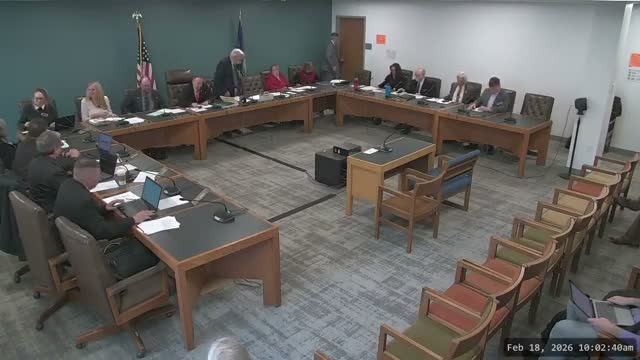
Summary
The Resources, Recreation and Development committee voted 9‑7 to rule HB 1258 inexpedient to legislate after members debated a six‑month PFAS reporting requirement, redundancy with existing DES data, and concerns about biosolids exposure; an amendment was offered to preserve public access to environmental health data.
A legislative committee voted 9‑7 to rule HB 1258 — a bill that would require expanded reporting of per‑ and polyfluoroalkyl substances (PFAS) and public health data — inexpedient to legislate, after members argued the proposal was duplicative, costly and insufficiently targeted.
Representative Donnelly moved the ITL motion and said he was "very conscientious about PFAS," but that the bill’s six‑month reporting frequency and broad scope created "a significant concern" over overhead and expense. He told the committee that the Department of Environmental Services (DES) already maintains searchable PFAS information online and described the bill’s requirements as "redundant." The motion was seconded by Representative Goole.
Representative Vail, who opposed the ITL, introduced an amendment (spoken in the hearing as "0 7, 9 6") intended to address concerns raised in testimony and to preserve public access. Vail said the legislation "reflects a simple principle" that when the state collects health‑relevant environmental data it "should remain accessible, usable, and reliable for communities, clinicians, and public health professionals who depend upon it."
An unidentified member (recorded in the transcript as Speaker 6) pressed a separate point about biosolids — treated wastewater sludge spread on farmland — saying that biosolids are not clearly covered by the bill or by DES’s public materials. That speaker cited cases in Central Maine where farms were shut down and food‑safety orders were issued after PFAS contamination was detected in milk, and urged at minimum an interim study rather than an outright ITL.
The chair cited a DES letter dated 02/17/2026 and the bill’s fiscal note as reasons to support ITL, and closed debate. After a roll call the ITL motion passed 9 to 7. Representative Vail filed a minority report.
What it means: The committee’s ITL ruling leaves existing DES reporting in place but removes the immediate prospect of the statute specified in HB 1258. Supporters of stronger statutory reporting signaled interest in further work with DES or an interim study to address gaps such as biosolids monitoring.
The committee did not adopt the amendment on the floor; further procedural steps (minority report or reintroduction in amended form) were possible next steps according to members’ comments during the hearing.