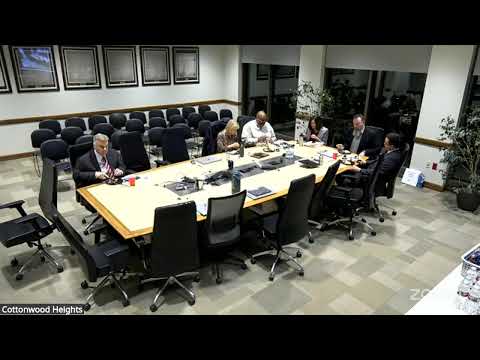
Cottonwood Heights discusses $2.1M federally funded MILO training range, safety and siting
Loading...
Summary
City staff and police described a modular MILO training facility funded by a $2.1 million DOJ COPS equipment grant; the council debated location tradeoffs, environmental controls, ongoing maintenance costs, potential rental revenue and whether additional fee and business-plan details are needed before committing to siting decisions.
City Manager Jared Herbert and public safety leaders briefed the council on Feb. 17 about a federally funded modular firearms training facility that would combine live-fire lanes with MILO scenario-based simulators.
Herbert and police staff said the city was awarded approximately $2,100,000 in equipment funding through the DOJ’s COPS program; staff emphasized that the award is categorized as equipment funding for public safety and requires no local match. The modular design would allow the city to place pre-fabricated ‘Connex’-style units configured for six live-fire lanes plus simulator spaces and a central control room.
Police staff explained the safety and environmental controls built into the proposed system: negative-pressure ventilation, pre-filters and HEPA filtration, and a lead-recovery trap that funnels casings into sealed containers for pickup by an authorized vendor. Staff gave a range of annual operating-cost estimates for filters and maintenance, noting a quoted annual replacement estimate of roughly $17,400 before lead resale credits and an approximate net replacement cost in some scenarios closer to $4,000–$15,000 depending on resale values.
Council members raised several concerns: proximity to schools and residences, audible noise, long-term maintenance and staffing costs, and public notice of the project. Staff said two siting options are under consideration: adjacent to the police station (operationally preferred but with an estimated drainage rerouting cost of about $200,000) or west of City Hall (lower civil-work cost, roughly $40,000). A concrete pad for the modular unit was estimated at about $110,000. Staff also said community donors have expressed interest in covering some incremental siting costs.
On training specifics, police staff said the MILO system allows scenario-based use-of-force training plus live-fire qualification, alleviating scheduling pressure at other county ranges. They said frangible (non-lead) ammunition is an option but would roughly double ongoing ammo costs (presented estimates: ~$40,000 versus ~$80,000 annually for frangible). Staff noted that requiring frangible only might limit renters and that maintaining strict controls over ammunition type would be operationally challenging.
Several councilors asked for a fuller business plan including an annual P&L, conservative revenue assumptions for rentals, staffing obligations and insurance costs before making siting or policy commitments. Council members also requested documentation of prior public notices and agenda citations regarding the project; staff said they would provide records of earlier council communications and retreat notes.
What’s next: staff proposed a site visit to an operating facility and suggested bringing a fee study and detailed business plan back to council for deliberation prior to a formal siting decision.