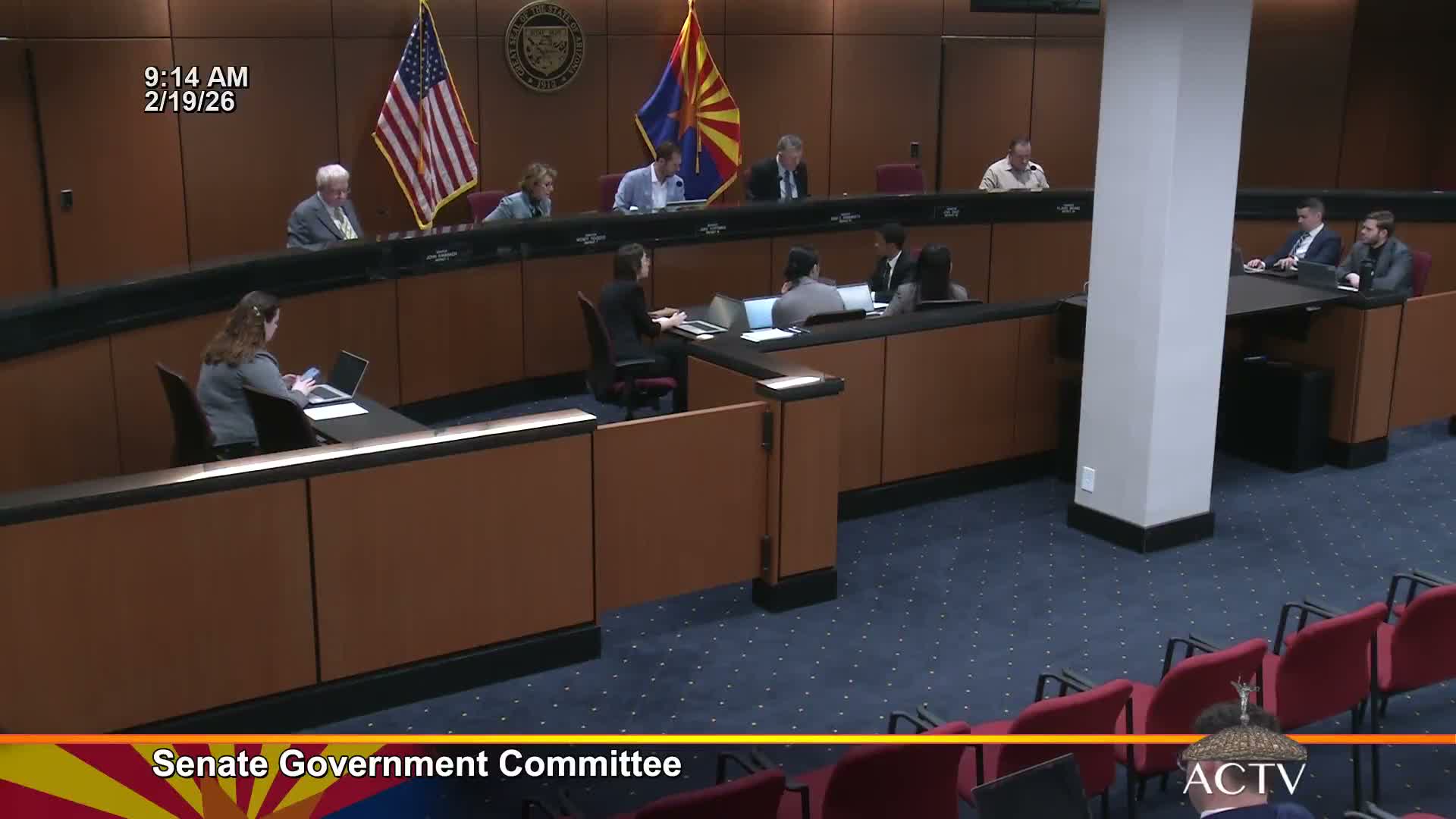
Senate committee adopts amendment to require 60% of district operating spending go to teacher pay; committee gives due‑pass 4–3
Loading...
Summary
The Arizona Senate Committee on Government adopted a strike‑everything amendment to SCR 1032 that would, if approved by voters, require school districts to direct at least 60% of operational spending to teacher pay beginning in fiscal 2028; supporters cited Auditor General findings, opponents raised concerns about impacts on small and special‑education services. The committee recommended the measure due‑pass, 4–3.
The Arizona Senate Committee on Government on Feb. 17 adopted a strike‑everything amendment to SCR 1032 that would require each school district to dedicate at least 60% of its operational spending to teacher pay, beginning in fiscal year 2028, and gave the amended measure a due‑pass recommendation in a 4–3 vote. The committee meeting focused solely on the proposed change and related testimony.
The amendment, described in staff comments as a three‑page "strike everything" substitute dated Feb. 17, 2026 (03:58 p.m.), also phases in compliance: districts that spend less than 60% on teacher pay must increase the portion each year until compliant; staff explained the amendment calls for annual increases of one‑and‑one‑half percent until a district reaches 60%. The staff summary said the Auditor General would determine compliance, and that unexpended Classroom Site Fund (CSF) monies distributed to a noncompliant district would revert to the CSF while the district remained ineligible for further CSF distributions until the Auditor General found compliance. Joint legislative budget staff would be directed to adjust CSF per‑pupil calculations to exclude students from districts ineligible for CSF distributions under the amendment.
Supporters said the measure responds to long‑standing concerns about how district dollars are allocated. "Arizonans support transparency and accountability with our tax dollars," Nathan Duell of Heritage Action told the committee, arguing that ‘‘less than half the funding school districts receive goes towards teacher pay’’ and that administrative growth has outpaced classroom spending. Matt Bienberg, director of education policy at the Goldwater Institute, cited the Auditor General’s analysis, saying the share of district funding reaching teachers has fallen even as per‑student spending has risen; he quoted the Auditor General’s finding that "if districts had continued spending their non‑CSF monies in the classroom at the same rate they did prior to receiving CSF monies, teacher salaries would have been about $7,500 higher on average." Lisa Brugg of the Center for Arizona Policy said the share going to instruction has dropped to "just over 52%," the lowest since tracking began in 2001, and urged voter control via the ballot measure.
Opponents raised operational and equity concerns. Mark Barnes of the Rural Arizona School Coalition warned small, rural districts could struggle to meet a 60% floor; he described one district’s finance review that showed roughly 41% of spending on teacher salaries and benefits and said reaching 60% "would take a couple decades" and would likely force cuts to other required services. Several senators on the committee questioned whether imposing a rigid percentage without additional funding could require districts to shift money away from student support services, counselors, nurses and special‑education supports. One senator said special education and other legally required services often sit outside "teacher pay" and would be at risk under a strict percentage requirement.
The hearing included a contested exchange about charter schools. A committee member asked whether charter schools would be covered; the sponsor said charter operators are "private businesses" chartered by the state and therefore not the target of the amendment, while another senator on the dais responded that state statute defines charter schools as public schools. The transcript records this as a disagreement and does not show any amendment language changing charter‑school coverage.
The committee adopted the strike‑everything amendment after a motion to adopt; the transcript states "The amendment is adopted." The committee then moved to consider SCR 1032 as amended and recorded votes. Senators recorded in the transcript as voting no were Bravo, Diaz and Kiwi; Senators recorded as voting yes were Farnsworth, Gabbard, Rogers and Hopkins. The clerk announced the committee vote as four yeas and three nays, giving the amended measure a due‑pass recommendation.
The meeting adjourned after the vote. There is no recorded final action in the transcript beyond the committee’s due‑pass recommendation; any further steps (full Senate consideration or placement on a public ballot, as the amendment is subject to voter approval) would occur later and are not detailed in the committee transcript.