Get Full Government Meeting Transcripts, Videos, & Alerts Forever!
Get email alerts on the Early Childhood Enrollment topic
No spam. Unsubscribe anytime.
How to enroll in Connecticut’s Early Start program: eligibility, documentation and attendance rules
Summary
An OEC informational video outlines how program managers should match children to Early Start spaces, verify age, residency and income, track attendance to maintain reimbursement, and update forms for OEC/ECE reporting.
A presenter in an Office of Early Childhood informational video laid out the steps Connecticut early childhood programs should follow to enroll children in Early Start–funded spaces, covering space types, documentation, income rules and attendance requirements.
The guidance centers on three priorities for matching a child to an Early Start space: the contract’s space type, the child’s eligibility and the family’s need. "Space types are outlined in your contract and in general policy a o 6," the presenter said, and programs must align a child’s assigned space with the age and service hours specified in that contract.
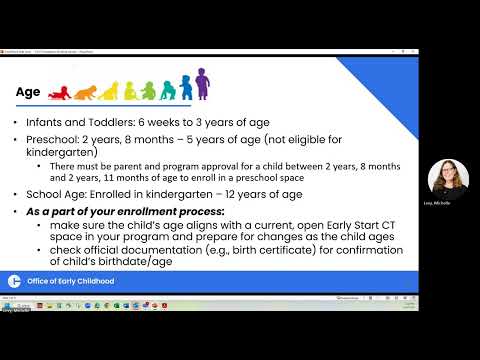
The video gives concrete eligibility and documentation rules. Programs must confirm a child’s age with a birth certificate; for children born outside Connecticut families have eight weeks to provide the certificate. "If a family is unable to provide a birth certificate, a valid nonexpired passport may be used to confirm the child's legal name and birth date," the presenter said. Non-English birth certificates should be accompanied by an English translation.
Income and residency requirements were also emphasized. "The current requirement for early start is that 60% of families enrolled fall at or below 75% of the state median income level," the presenter said, and programs must document family income and track the percentage that meet that threshold. Connecticut residency must be documented; the presenter added that families from Massachusetts, New York and Rhode Island who have childcare subsidies usable in Connecticut are eligible.
The video details attendance rules tied to reimbursement and ongoing eligibility. "To be reimbursed for a space for a given month, a child must have attended the program at least 1 day that month," the presenter said, and a child may not fall below that minimum for more than two months in any fiscal year. The presenter translated that into schedules: programs operating a 12‑month schedule should expect attendance in at least 10 months at minimum thresholds, and 10‑month schedules should expect at least eight months of attendance for ongoing eligibility.
Programs were advised to review enrollment forms and reporting practices to capture required data — race, IFSP/IEP status, income and space-type assignments — and to ensure reporting to OEC and the ECE reporter. The presenter recommended establishing internal processes to verify income, calculate family fees, and track spaces and openings against contracted types.
The video concluded by directing programs to the OEC website for general policies and advising them to contact their Early Start liaison or their OEC assigned program manager for case-specific questions. "For more information and to find the general policies, you can visit our website at www.ctoec.org," the presenter said.
The guidance is presented as administrative instruction for program managers; it does not record any votes or formal board actions.