Get Full Government Meeting Transcripts, Videos, & Alerts Forever!
Get email alerts on the Community Health Workers Policy topic
No spam. Unsubscribe anytime.
Connecticut webinar spotlights community health workers’ growing role, certification progress and Medicaid reimbursement planning
Summary
At a webinar hosted by the Connecticut Office of Health Strategy, state and national presenters described the CHW role, cited evidence of cost savings and health gains, reviewed Connecticut’s certification milestones and said a 2023 law directed the Department of Social Services to design Medicaid reimbursement for CHW services.
Rachel Resnick, a program lead at the Connecticut Office of Health Strategy, hosted a webinar that reviewed the evolving role of community health workers (CHWs), the research supporting their use, and ongoing state work to design Medicaid reimbursement.
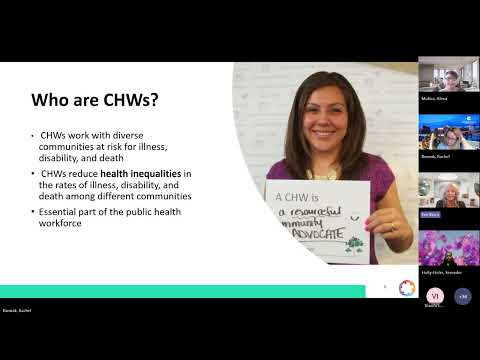
The session emphasized practical results and policy steps. ‘‘Community health worker is a frontline public health worker…a trusted member of and or has an unusually close understanding of the community served,’’ said Eve Berry, president of Eve Berry and Partners Consulting, defining the scope of CHW work as liaison, outreach, education and advocacy. Rachel Resnick described a 30‑year body of peer‑reviewed studies and said OHS is assembling a resource compendium that will link to CHW effectiveness research.
Why it matters: presenters argued that integrating CHWs into care teams improves outcomes and reduces costs. Resnick summarized published findings that CHW interventions commonly show improved diabetes and hypertension management, better medication adherence and, in clinical settings, fewer hospital admissions and emergency department visits. She said studies often report a return on investment of approximately 2:1 to 4:1.
State progress and outstanding issues: panelists reviewed Connecticut milestones. Eve Berry traced national and state developments, noting C3 Project core competencies were adopted into Connecticut training standards and that certification passed in 2019 and began implementation in 2020. ‘‘In 5 years, 500 certified CHWs,’’ Resnick said when asked about current certification counts; she noted the overall CHW workforce in Connecticut is larger, including many who are not formally certified.
The webinar also covered practical barriers to professionalization. Resnick said certification involves fees and continuing‑education requirements and warned those costs and variable state certification standards can limit transferability and access. She said OHS is working to expand low‑ or no‑cost continuing education and to track local needs.
Medicaid reimbursement design: Resnick told attendees that the legislature passed a bill in 2023 directing the Department of Social Services to design and implement Medicaid reimbursement for CHW services. She outlined services commonly considered by other states and by the draft design—care coordination, system navigation, prenatal support, health promotion and coaching for self‑management—and invited public input as the state develops billing and program rules.
Next steps and public participation: Resnick announced the CHW advisory body meets quarterly and said the next meeting is Thursday, Dec. 4 at 10:00 and is open to the public; she encouraged CHWs and employers to participate and to submit comments via OHS channels. Panelists recommended public‑facing outreach—PSAs, a Connecticut CHW YouTube channel and podcasts—to clarify CHW roles to health partners and the public.
The Office of Health Strategy plans additional webinars and said it will share the recorded session on the OHS YouTube page and distribute the OHS resource compendium when available.