Lifetime Citizen Portal Access — AI Briefings, Alerts & Unlimited Follows
OEC training: How providers should calculate family fees for Early Start Connecticut
Loading...
Summary
A recorded Early Start Connecticut training from the Office of Early Childhood walked providers through the documentation and math to determine weekly family fees for state-funded early care spaces, including use of the OEC fee schedule, the online calculator (07/01/2025 schedule) and rules for Care for Kids certificates and shared spaces.
Unidentified Presenter, a presenter for the Office of Early Childhood (OEC), led a training explaining how providers must determine weekly family fees for children enrolled in Early Start Connecticut-funded spaces. The session covered what documentation to collect at enrollment and annually, how to calculate gross annual income, how to use the OEC fee schedule and online calculator, and special rules for Care for Kids certificates and children who share a full-time space.
Why it matters: family fees determine out-of-pocket costs for households and must be applied consistently across families. The OEC requires providers to notify families which documents they will accept, to document their calculations, and to follow the OEC fee schedule published in general policy B01.
How providers should determine a fee: the presenter said the three necessary inputs are family size, the family’s gross annual income and the child’s space type. "The family fee is the weekly fee charged to a family by the program for each child enrolled in a state funded space," the presenter said. The session defined family size to include a parent, the parent's spouse and minor children living together; legal guardians count as parents, and in some cases (for example, children in DCF foster care) a child may be treated as a family of one.
Acceptable documentation and attestations: providers may accept a family’s most recently filed federal or state tax return, payroll stubs (a month’s worth), or an employer letter. If a family or guardian claims no income, programs should request a written attestation; whether to require notarization is up to the provider but must be applied consistently.
Calculating income: to annualize pay‑stub income, add the gross amounts from the submitted stubs, divide by the number of stubs to obtain an average weekly gross, then multiply by 52 to produce annual income. Providers may adjust the math based on pay frequency but must document the rationale and apply it consistently.
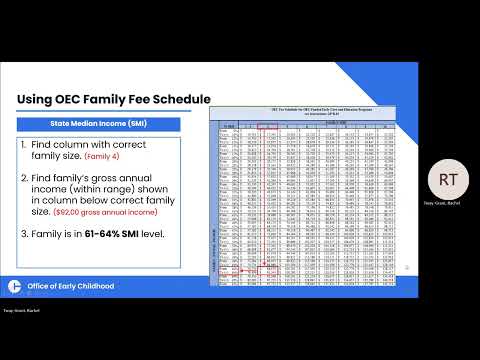
Using the fee schedule and computing the weekly fee: once the three inputs are known, the provider locates the family-size column and the income range on the OEC fee schedule in general policy B01 to find the percentage of annual income to charge for the space type. "You should always round up to the nearest whole dollar for the final weekly fee to be charged," the presenter said. In the session’s worked example, a family of four with $92,000 gross annual income enrolling two children (Bluey in full-time preschool; Bingo in half-time infant/toddler) fell into the 61–64% SMI range; applying 8% produced an annual fee that divided by 52 returned $141.54 weekly, which the presenter rounded to $142.
Online calculator and recordkeeping: the OEC’s online family fee calculator (on the ECE Reporter homepage) uses the same fee schedule; the presenter demonstrated selecting the 07/01/2025 fee schedule and entering the example family data to obtain $141.54, which matched the manual calculation. The presenter noted that any information captured by the family fee calculator must be kept on file for the child if the provider uses that tool.
Care for Kids certificates: if a child has an active Care for Kids certificate, the fee printed on the back of that certificate is the fee the provider must charge. If the certificate expires or becomes inactive, providers should revert to the OEC fee schedule calculation.
Shared full‑time spaces: for two children sharing a full‑time space, providers must (1) calculate each child’s full‑time weekly fee separately using that child’s family data, (2) determine each child’s percentage of space use (for example, 27 hours/week = 63%; 16 hours/week = 37%), and (3) multiply each child’s full‑time weekly fee by their percentage to derive each child’s final weekly charge.
Resources and contact: the presenter demonstrated where to access the instructions, the SMI chart and the fee schedule tabs within the online calculator and closed the session by asking providers to contact their Early Start program manager with questions. "As always, please reach out to your early start program manager with any questions," the presenter said.