Get Full Government Meeting Transcripts, Videos, & Alerts Forever!
Get email alerts on the Early Childhood Assessment topic
No spam. Unsubscribe anytime.
Office of Early Childhood details assessment rules, family-reporting steps for programs
Summary
The Office of Early Childhood outlined state requirements and OEC policy AO2 that programs must use assessment tools aligned to Connecticut standards, partner with families at least twice a year, and report assessment tools monthly in ECEReporter; family-friendly summaries and staff training are required.
An Office of Early Childhood presenter said programs must assess young children “in partnership with families at least twice a year” and report assessment tools monthly in the state ECEReporter system, citing state legislation and OEC general policy AO2.
The guidance, the presenter said, aims to strengthen family partnerships, promote best practices in early childhood assessment, and create consistency across OEC-funded programs while helping the agency plan professional learning opportunities.
Under OEC general policy AO2, programs are required to use an assessment tool aligned with the Connecticut Early Learning and Development Standards, identify the tool in their records, and provide written information to families explaining the program’s assessment processes. “You will report in the assessment and developmental screening tools used by your program on a monthly basis as a part of completing the monthly report,” the presenter said. Programs must also provide a family-friendly written summary of assessment results and offer families the opportunity to meet to discuss their child’s progress.
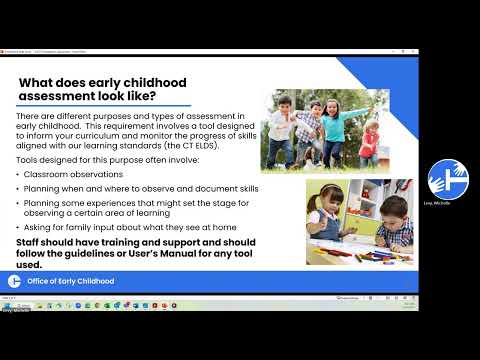
The presenter emphasized proper tool selection and use: screening instruments and ongoing assessment tools serve different purposes and should be used only for their intended roles. Effective tools may rely on classroom observation, planned experiences to elicit specific skills, and family input, the presenter said. Staff implementing assessments must receive training and follow the tool’s user manual and supporting guidance.
On reporting mechanics, the presenter described ECEReporter fields where programs will indicate which ongoing assessment tool they use, select any developmental screening tools employed, and attest to the accuracy of their initial submission. The presenter noted that three partnership-related questions in individual child records — providing a written summary, inviting a family meeting, and whether a meeting occurred — are “automatically set to no,” and should be updated to “yes” when each action occurs; the month and date will be recorded when a program sets the answer to yes.
The Office of Early Childhood also offered resources for programs, including a white paper and infographic on screening and assessment, a form to request printed copies of the Connecticut Early Learning and Development Standards, a flyer with free trainings, and contact information for OEC program managers. For family child care providers, the presenter pointed to family child care networks as local supports.
Programs should review their assessment tools, ensure staff training and family communication are in place, and update ECEReporter monthly to reflect current practices. The presenter closed by thanking providers for partnering with families to support young children’s learning and development.