Get Full Government Meeting Transcripts, Videos, & Alerts Forever!
Get email alerts on the Early Start Contracting topic
No spam. Unsubscribe anytime.
OEC outlines steps, deadlines for Early Start Connecticut contractors
Summary
Connecticut's Office of Early Childhood told newly awarded Early Start providers to register in Core-CT, the Secretary of State business registry and CTsource, complete SP-26MB and the OEC pre-contract form, and submit required documents by Jan. 12; first payment will follow contract execution.
State officials with the Connecticut Office of Early Childhood (OEC) used a pre-contract information session to walk newly awarded Early Start Connecticut providers through registration, contracting and payment steps.
"Congratulations for a successful application to become an Early Start provider," said Kyle Pylon, manager of the OEC grants and contracts team, opening the session and outlining how attendees will get the slide deck, tip sheets and answers to submitted questions after the presentation.
Why it matters: these steps enable vendors to receive state payments and comply with contract terms. OEC staff emphasized that timely registration and accurate legal names on paperwork are essential for payment and for avoiding reconciliation that could reduce future payments.
What OEC told providers
Registrations and forms. Contractors must register as suppliers in Core-CT (the state's payment system) and complete two forms sent with award letters: SP-26MB (which contains the agency vendor form and a W-9) and the OEC pre-contract form. OEC warned providers to ensure the legal business name matches across documents.
Deadlines and contacts. OEC said all forms and confirmation of award acceptance are due Monday, Jan. 12, and should be emailed to the address on page 2 of the award letter or to the assigned grants-and-contracts specialist (listed as Lindsey, Annette or Irma).
Optional steps that help with payments. Creating an e-supplier account is not required but helps organizations track payments; OEC strongly recommended enrolling in direct deposit to speed payment processing.
Other required registrations. Providers must register with the Connecticut Secretary of State Business Registry (business.ct.gov) and maintain contract documents in CTsource, the state's repository for active contracts and required contractor documents. OEC said it will provide tip sheets for both processes.
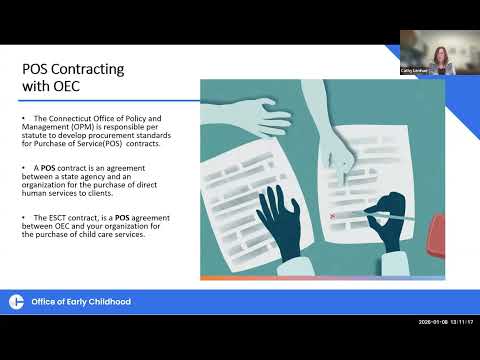
Contract structure and nonnegotiable terms. OEC described the Early Start contract as a Purchase of Service (POS) agreement. Kathy, director of the grants and contracts unit, said the Early Start contract template has been preapproved by the Office of the Attorney General and therefore cannot be modified for individual contractors. The contract is organized into Part 1 (service-specific items such as definitions, service descriptions, budgets, reporting and program administration) and Part 2 (standard state terms and conditions developed by the Office of Policy and Management and included in all state contracts).
Policy and quality requirements. By signing, contractors attest to follow OEC general policies, which OEC publishes and updates on its website. Those policies cover staff qualifications, reporting, eligibility and enrollment, reimbursement, quality assurance, children with IEPs, fee schedules and rules on underutilized spaces. OEC also described quality-assurance requirements, including alignment with Connecticut's early-learning expectations, contractor evaluations and required training.
Budget, payments and reconciliations. OEC said each contract will include an individualized budget showing the number of spaces and annual amounts per space. Kathy said the first payment is made "upon execution of the contract" after signatures are collected and the contract is uploaded so fiscal can process the first payment. OEC will reconcile payments against utilization and, if an overpayment is found, will either reduce future payments or require funds be returned.
Audit and record retention. OEC highlighted audit and record-retention rules, noting that contractors receiving more than $500,000 in state financial assistance must submit a single-state audit; smaller recipients should follow the exempt-notification process described in the contract.
Signature and campaign certification requirements. OEC advised contractors to flatten or remove signing restrictions from DocuSign or similar services so the commissioner's signature can be applied; printed and scanned signatures are acceptable. Separately, contractors should complete the State of Connecticut Campaign Contribution Certification (OPM Form 1): for contracts over $50,000 that form must be notarized and uploaded to CTsource (the contract itself does not require notarization).
Help and next steps. OEC staff encouraged providers to reach out to their assigned grants-and-contracts specialist with paperwork questions, and noted the Women's Business Development Council is a business-support partner for child-care programs. OEC said it will email the slide deck, tip sheets, the recording and answers to submitted Q&A after the session.
The session closed with OEC reiterating the Jan. 12 submission deadline and offering further assistance as providers finalize contracts.