Get Full Government Meeting Transcripts, Videos, & Alerts Forever!
Get email alerts on the Medicaid Maternity Case Rates topic
No spam. Unsubscribe anytime.
Connecticut DSS, Mercer outline PY2 maternity bundle case-rate refresh, phase in clinical and social risk adjustments
Summary
The Department of Social Services and Mercer presented updates to the Husky maternity bundle case-rate methodology—phasing in Johns Hopkins ACG clinical risk and an ADI social-risk add-on, applying credibility blends for low-volume practices, and keeping doula ($14) and lactation ($7) add-ons—while asking providers to submit written feedback by Nov. 21.
The Connecticut Department of Social Services and its vendor Mercer outlined proposed updates to the Husky maternity bundle case-rate methodology during a public forum, saying the changes aim to better align payments with patient acuity while limiting year-to-year disruption.
Fatmata Williams, deputy Medicaid director, opened the session and handed the presentation to Mercer’s technical team. Sean Theal Sachs of Mercer framed the goals as improving maternity health, reducing disparities and tying payments to performance and quality measures. Caroline Scott, Mercer’s case-rate lead, walked attendees through the stepwise PY2 refresh and a multi-year phase-in of risk adjustment.
Scott said the program will move toward a 50/50 risk-adjusted target price over multiple years and that the PY2 implementation will apply one-sixth (1/6) of the budget-neutral risk adjustment, with one-third in PY3 and one-half in PY4. "Our goal is to move towards a 50 50 risk adjusted case rate over 3 years. For year 2, we're going to implement 1 sixth of the rate being subject to the risk adjustment," Scott said.
Mercer actuary Eileen Bennett described the technical elements: the team will use the Johns Hopkins Adjusted Clinical Groups (ACG) to assign clinical risk scores and add a social-risk component using the Area Deprivation Index (ADI). Under the ADI adjustments described, members in ADI decile 9 receive a +0.1 addition to their risk score and ADI 10 receive +0.2. Bennett emphasized that the risk adjustment is budget neutral. "Risk adjustment is budget neutral," Bennett said.
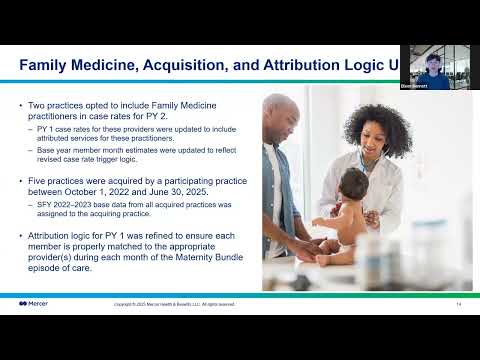
Scott and Bennett explained other PY2 changes: two practices opted to include family medicine practitioners in their case-rate attribution (which may lower per-case rates but increase the volume of case-rate payments), the team updated attribution logic and accounted for several practice acquisitions, and they repriced 2022–23 claims to the current fee schedule with minimal net impact.
The presentation also covered credibility and emerging-acuity adjustments. Under the current State Plan Amendment (SPA) rules, a practice must have 30 maternity episodes in a performance year to be eligible for a standalone case rate; practices with fewer episodes are blended with the statewide average. Scott showed a credibility example and said some small-practice blends were necessary for PY2 because of limited experience during the base period.
Add-on payments remain unchanged for PY2: providers that opted into doula services will receive a $14 per-member-per-month add-on and lactation support remains a $7 add-on. Using Mercer’s illustrative example, one fictional practice saw a net PMPM increase of $1.26; on average across participating practices Mercer reported an average PMPM decrease of $1.12, a change primarily attributable to family-medicine attribution updates.
During Q&A, a question raised in the chat by Dr. Koppel asked why some practices with higher acuity still had lower-than-average PMPMs. Scott replied that the original PY1 case rates were calculated from historic fee-for-service claims and therefore were not risk-adjusted; the refresh is intended to move payments gradually toward projections based on acuity. An unidentified participant asked how long it would take higher-acuity providers to see materially higher payments; Scott reiterated that the phased approach is intended to limit annual disruption while shifting money toward higher-acuity members over time.
Tiffany (moderator) closed the meeting with logistical instructions: all presentation materials will be posted to the Department of Social Services website and written feedback on PY2 case rates must be submitted to Kim Osno at CHN by November 21 using the subject line "maternity bundle p y 2 case rate feedback," and include the provider's practice name and TIN. Practice-specific rate questions will not be taken on this call but can be addressed in follow-up meetings on request.
Next steps: DSS will post slides and materials to its website, Mercer will incorporate submitted feedback into the case-rate process, and staff will offer practice-specific follow-up as requested. The forum concluded with a reminder of the November 21 hard deadline for written feedback.