Get Full Government Meeting Transcripts, Videos, & Alerts Forever!
Get email alerts on the Supplemental Housing Package topic
No spam. Unsubscribe anytime.
Washington governor proposes $244 million supplemental housing package, adds $55 million for flood relief
Summary
Governor Ferguson unveiled a proposed $244,000,000 supplemental housing investment that includes $55,000,000 for flood-damaged home rehabilitation and a $225,000,000 Housing Trust Fund infusion to build or preserve more than 4,000 housing units; he also signed an executive order to form a Department of Housing task force.
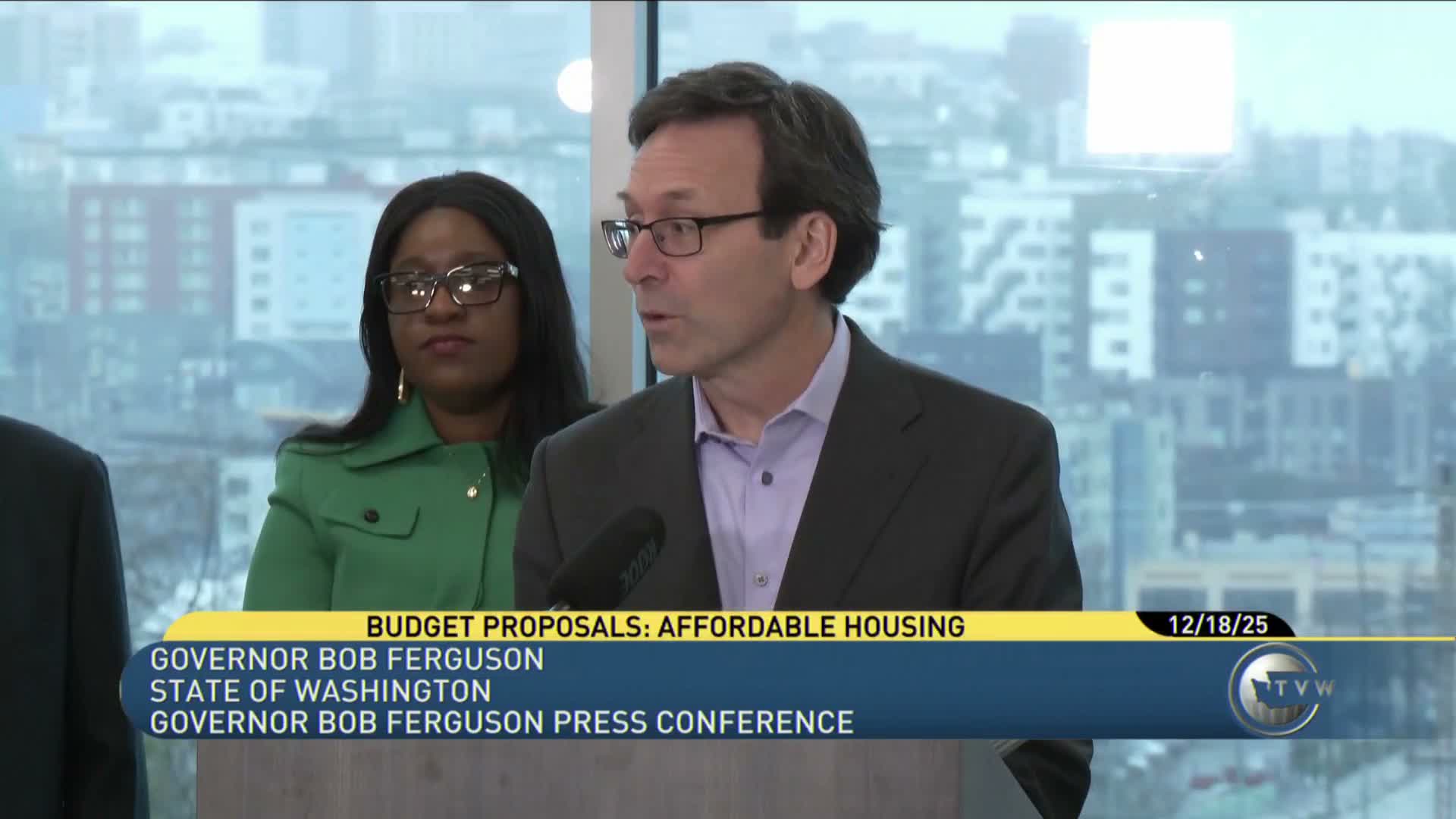
Governor Ferguson onstage at Beacon Pacific Village in Seattle announced a proposed $244,000,000 supplemental housing investment and a set of immediate flood-relief measures aimed at preserving and expanding affordable housing across Washington.
The package, which Ferguson said his team will send to the state legislature as a supplemental budget request, includes $55,000,000 earmarked for rehabilitation and preservation of housing harmed by recent flooding. "There is $50,000,000 to the Housing Trust Fund preservation program," Ferguson said, and the administration has expanded the program "to include repairs for flood-damaged homes." He added $5,000,000 would go to grant funding under the Low Income Home Rehabilitation Grant Program to help lower-income homeowners repair flood damage, with priority for families with young children, seniors and veterans.
Ferguson said the broader supplemental proposal adds $225,000,000 to the state's housing trust fund to accelerate development and preservation. He and his budget team described the breakdown as including $50,000,000 for preservation, $20,000,000 to acquire and preserve mobile and manufactured home communities (which the governor said would prevent displacement of about 400 households), $81,000,000 to develop roughly 2,000 new affordable rental units and $73,000,000 to build 664 first-time homebuyer units. Ferguson said an additional $11,000,000 in grant funding is proposed (including the $5,000,000 flood relief), with $6,000,000 to modernize permitting systems to speed up housing development.
"My philosophy is you got a crisis, act like it's a crisis," Ferguson said, describing housing as the administration's top priority. He said the budget was largely complete when the recent storm hit, and that the administration adjusted priorities to direct some of this supplemental funding to the state's flood response and recovery.
Office of Financial Management director Katie Chevensey told reporters that most of the proposed investments are in the capital budget and would be funded through state bonds, with smaller portions from dedicated funds, a small amount from the general fund and some Climate Commitment Act dollars for building-efficiency investments.
Ferguson said the supplemental package is intended as both an immediate "down payment" for needs the state can identify now and a bridge while the state pursues federal disaster relief. He told attendees the administration had "scrubbed" prior capital budgets and identified limited leftover bond capacity to prioritize housing projects without large cuts to other capital priorities.
The governor also announced he signed an executive order to create a task force to prepare for establishing a cabinet-level Department of Housing; he said the executive order begins planning and that legislation will follow to create a housing agency and to help local governments buy land and adjust zoning where needed.
Officials emphasized this is a proposal that still requires legislative action. The administration described two near-term procedural steps: (1) introduce "early action" legislation that would allow the legislature to consider flood-relief funding promptly at the session start, and (2) submit the supplemental budget request to the legislature for consideration.
The event included remarks from Lieutenant Governor Denny Heck and Housing Development Consortium executive director Patience Malaba, who praised the investments while warning that federal funding shifts could threaten operating support for affordable housing. Malaba and others urged attention to operating dollars as well as capital investments.
Next steps: the governor will submit the supplemental budget proposal and early-action flood relief request to the legislature; those proposals must pass the legislature and return to the governor for final approval before funds are disbursed.