Get Full Government Meeting Transcripts, Videos, & Alerts Forever!
Get email alerts on the State Budget topic
No spam. Unsubscribe anytime.
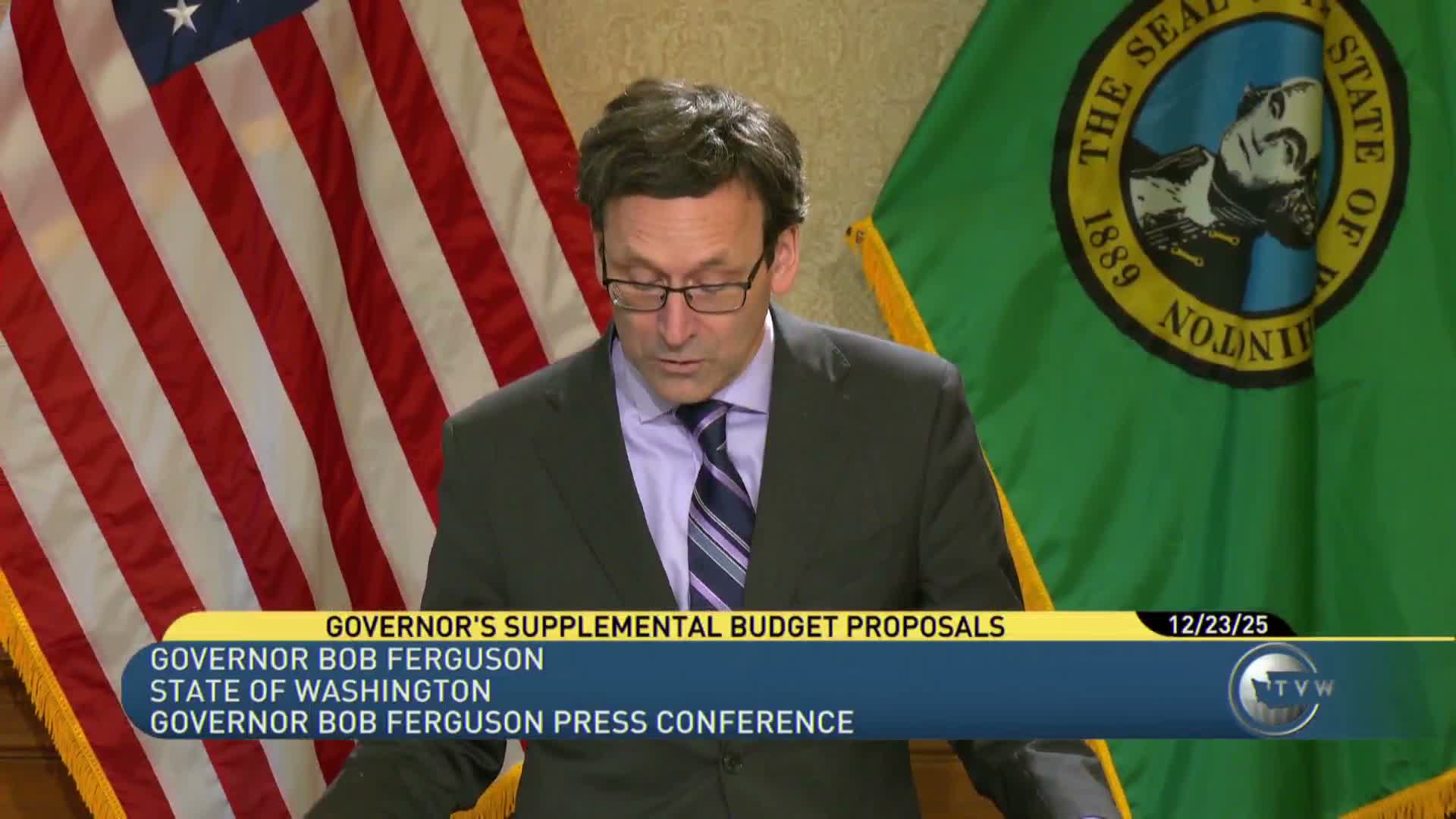
Governor proposes two-year supplemental budget using rainy day fund, cuts and redirected revenues
Summary
The governor proposed a two-year supplemental budget through June 30, 2027, that balances a roughly $2.3 billion net shortfall with Rainy Day Fund transfers, repeals of select tax breaks, use of unspent funds and agency reductions while preserving key programs such as the Working Families Tax Credit.
The governor on Wednesday outlined a supplemental two-year budget that would carry the state through June 30, 2027, seeking to close an estimated $2.3 billion shortfall by using $1 billion from the Rainy Day Fund, reclaiming unspent state funds and cutting nearly $797 million in agency spending.
The governor said the plan is balanced and does not raise taxes, noting, "My proposed budget is balanced. It does not raise taxes." He described targeted investments in transportation, housing and public health — including $1,000,000,000 for three new ferries, $2,100,000,000 for roads and bridges, and $244,000,000 in housing — while preserving core services such as K–12 education.
Why it matters: State officials say falling revenue, rising costs and federal policy changes drove the shortfall. The governor told reporters the administration funded $700 million of agency critical requests and then recommended a mix of policy and one-time fixes: repeal limited corporate tax breaks (including ending certain data-center sales-tax exemptions and a preferential B&O rate for prescription-drug wholesalers), redirect about $123 million in unspent funds, and deploy $1 billion from the Rainy Day Fund.
Key details: The governor said the state received about $142,000,000 in higher-than-expected revenue collections after his submittal, but added, "By law, I cannot put that $142,000,000 in my budget." He said that extra revenue will be available for the legislature to consider. The proposal also relies on temporarily shifting capital gains tax allocations and other non-tax resources, and delays or caps planned program expansions to reduce spending growth.
The budget keeps several targeted affordability measures in place by using Climate Commitment Act (CCA) auction revenues: the submittal uses $569,000,000 in CCA dollars to maintain the Working Families Tax Credit and leaves about $130,000,000 for new climate-impact investments, such as $30,000,000 in clean-energy credits (designed to provide a one-time $200 credit to low-income households) and $33,000,000 to expand home energy assistance for households at up to 80% of area median income.
What was not decided: The governor said agencies must manage to reduced budgets and that officials have not finalized the full scope of potential job impacts, adding that no furloughs are proposed in the submittal but job losses could occur as agencies adjust to smaller appropriation levels.
Next steps: The submittal now goes to the legislature, which can use the newly reported $142,000,000 in revenue and will consider the governor's proposed changes. The governor said he has already discussed the plan with legislative leadership and expects continued negotiations during the short session.