Get AI Briefings, Transcripts & Alerts on Local & National Government Meetings — Forever.
Economic and Revenue Forecast Council approves updated revenue forecast, cites tax timing and stronger receipts
Summary
The Economic and Revenue Forecast Council approved a February 2026 revenue forecast that raises near‑term revenue estimates after stronger taxable sales, early implementation of tax changes and a large unclaimed property payment. The council approved the forecast by voice vote with no roll call.
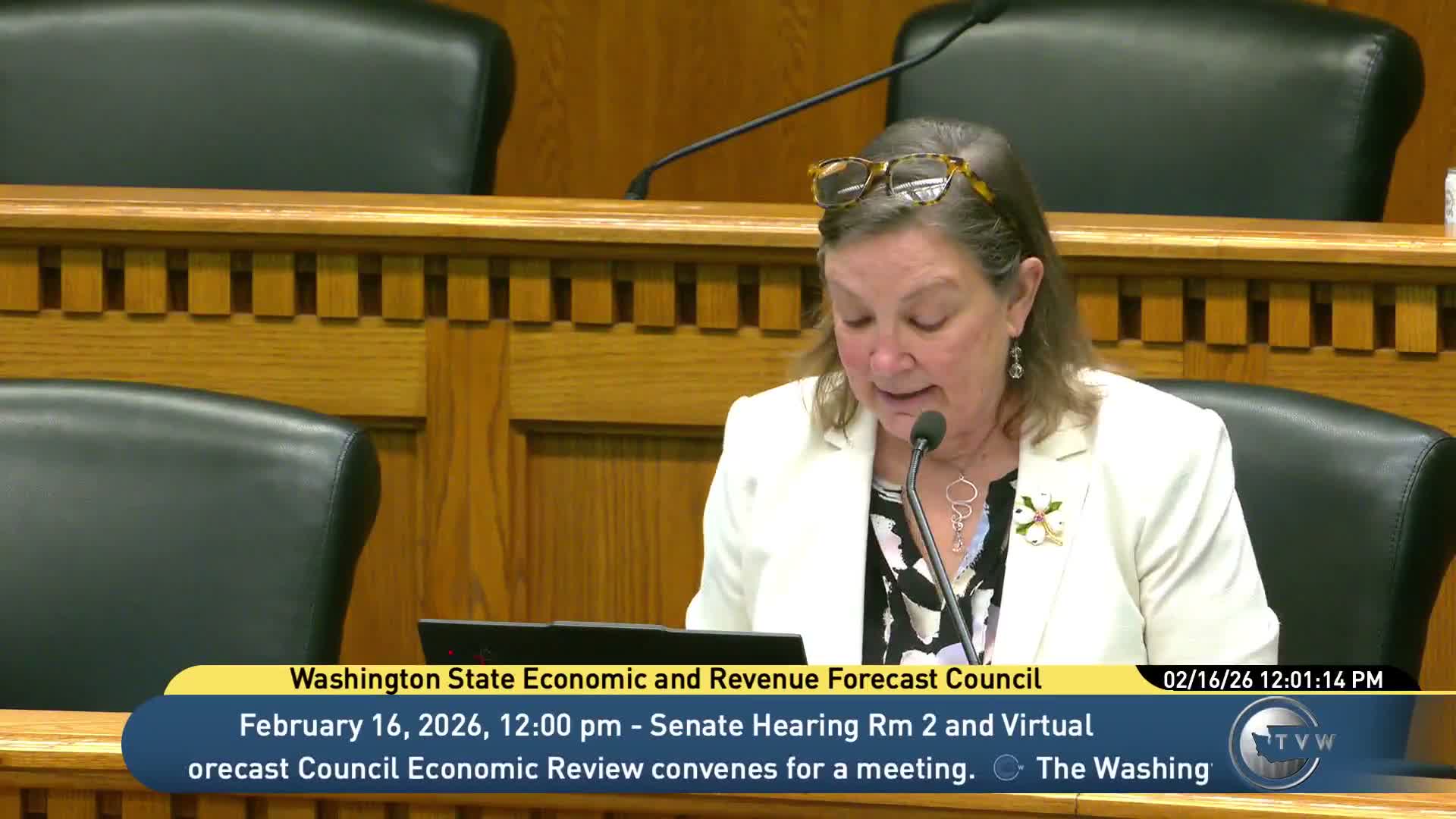
The Economic and Revenue Forecast Council approved an updated state revenue forecast on Feb. 16, 2026, projecting higher receipts in the current and upcoming biennia driven by stronger taxable sales, legislative tax changes and a large one‑time payment.
Dave Reich, executive director of the Economic and Revenue Forecast Council, said the council entered the update “about 3.9% or $340,000,000 above” the prior baseline and that the update produces an estimated increase of about $827,000,000 (roughly 1.1%) for the current biennium. He said the next biennium (2027–29) shows an increase of about $1,028,000,000 (about 1.3%) compared with the previous baseline.
Reich attributed the upward revision to three factors: tariff‑related early buying that boosted 2025 receipts, legislation enacted in 2025 that increased sales and Business & Occupational (B&O) tax rates, and a return of revenues to better match economic activity. He also flagged a large, one‑month unclaimed‑property receipt and a very strong reading for use tax collections in the most recent month as contributors to the revision.
On fund specifics, Reich said the change to the general fund forecast is about $656,000,000. He noted that roughly $340,000,000 of that figure ‘‘is money that’s already in the door’’ and that some portion—about $180,000,000—reflects the earlier than expected implementation of a change to the B&O tax that began in October instead of January.
Reich described the broader macro picture as a modest improvement from November: slightly stronger U.S. and Washington GDP, lower inflation than previously expected in some measures, and a small upgrade to employment prospects for 2026. He emphasized persistent risks, particularly trade policy and tariffs, and noted the council provides optimistic and pessimistic alternative scenarios that could swing revenues by billions depending on tariff outcomes and other shocks.
The council moved and seconded approval of the forecast as presented. The Chair called for a voice vote; members answered “Aye,” and the Chair declared the forecast approved. No roll‑call vote was recorded.
The council did not receive substantive public or member questions after the presentation and moved to staff updates before adjourning.