
Legislative update: data-sharing bill advances; state privacy bill stalls
Get AI-powered insights, summaries, and transcripts
Subscribe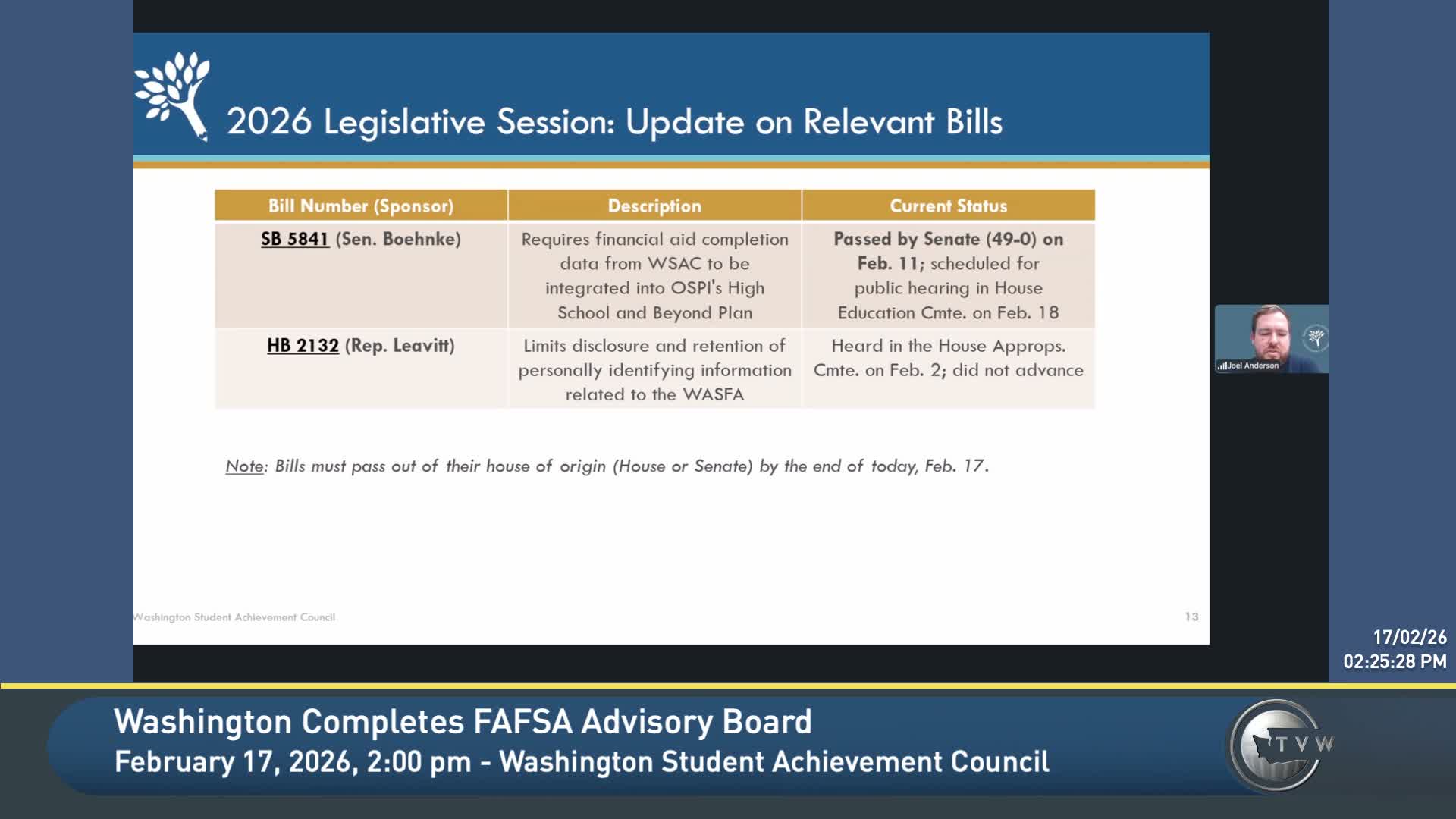
Summary
WASAC's legislative staff reported that Senate Bill 5841 — now amended to require WASAC–OSPI data sharing of FAFSA/WASFA completion status — passed the Senate and is scheduled for a House Education hearing; House Bill 2132, which would have limited WASFA data retention/disclosure, died in committee.
Julie Anderson, associate director of legislative and external affairs, briefed the advisory board on two bills that could affect the campaign’s work.
Anderson said Senate Bill 5841 was amended and "no longer requires financial aid completion, but instead requires the sharing of financial aid completion status between WASAC and OSPI for a student's high school and beyond plan." In its amended form the bill passed the Senate unanimously on Feb. 11 and was scheduled for a hearing in the House Education Committee. Anderson said WASAC included a request for implementation funding in the bill’s fiscal note so the agency can build the data‑sharing pathway and update platforms to show a student’s completion status regardless of whether they file FAFSA or the state WASFA.
Anderson also summarized House Bill 2132, which would have limited the disclosure and retention of personally identifying information filed on the WASFA. That bill received a public hearing in the House Appropriations Committee on Feb. 2 but did not advance. Anderson said fiscal cost and feasibility concerns — including the complexity of deleting or retaining records and the implications for financial aid packaging and trend‑tracking — were among the reasons it stalled.
Board members discussed monitoring SB 5841’s progress and the fiscal note for implementation funding. Anderson offered to take questions via chat and to continue advising the advisory board as the legislation moves through committee.