
WASAC advisory board: FAFSA/WASFA completions at 40% but equity gaps persist
Get AI-powered insights, summaries, and transcripts
Sign Up Free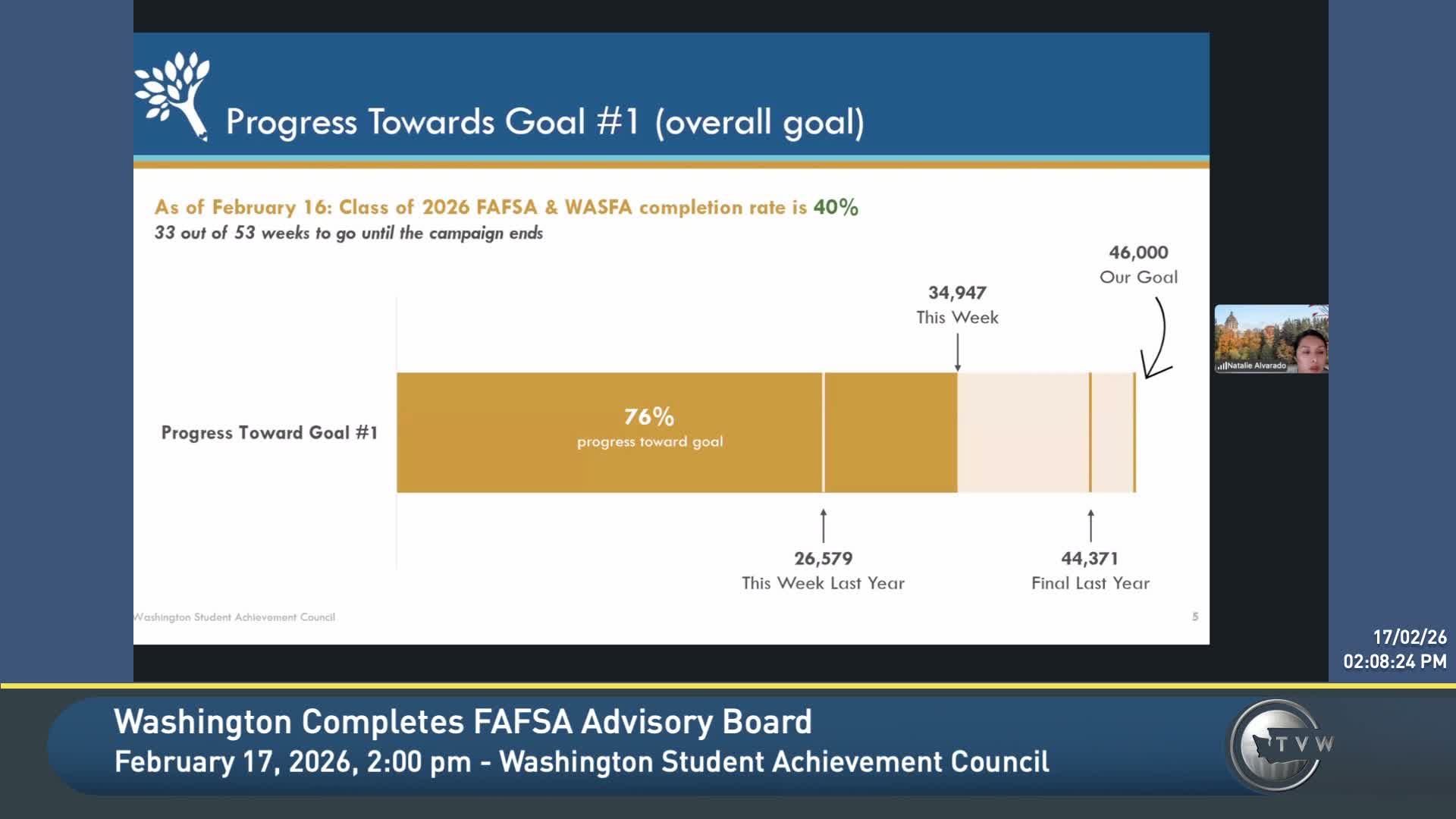
Summary
WASAC staff told the advisory board the class of 2026 is 40% complete with FAFSA/WASFA as of Feb. 16, putting the campaign roughly 76% toward a 46,000-completion goal, while disparities by FERPA status and race/ethnicity widened and prompted targeted outreach plans.
Natalie Alvarado, with WASAC, told the advisory board on Feb. 16 that the class of 2026’s FAFSA and WASFA completion rate stood at 40%, with 34,947 submissions recorded so far. That places the Washington Completes FAFSA campaign at roughly 76% of its 46,000-completion statewide target.
Alvarado said the campaign is 33 weeks into a 53-week cycle and urged partners to preserve weekly momentum. “Going forward, our focus is maintaining at least 1,000 new FAFSAs each week,” she said, citing a January average of about 1,161 weekly completions.
Despite rising totals, Alvarado and other staff emphasized persistent equity gaps. The completion gap between FERPA-eligible and non-FERPA students widened to about eight percentage points (FERPA students 34% vs. non-FERPA 42% as of Feb. 16), and the campaign’s equity gap score by race and ethnicity was 2.59 — meaning the subgroup with the highest completion rate files at more than 2.5 times the rate of the lowest group. Alvarado called out Asian students at 52% and Native Hawaiian/Pacific Islander students at 20% as examples of disparity.
Advisory members and school staff described common barriers that contribute to those gaps: families who assume students won’t qualify for aid, students who plan non-college paths without realizing FAFSA can support trade or credential programs, and technical matching or data‑lag issues that delay dashboard updates. WASAC staff said FAFSA matches typically appear in their dashboard within one to two business weeks but that mismatched identifiers (for example, differing birthdates or name spellings) can create delayed or potential matches that require manual review.
Board members and staff urged targeted, human-centered outreach to reach students furthest from completion, including one-on-one help, expanded language access, partnerships with local colleges and navigators, and aligning FAFSA completion with scholarship application outreach. The board plans to use weekly data to prioritize schools closest to the 6% growth threshold for free/reduced-price-lunch students and to concentrate supports where small conversion gains will push schools over the target.
The advisory board did not take any formal votes at the meeting. Leaders asked members to carry outreach and toolkit materials back to their communities and to report back progress before the next meeting.