
Council adopts February transportation revenue forecast after ERFC reports $101 million near-term shortfall
Get AI-powered insights, summaries, and transcripts
Subscribe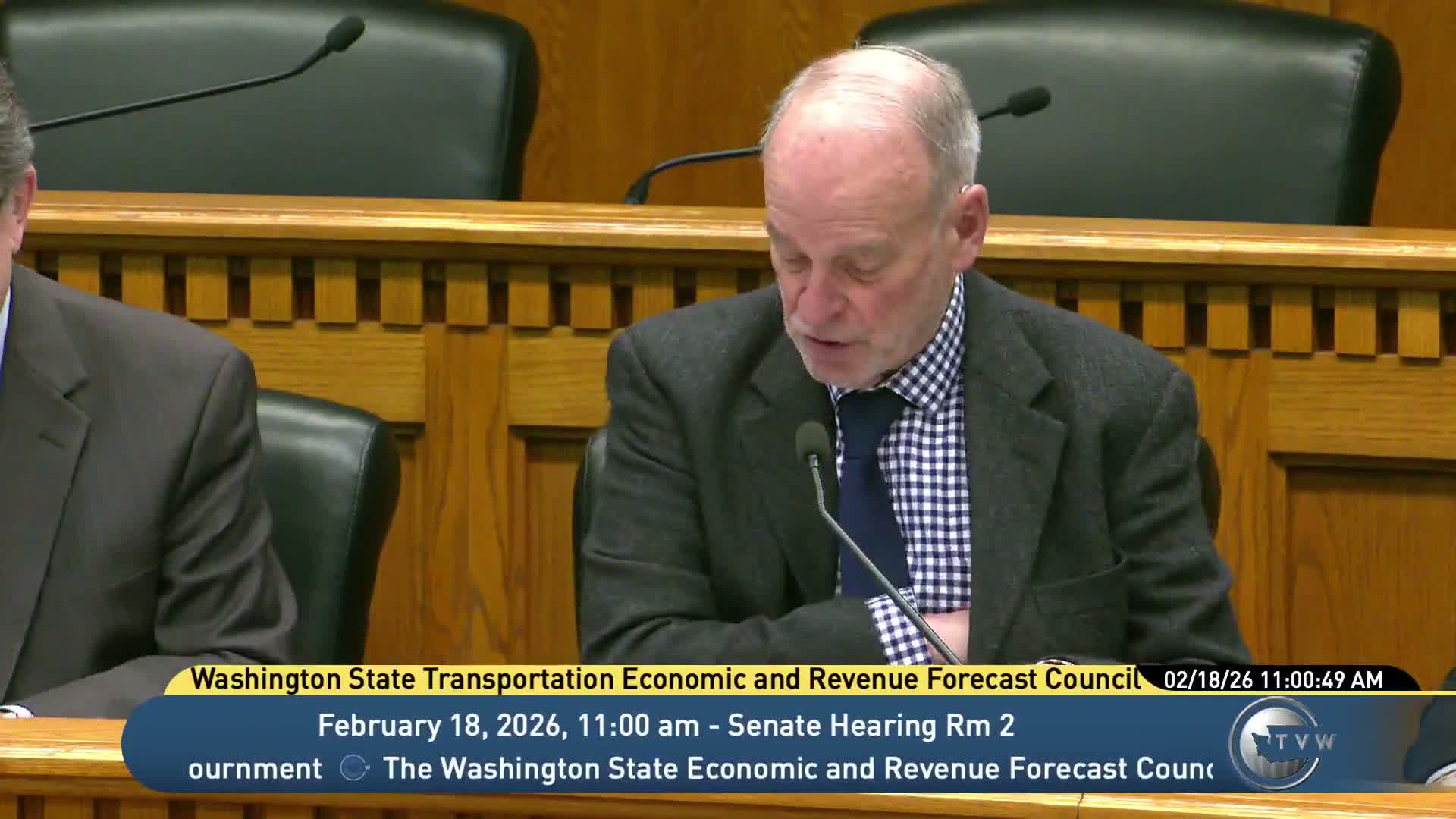
Summary
The Transportation Economic and Revenue Forecast Council approved a February revenue update that trims state transportation receipts by about $101 million in the current biennium and $86 million in the next, driven mainly by lower fuel consumption, falling registrations and data irregularities after a Department of Licensing system change.
The Transportation Economic and Revenue Forecast Council adopted its February update to the state transportation revenue forecast after staff reported lower-than-expected receipts driven primarily by fuel consumption and vehicle registration changes and flagged a data irregularity tied to a Department of Licensing system change.
For the current biennium, ERFC Executive Director Dave Reich said, "we've reduced the forecast by $101,000,000 by 1.1%." He said the next biennium's forecast is lower by about $86,000,000 (about 0.8%). Reich attributed roughly two-thirds of the current-biennium decline to reduced gas-tax receipts and cited about $28,000,000 in lower license and permit revenues.
Why it matters: transportation revenues fund roads, ferries, toll programs and related capital planning; a smaller forecast narrows projected resources available to deliver projects and affects planning assumptions for future budgets. Reich also warned of continued external risks, including trade policy, tariffs and federal spending uncertainty.
Key findings and drivers: ERFC updated national and state economic inputs and found modest improvements in employment and personal income forecasts, but offsetting effects from reduced fuel consumption and fewer vehicle registrations. Reich described a Department of Licensing software change that produced volatile treasury distribution patterns and said ERFC is "switching to a different data source, the DOL data source on actual consumption" while working with DOL to reconcile distribution timing and levels. He said revenues derived from distributions were "a little bit on the low side" pending resolution of the discrepancy.
Reich also reported sector-level changes: gasoline consumption was lowered slightly, special fuels saw modest reductions, and combined motor-fuel tax plus EV-fee revenues show a different growth profile following 2025 Legislature changes (including a 2% annual adjustment). ERFC noted increased electric-vehicle registrations (about a quarter-million EVs statewide at the end of fiscal year 2025) but said EVs remain a small share of the 7 million vehicles registered statewide.
Other updates included a modest near-term bump in ferry revenues (about $2.3 million increase for the current biennium) and no change to toll forecasts overall, though the SR 509 toll facility is performing above initial expectations. ERFC left the federal funding forecast unchanged for this update but flagged that the Infrastructure Investment and Jobs Act expires in September, making federal support a risk to monitor.
Exchange highlights: Senator Lias asked how quickly a Supreme Court change to tariff policy would affect consumer prices and activity; Reich said long-run effects are positive but short-run outcomes are uncertain because of refund processes and possible replacement tariffs. Representative Barkas asked whether DOL data can be broken down regionally; Reich said the finest resolution available is "to the rack," not individual stations, and that ERFC models gross gallons (before refunds). Sarah King asked whether ERFC can identify unpaid car tabs; Reich said ERFC tracks overall registration levels but that specifics about unpaid tabs are a Department of Licensing matter.
Action and next steps: A motion to accept the February transportation forecast was moved, seconded and approved by voice vote. Council members did not record a roll-call tally in the transcript; the motion passed and the meeting adjourned.
The council will continue to monitor DOL data reconciliation, federal funding developments and economic risks that could alter the revenue outlook in subsequent ERFC forecasts.