Get Full Government Meeting Transcripts, Videos, & Alerts Forever!
Get email alerts on the Conservation Agriculture Transport topic
No spam. Unsubscribe anytime.
Applicants press conservation, agriculture and transportation as linked priorities in Pitkin County interviews
Summary
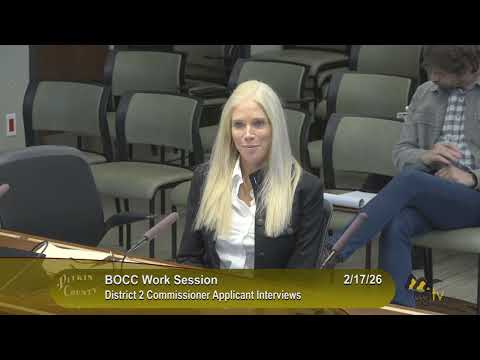
During follow‑up questioning Feb. 17, many District 2 applicants urged stronger conservation tools, protection for agricultural water and land, and transportation planning that directs growth into town centers to preserve open space and wildlife habitat.
A focused discussion after the Feb. 17 interview series pushed conservation, agriculture and transportation to the forefront of the District 2 appointment conversation in Pitkin County.
Commissioners said the earlier round of interviews had been city‑centric and asked candidates to address conservation, wildlife habitat, the role of agriculture and the Crystal River Valley specifically. Scott Woolley, citing his environmental‑policy background and work on local boards, urged expanded use of buybacks and partnerships with organizations such as the Aspen Valley Land Trust to keep key parcels in conservation. "I think there's more room for that," Woolley said, urging community land‑trust ideas and coordinated purchases.
Several applicants argued that directing density into urban growth boundaries and improving transit helps protect agricultural land and wildlife habitat. Charlie Tarver said a finite transportation system can "direct growth and protect agriculture," arguing that density in town centers saves surrounding open land. Max Ben Hamill described agriculture as both an economic and educational asset and suggested more programs to connect youth to farming.
Candidates raised water‑rights protections and long‑term strategies for ranches and farms. Tom Egan and others asked how the county will prevent parcel fragmentation when ranch ownership transitions across generations; candidates suggested deeper, long‑term engagement with landowners to design solutions. The board highlighted recent county and partner purchases — including a multi‑county acquisition called 3 Meadows Ranch — as examples of conservation work the county has pursued.
Wildlife and trail impacts were another theme. Applicants recommended a balanced approach to trail building that recognizes effects on winter ranges and calving areas and suggested limiting trail expansion in sensitive habitats or creating designated trail growth zones similar in effect to urban growth boundaries.
The exchange concluded with commissioners asking staff to consider how to fold these topics into public outreach and the upcoming appointment process so the candidate ultimately selected will be prepared to engage on conservation, agriculture and valleywide transportation.